Northern Italy is not one fishery but a string of valleys, each with its own river, its own association and its own rules, and the best way to read it is the way the water does, from the mountains down. Trentino has the clear limestone rivers. Alto Adige has the cold granite and gneiss valleys. Lombardy has the big Alpine trout rivers off the Rhaetian Alps and the Adamello. Veneto and Friuli have the Dolomite torrents and the great braided Tagliamento, with marble trout in all of them. Valle d'Aosta has the glaciers. This guide is a map of that country, season by season, and it leaves the permits to the people who issue them.
Limestone for clarity. Granite for cold. Glaciers for the early start.
Northern Italy: A Country of Valleys
The first thing to understand is that there is no such thing as Italian trout fishing. There is Trentino, with its clear limestone rivers and its permit-driven beats. There is the Aurino in the granite of the Tauferer Ahrntal, and the Passirio coming down off the gneiss to Merano. There is the Tagliamento, braided and unconfined, and the Dolomite torrents of the Piave basin. Each is its own small country, usually with a local association behind it.
This guide is about where to go, what each kind of water is, and who to ask. It works by region, west and north to east, and leaves tactics to the playbooks. The thread running through all of it is the marble trout, a native fish worth handling gently, and the habit of checking local rules before you pick up the rod.
Trentino: Clear Limestone and Permit-Driven Beats
Sarca, Avisio, Noce and Brenta: clear water that rewards close observation.
The Sarca runs clear over limestone and into Lake Garda, with marble trout in the main river and brown trout and grayling in its tributaries. The clarity rewards fine presentation, and both Euro nymphing and dry-dropper work. Its beats are permit-driven, so find out who issues what before you arrive.
The Avisio comes through the Fiemme and Fassa valleys with brown and marble trout, and some sections are shaped by hydro releases. It fishes well on dry fly during caddis hatches when the light is right. The Noce, in the Val di Sole, has a snowmelt character that sets its fishing window: the upper river is excellent once the spring runoff settles, with marble trout, brown trout and grayling for those who can manage a clean drift.
The Brenta in the Valsugana is wider than most Trentino streams, with mixed runs, pools and riffles, brown and marble trout and some grayling. It fishes well when levels settle. The smaller Adige tributaries are more intimate limestone streams, with beat-specific permits through the Trentino associations. For stillwater, Lake Molveno sits at 864 metres in the Brenta Dolomites, with brown trout and char, bank and boat fishing both possible; check local permits and stocking status.
Alto Adige: Granite and Gneiss Valleys
Cold, hard, grey-green water in valleys that feel nearer to Austria than to Rome.
The Aurino comes off the Rieserferner group and runs about fifty kilometres through the Tauferer Ahrntal to the Rienza near Bruneck. It is granite country, and the water is cold, hard and clear over boulders. The valley has a real reputation among Italian fly anglers.
The Passirio drops from the Timmelsjoch to the Adige at Merano, down the Val Passiria over gneiss and mica schist, clear, quick and faintly green in the deeper water. The Rienza drains the Val Pusteria from the Sexten Dolomites, through Lake Dobbiaco and on to the Isarco at Bressanone. By the lower stretches it is a proper valley river with long flat glides where patient dry-fly work pays.
Lombardy: Adda, Oglio and Serio
Big Alpine water in Valtellina, marble trout in Val Camonica, and pocket water in Val Seriana.
The Adda through Valtellina is big-water Alpine trout fishing: wide gravel runs and long glides fed by snowmelt and glacier off the Rhaetian Alps above Bormio. Around the beats at Tresenda and Piateda it carries brown trout, marble trout, hybrids and grayling; release rules for marble trout apply, so ask the association what you may keep.
The Oglio runs the length of Val Camonica off the Adamello massif, cold and remarkably clear. It is marble trout water first, with good numbers between Ponte di Legno and Darfo Boario Terme, holding in the deeper glides where the valley floor flattens. Grayling here are fully protected, so release rules apply; ask the association.
The Serio starts with the Cascate del Serio and settles into schist-bedded freestone water with brown trout, marble trout and grayling through Val Seriana. It is smaller and more intimate than the Adda or the Oglio, and properly pocket-water fishing.
Veneto: The Piave and Its Dolomite Tributaries
Marble trout water through Belluno, and two Dolomite torrents that feed it.
The Piave is a long river, and the stretch that matters for fly fishing runs through Belluno down to Longarone. Cold, clear limestone current carries marble trout, with brown trout on the seams and grayling in the Belluno currents for anglers patient enough to spot them. It is a big river with a gorge temperament, so read it in sections.
The Cordevole, the Piave's main tributary, runs from near Passo Pordoi through Lake Alleghe and down the Agordino. Wild brown and marble trout hold in the pocket water and glides below Alleghe, under the local association's rules, which are among the stricter in the region. Read them in full before you go.
The Boite is the other principal tributary: a forty-five kilometre Dolomite torrent through Cortina d'Ampezzo and Cadore to the Piave at Perarolo. It is narrower and more technical than the Piave, with tight corridors through spruce forest and wild brown trout throughout. Marble trout show occasionally where the valley opens out.
Friuli: Tagliamento, Fella and Natisone
A braided Alpine river that still moves, and its two clearest neighbours.
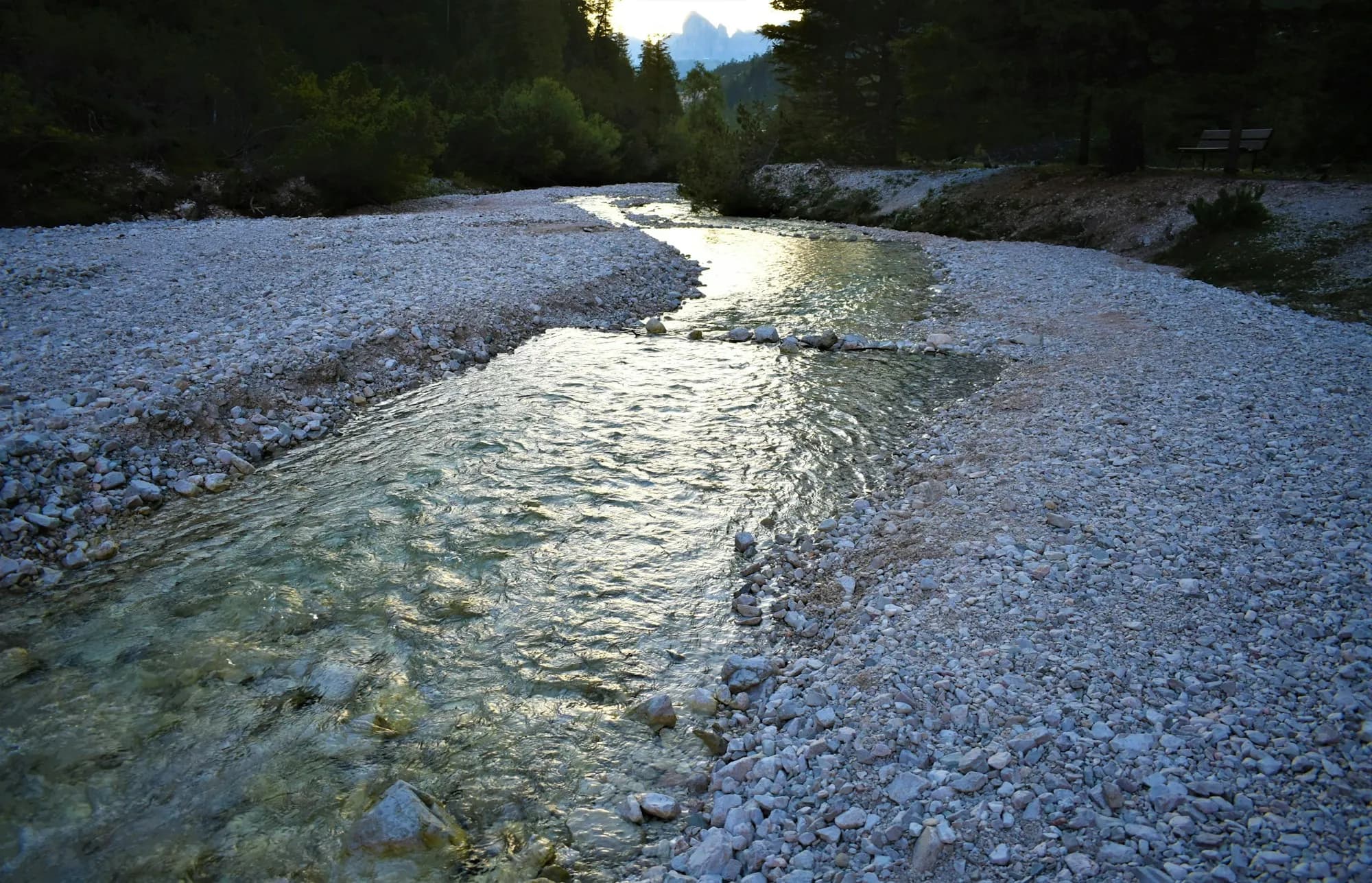
The Tagliamento is Friuli's great braided river and the last in the Alps that still behaves like a gravel-bed river should, splitting and cutting new channels after every flood. The middle reaches through Carnia and past Venzone hold marble trout and grayling in clear, cold water. Read the braid rather than a single channel.
The Fella is its principal tributary, dropping through Val Canale and the Canal del Ferro over pale limestone cobbles, clearer than the river it joins. Marble and brown trout hold in the pocket water and pool tails around Moggio Udinese. Grayling were once dense here but never recovered after the 1994 flood, so treat any as a bonus.
The Natisone is a limestone-and-marl river on the Slovenian border, running near Stupizza through gin-clear gorges to Cividale del Friuli. Because it is a border river, confirm which country's permit covers the bank you plan to fish. Marble trout have historically spawned here in real numbers, alongside brown trout and grayling. The no-kill water around Cividale is respected marble trout fishing, and its rules deserve a careful read.
Valle d'Aosta: Glaciers and Managed Reserves
Meltwater rivers that fish best early in the day and in the shoulder months.
The Dora Baltea gathers itself from glaciers under Mont Blanc and Monte Rosa, and by the middle valley below Aosta is a wide, deceptively even-paced river. The no-kill reach through Chambave, Fenis, Nus, Saint Marcel and Verrayes runs for about nine and a half kilometres over sand and bedrock sills, and it is the waded-hundred-yards kind of water that looks easier than it is.
The Lys comes off its own glacier below the Lyskamm and runs about forty kilometres down the Gressoney valley to Pont-Saint-Martin. In summer it runs white with meltwater by mid-afternoon, so fish it early or in the shoulder months. A managed reserve sits above Gressoney-La-Trinité.
The Ayasse leaves Lago Misérin at the head of the Champorcher valley and runs about twenty-four kilometres to the Dora Baltea near Hône: a mountain torrent, clear year-round bar the odd coloured hour after heavy rain. A managed tourist reserve sits above the village. Check the reserve rules and stocking arrangements with the managers before you go.
The Italian Alpine Year
Snowmelt and glaciers set the calendar. Read the river before you read the date.
Winter: expect little fishing. Most trout waters in the Alpine valleys are closed in winter, and marble trout are spawning in the cold months, so any winter fishing is on specifically permitted waters, such as some managed reserves. Ask the local association before you assume anything is open.
Spring: snowmelt shapes the window. The upper Noce fishes well once runoff settles, and the Brenta, which fishes when levels settle, and the Avisio, with its caddis, come on as the water clears. The glacial rivers are still carrying meltwater, so the Lys and the Dora Baltea are best taken as the water allows.
Summer: glacial rivers such as the Lys run white with meltwater by mid-afternoon, so fish them early. Cold water fed from the high ground, in the granite valleys of Alto Adige and the Lombard rivers off the Adamello and the Rhaetian Alps, is the natural place to look. The Trentino lakes warm; check species and methods locally.
Autumn: the glaciers are no longer running hard, which suits the Lys and the other meltwater rivers, and the clear limestone rivers of Trentino, Friuli and Veneto reward fine presentation while they are open. Seasons commonly close in late September or October, depending on region and water, and marble trout spawn on some of these rivers in late autumn, so check the closing date and any protected reaches before you fish.
Gear, Permits and Getting About
A nine-foot four- or five-weight, fine tippet, and a local association to ask.
A nine-foot four- or five-weight handles most of this water. Fine tippet suits the clear limestone rivers, and a longer leader or a Euro nymphing set-up helps on the pocket water of the Dolomite torrents. Wading boots with good grip earn their keep on bouldery beds, and on the braided Tagliamento a wading staff helps.
Fishing licences and day permits are issued at regional and provincial level and often through the local fishing association, and the rules differ from valley to valley. Check the regional or provincial rules, the association and the venue page for the water you plan to fish. Base yourself in a valley town such as Bruneck, Merano, Belluno, Cividale or Aosta and let the local association tell you what is open.