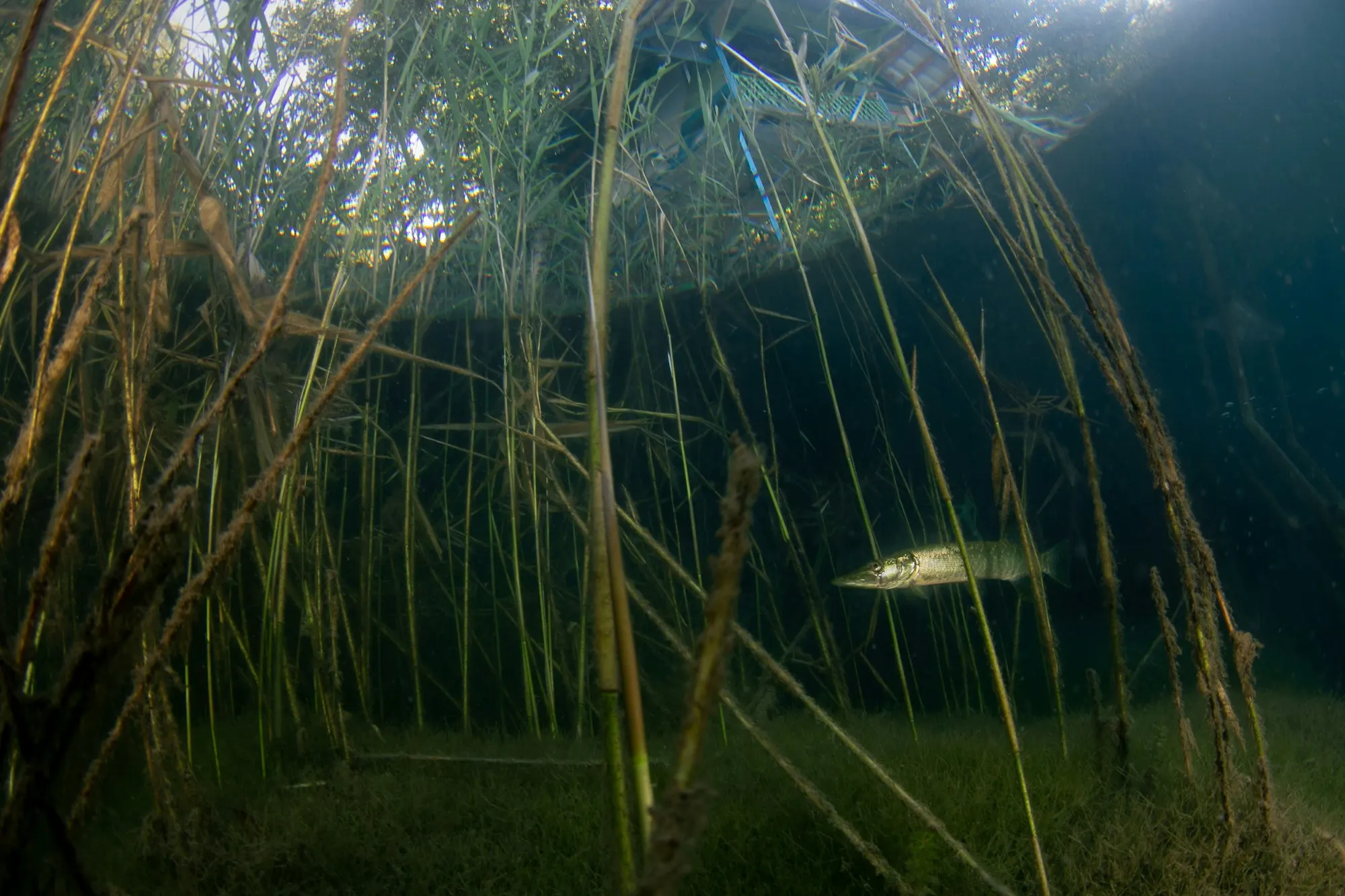
Most of what is said about pike and weather has never been tested, and much of what has been tested says the weather matters less than we think. What matters most is going where the fish are, on water that has not been hammered, and fishing it slowly and thoroughly. That is good news for the winter angler. Cold water alone is no bar, dusk comes early, and the predator seasons on many waters are timed for exactly the months the trout rivers are shut. This guide sets out what is known, what is folklore, and how to fish for pike with a fly rod and put them back in good order.
Fresh water, a slow fly, the last of the light, and a wire trace every time.
Why Pike, and Why Now
From late autumn the fly angler in Britain and Ireland loses most of the rivers. Pike are one of the honest answers. They are native through much of lowland Britain and the continent, long established in Ireland, they feed through the cold months, and they take a big fly well. On several English trout reservoirs the predator season is timed for exactly these months, and Irish and continental loughs and lakes have long winter pike traditions.
This guide is about the fly rod and the cold half of the year: what is actually known about pike and weather, where pike lie when the water cools, how to fish for them, who sets the rules, and how to put a fish back in good order. The coarse fly fishing playbook gives a shorter introduction to pike flies and tackle, and is the place to start if pike are new to you.
What Is Known About Pike and Weather
Where you fish and how hard it has been fished matter more than the weather. Of the weather, temperature matters most, and it is a broad band, not a peak.
Very little published work links pike catch rate to daily weather, and what there is points the same way: encounter beats weather. The largest effect measured in a controlled German study of catch-and-release pike angling was how hard the water had been fished in the previous two days. Pike learn to avoid lures within about a week. That is why a water fishes best just after a predator season opens, and why a quiet corner of a big reservoir can out-fish a famous mark that has had three boats on it all morning.
Water temperature is the weather term with the most support, but as a broad cool-water band. Catch rates hold across roughly six to sixteen degrees, and pike are still catchable below that; in the same German study catch rate rose as the water cooled. Warm water is the real problem: above about twenty degrees catch falls and handling stress climbs. For winter fishing the useful reading is simple. Cold water alone is not a reason to stay at home.
Light: dusk, and to a lesser degree dawn, is the best-supported light effect. Overcast skies are widely recommended, but that is expert opinion rather than measurement. A moderate wind fished better than flat calm in the one controlled study, and at least one flat, bright opening day on a big reservoir was reported as a struggle.
What the evidence does not support: barometric pressure showed no effect in the one controlled test, and a pressure swing changes what a pike feels by about as much as moving ten centimetres deeper. "The first frosts switch them on" has never been tested. Around full and new moon there is a small, real uplift in big-predator catch records, of the order of a few per cent. None of these is worth cancelling a trip over, and none is a reason to make one.
Where Pike Lie in the Cold Months
Deep features on the reservoirs, drop-offs beside old weed on the loughs, slack water on the rivers. Then back to the weedy bays as spring comes on.
On the big reservoirs, anglers who fish them through the winter keep naming the same places: the dam wall, the valve towers, drop-offs and the edges of deep shelves. These are man-made deep-water features and they hold fish from early autumn into winter. Fry shoals and stocked trout give pike a lot to eat on these waters, which spreads the fish out, so expect to fish several features rather than one hot spot.
On natural loughs and lakes, the dying weed of autumn leaves the edges of the old beds as ambush cover, and drop-offs from shallow bays into deeper water are worth working slowly. On shallow, reedy systems such as Oughter and Gowna, the channels between islands and the edges of the reed beds concentrate fish.
On rivers and drains, pike in cold water move out of the main flow into slacks, eddies, the inside of bends, backwaters and the deep water below weirs. High, coloured water after rain pushes them tighter into those slacks.
As late winter turns to spring, pike begin to gather in weedy bays ahead of spawning, which happens in shallow, weedy water at around eight to twelve degrees. Fish caught then are full of spawn and close to their most vulnerable. Many waters and countries close the season around that time for that reason, and it is good practice to leave spawning fish alone where they do not.
Tackle, Flies and the Cold-Water Retrieve
An eight to ten weight, a sinking line for depth, a wire trace every time, and a fly that moves when it is barely moving.
A nine-foot eight, nine or ten weight rod casts the large, air-resistant flies pike take, and has the backbone to bring a fish in quickly, which matters for its welfare. Carry a floating or intermediate line for margins and shallow bays, and a fast-sinking line for the deep features the reservoirs fish from in winter. A fly line will not reach the deepest shelves, so fish the edges where deep water comes close to a feature, or the shallower ends of a drop-off. Some waters are boat only for predators, so check before you plan a bank day.
The trace is not optional. A short wire trace, bite-proof and tied to a strong mono or fluorocarbon leader, is the standard on every water that takes pike welfare seriously. Pike teeth cut through ordinary leader, and a bitten-off fly left in a fish is a slow death.
Flies are baitfish imitations and leech shapes: bucktail and synthetic baitfish streamers, rabbit-strip leeches, flash flies and tubes, in sizes that look like a meal. Natural roach, perch and trout colours are the usual starting point, with something bright for coloured water. Surface poppers and frogs belong to warmer water.
In cold water, slow the fly down and fish it deeper. Count the fly down on a sinking line, then retrieve in long, slow pulls with pauses, letting materials that breathe do the work. Pike will follow a fly a long way without taking. Anglers who fish the reservoirs report that a change of pace at the end of a follow, often a quicker strip rather than a slower one, sometimes turns a follow into a take. Strike with the line hand, a long firm pull, rather than lifting the rod, which pulls the fly away from a fish that is still turning.
Planning a Winter Day
Fresh water first, dusk last, and the wind on your side. Then cover water.
If you can choose your days, the first days after a predator season opens on a water, or after a quiet spell with few boats, are the best bet on the evidence. Short winter days put dusk within reach of an ordinary outing, so plan to be on good water for the last hour and a half of light, and to be off the water safely after it.
A moderate breeze beats a flat calm, though strong wind makes boat control and casting a big fly harder, which is a reason to fish sheltered water rather than a reason to expect fewer fish. Overcast days are worth trying; bright ones are not a reason to stay at home, especially on deep or coloured water.
Above all, cover water. Pike are encountered, not conjured. Fish a feature thoroughly, move, and fish the next one. On the big reservoirs, give other boats room on the towers and points; a mark that has just been fished hard is the poorest bet you can make.
Cold-water boating is serious. Wear a lifejacket, tell someone where you are, keep the boat dry and tidy, and come in early if the wind gets up. Frozen staging and wet rocks are dangerous in their own right.
Seasons and Rules: Who Sets Them
National agencies set the licence and the close seasons; owners and clubs set the rest. Check both, every season.
England and Wales: the Environment Agency sells the rod licence for England and Wales, and the Environment Agency and Natural Resources Wales set the byelaws. Rivers have a coarse fish close season in spring and early summer, which covers pike. On stillwaters and most canals the close season is up to the owner or club, so the water's own rules decide. The English trout reservoirs that allow predator fishing run their own predator seasons, often boat only and with method restrictions, so read the current predator page before you book.
Scotland has no national rod licence and no statutory close season for pike, but the fishing still belongs to someone: you need the owner's or club's permission, and their rules apply. Northern Ireland: DAERA and the Loughs Agency set licence and permit rules for their areas. Ireland: no licence is needed for pike, and Inland Fisheries Ireland sets the national rules, including limits on killing pike and on moving fish between waters. On some western wild-trout loughs pike are managed to protect the trout and the local rules differ, so check before you go.
On the continent, most countries close pike fishing for part of late winter and spring around spawning, and the dates are national or regional. Germany sets them by Land, France by water category, the Netherlands nationally. Permits are local, often through the regional angling association. In Germany you also need a state fishing licence, and only some Länder sell a short-term tourist licence; in the Netherlands you need a VISpas. Look up the current rules for the specific water before you travel.
Handling Pike in the Cold
Be ready before the fish is. Keep it in the water, keep air time short, and keep frost off it.
Pike are tougher than they look in some ways and fragile in others. They do not tolerate long air exposure, rough handling of the gills, or being laid on hard, dry or frozen ground. Have the kit ready before you cast: a large, soft, knotless net, long-nosed forceps or pliers, strong hook or wire cutters, and an unhooking mat if you are on the bank.
Use barbless or crushed-barb hooks; they make unhooking quick, and quick is the point. Leave the fish in the net in the water while you get ready. If you need to lift it, support it horizontally under the head and the belly. Only use a gill-cover hold if you have been shown how, and never put fingers in the gill rakers. Never hold a pike by the eyes, and do not use gags or sacks.
Winter adds one rule of its own: frost and ice damage eyes, gills and fins in seconds. Wet the mat, keep the fish off frozen ground and snow, and keep the time out of the water as short as you can make it. If a hook is deep, do not cut the trace and leave it in the fish. Use long forceps through the gill opening if you have been shown how, or cut the hook with strong cutters and take it out in pieces. If you are not sure, get an experienced angler to help.
Return the fish upright in the water, facing into any flow, and hold it gently until it swims off strongly on its own. Never move pike from one water to another; it is illegal in many places and spreads fish and disease where they do not belong.
Where to Fish for Winter Pike
English trout reservoirs with predator seasons, Irish and Fermanagh loughs, a Welsh lake, a Scottish loch, and a few continental names.
England: Rutland, Grafham, Pitsford and Draycote run predator seasons for pike and perch through the colder months, alongside their trout fishing, with boat-only rules and set methods; Draycote has recently added predator fishing. Ladybower in the Peak District turns to pike and perch over the winter; ask which methods it allows. Each water publishes its own predator rules and season, and they change, so check the current page.
Wales and Scotland: Bala Lake (Llyn Tegid) is a controlled fishery for pike, perch and wild brown trout. It also holds the gwyniad, a protected whitefish found nowhere else, which must never be targeted. Loch Awe in Argyll is a long, deep loch with wild brown trout and ferox, where pike are a genuine fly quarry for anyone with the tackle.
Ireland and Fermanagh: the Erne system, Upper Lough MacNean on the border, the reedy maze of Lough Oughter and Lough Gowna in Cavan and Longford, and the big Shannon lakes, Derg and Ree, which want careful boat handling. In Cork, the Lee Reservoirs and Lough Allua; within an hour of Dublin, Pollaphuca, where the pike fishing has a closed period in the autumn and the pike are known to come well to the fly.
The continent: the shallow brackish lagoons behind Rügen on the German Baltic coast are a well-known guided pike-on-the-fly destination; Lac du Der-Chantecoq in Champagne is a huge flood-storage lake that fills through winter and spring, and its pike fishing follows the French close season, so check the current dates; the margins of the IJsselmeer in the Netherlands and the lakes and canals of Brandenburg are mixed predator water. Check national close seasons and local permits before travelling to any of them.