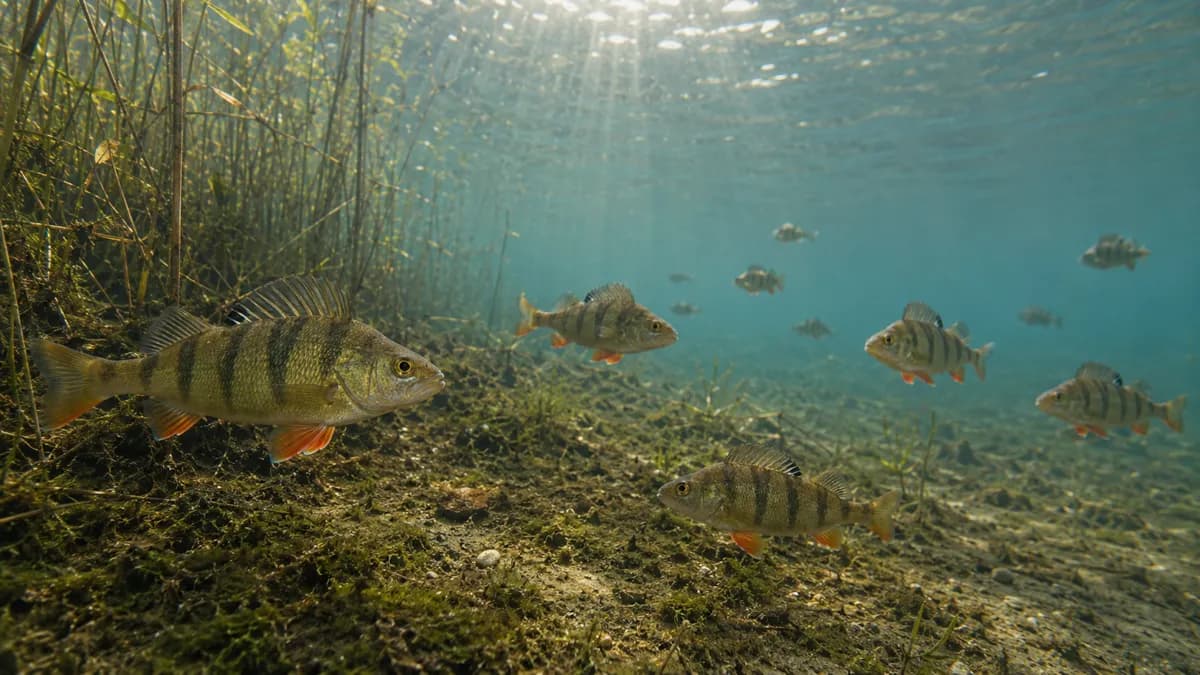
Perch are the species most fly fishers never quite take seriously, and that is a mistake. They are predators with eyes that look forward, they shoal, they hunt, and they take a fly with the kind of unambiguous commitment that a brown trout reserves for a hawthorn fly on a good May afternoon. The four-pounder that lives under your local marina pontoon has been catchable on a fly all along. Nobody has bothered to try. A micro Clouser, stripped along the harbour wall with the right cadence and a deliberate pause; a balanced leech hung under an indicator on a January canal; a mini muddler skated through summer fry-bashing in the weedy margins. Three lanes, ten patterns, year-round fish.
Strip. Pause. The take comes on the hang. The bigger the fish, the harder the pluck.
The Perch Revelation
Perch are the species most fly fishers never quite take seriously, and that is a mistake. They are predators with eyes that look forward, they shoal, they hunt, and they will eat a fly with the kind of unambiguous commitment that a brown trout reserves for a hawthorn fly on a good May afternoon. They live in places that most fly fishers walk past — harbours, canal pontoons, weedy reservoir margins, the slow corners of slow rivers — and the four-pounder that lives under your local marina has been catchable on a fly all along. Nobody has bothered to try.
The case for perch on the fly is that they hit. They do not sip. They charge a striped Clouser like it owes them money, and the take is unmistakable — a hard pluck on the strip-pause that loads the rod immediately. Specimen perch (two pounds and up) fight steadily and stubbornly, using their broad bodies as ballast against the current of the rod. A two-pound perch on a four-weight is a richer five minutes than a half-pound stocked rainbow on a four-weight ever will be.
And then there is the where. Perch live in the structure that most fly fishers shy away from. Submerged timber, weed walls, harbour walls, lock approaches, reservoir riprap. The fly fisher who learns to fish tight to that structure — with hook-up flies, with strip-pause cadence, with patience for the hang — discovers a fishery that runs three hundred and sixty-five days a year on most British stillwaters and Continental canals. The perch was always there. The question is whether you start fishing for it.
Why Perch Eat Flies
Predatory, shoal-oriented, structure-bound. They eat small fish, fry, leeches, dragonfly nymphs, freshwater shrimp and crayfish — almost all of which a fly rod can imitate.
European perch (Perca fluviatilis) are an obligate predator from the moment they pass the four-inch mark. Their diet is small fish, fry, leeches, large invertebrates, and — where present — crayfish. Everything on that list has a fly rod imitation, and the better the imitation matches the perch's expected forage, the more reliable the take.
They are not solitary. Perch shoal in age-class groups through most of the year, breaking into smaller hunting packs in summer and gathering into larger winter aggregations as the water cools. Find one and there are usually three to a dozen more in the same area. This shoaling behaviour is the angler's lever — a methodical working of a productive lie almost always produces multiple fish.
They are structure-bound. Open-water perch exist, particularly in large reservoirs, but the everyday perch holds tight to vertical structure. Weed walls. Drop-offs. Lock walls. Pontoons. Sunken timber. Marina pontoon legs. The fly must arrive at or just outside this structure, at the right depth, with the right cadence. Fish the structure, not the open water.
They are eye-driven, but the eyes are best in low light. Dawn and dusk on bright days, all day on overcast days, and frequently right through the day on canals where surface cover keeps light levels low. Perch see and intercept rather than smell-and-stalk; flash and silhouette matter more than presentation perfume.
The Three Lanes
Searching baitfish (default). Deep and cold (autumn-winter). Weedy and shallow (summer fry-bashing). Three boxes, ten patterns, year-round fish.
The perch fly box reduces cleanly to three lanes. The first lane — searching baitfish — covers ninety per cent of the year. Micro Clouser Minnow, Woolly Bugger, Perch Fry Streamer, with Zonker and Sparkle Minnow as variants. These are 4-8cm baitfish patterns fished on a floating or intermediate line, stripped with short sharp pulls and 3-5 second pauses. Most takes come on the pause. This is the default approach for any perch trip when nothing tells you otherwise.
The second lane — deep and cold — is the autumn-into-winter box. Balanced Leech under an indicator on a 1.5-4m leader. Jig Bugger bouncing along bottom near the structure. Zonker on a sink-tip pulsing through the deeper lies. Woolly Bugger heavily weighted, fished slow figure-of-eight along the bottom. Cold-water perch hold deeper and feed more methodically; the fly must reach them and stay in the strike zone with patience.
The third lane — weedy and shallow — is the summer fry-bashing window. Mini Muddler skated through the surface margins when perch push fry into the edges. Damsel Nymph fished slow along weedbed margins for the smaller and medium fish that take big nymphs readily. Sparkle Minnow for the visible fry-feeders. Crayfish Jig hopped along rocky margins where naturals occur. Best in the last hour before dark and the first hour after dawn on bright summer days.
Lane One: Searching Baitfish
Micro Clouser, Woolly Bugger, Perch Fry Streamer. Strip-pause cadence. Tight to cover. The default lane for nine months of the year.
The Micro Clouser Minnow is the first fly in the perch box, and for good reason. The dumbbell eyes ride the hook point upward — which keeps the fly out of the snags around weed and timber that perch live among — and the strip-pause action produces a jigging motion that perch recognise as a wounded baitfish. Olive over white is the everyday colour; white over chartreuse for coloured water; black for low light. Size 6-8 covers most fish, size 4 for specimens.
The Woolly Bugger may be the most versatile perch fly ever tied. It suggests a leech, a small fish, a tadpole, or just an edible thing of the right size — perch will eat it interpreted as any of these. Olive and black are the two essentials. Stripped fast it is a fleeing baitfish; swung slow it is a hovering leech; fished figure-of-eight along the bottom it is a foraging benthic something. The fly to tie on when you do not know what else to try.
The Perch Fry Streamer — barred olive and yellow with orange accents — captures the cannibal instinct that becomes increasingly important as perch mature. Big perch eat small perch with no compunction, and from midsummer through autumn the year's perch fry become the dominant single forage item on many stillwaters. A fly that looks like one and behaves like a confused or injured one produces.
Cadence is the constant. Short sharp strips of two to four inches, then a deliberate pause of three to five seconds. Count the pauses. Most takes come during the hang — the perch follows the fly through several strips and commits when the fly stops moving. A steady retrieve produces follows but fewer hookups. Stop the fly to catch the fish.
Lane Two: Deep & Cold
Balanced Leech under an indicator. Jig Bugger bouncing the bottom. The cold-water lane for the biggest fish of the year.
The Balanced Leech is the cold-water perch fly. Pinned by a balance bead so that the fly hangs horizontal under an indicator at any depth, it presents at exactly the level you set it — typically 1.5 to 4 metres on winter stillwaters — and pulses with the slightest wave action. Black, olive and brown are the core colours, with a small flash strand to help visibility in murky winter water. Set the indicator to perch depth, cast to known holding water near pontoons or weed walls, and watch the indicator. The take registers as a clean dip.
The Jig Bugger is the cold-water lane on rivers and structure-rich stillwaters. Tungsten jig bead, hook-up orientation, weighted enough to bounce near the bottom and probe vertical edges. The CzechNymph approach — well documented for river perch — pairs a larger jig fly with a smaller dropper behind. The bigger fly draws attention and many fish follow it without committing; the smaller fly gets the strike. Olive/orange and black/red are the productive colour combinations.
The Zonker is the slower, pulsing target that suits sluggish winter perch. The rabbit-strip body breathes on the pause and pulses on the slow retrieve — both essential to triggering cold-water takes. White is the standard cold-water colour; black for low-light winter sessions. Fish on an intermediate or sink-tip line to keep the fly in the strike zone without skating it through.
The biggest perch of the year often come in this lane. Anglers willing to fish patient and deep through November, December and January, in cold winds and short days, find the four-pound fish that the summer baitfish-strippers never see. The reward is in the persistence.
Lane Three: Weedy & Shallow — Fry-Bashing
Mini Muddler skated through the margins. Damsel slow along weedbed edges. The summer fry-bashing window — explosive surface takes and visible action.
Summer perch push fry into the shallow weedy margins, harbour corners and reservoir edges in a behaviour fly anglers can exploit at close range. A Mini Muddler fished on a floating line with sharp strips and pauses across the surface draws explosive takes — the deer-hair head wakes and pushes water, and perch hear the disturbance before they see the fly. Brown, black and olive cover the situations. Size down rather than up if the takes are tentative.
The Damsel Nymph is the weedy summer fly that nobody talks about. An olive marabou damsel fished slow along the weedbed margin — short strips, long pauses — produces a steady stream of small-to-medium perch from May through September. The marabou tail pulses irresistibly on the pause. Often the most reliable fly when fry-bashing is not happening but perch are still active in the weed.
The Sparkle Minnow is the visible-fry-feeder fly. Small flash baitfish (3-5cm) imitating bleak, dace, perch fry or roach. Silver/white is the standard; gold and chartreuse in slightly stained water. Strip with quick pauses to mimic a fleeing fry.
The Crayfish Jig — small jig fly with rubber legs in olive, brown or rusty-orange — is the fly for the bottom of rocky margins, canal beds, marina walls and reservoir riprap. Hop it along the bottom with short lifts and longer pauses. Particularly effective on perch that have learned to forage on crayfish in maturing waters, where the takes are often the largest perch of the day.
Reading Perch Water
Structure, depth, and shoal logic. The perch fly fisher reads vertical edges and works them methodically.
Perch water is vertical-structure water. The first reconnaissance on a new venue locates the structure: weed walls, drop-offs, pontoon legs, harbour walls, lock approaches, sunken timber, fallen trees, bridge supports, rocky margins. Mark each. The perch are within a rod-length of one of these features almost without exception.
Depth varies by season. Spring and early summer perch are shallow — 0.5 to 2 metres — and often visible in clear water. Summer perch through August move slightly deeper as the surface warms but remain available to mid-depth flies (1 to 3 metres). Autumn and winter perch drop into the 3 to 6 metre band where stillwater depths allow, requiring sink-tips, weighted jigs or indicator setups.
Shoal logic is the productivity multiplier. Where you catch one perch, work the lie for several more before moving on. A productive lie often produces three to ten fish in a session as competing perch from the shoal commit successively. Rest the lie for ten minutes after a streak of takes, then return — the rest often re-fires the bite.
Low light is the perch fly fisher's ally. Bright midday with sun directly on the water pushes perch deep and tight to the structure. Overcast days, dawn, dusk and any conditions that flatten the light produce more aggressive takes and willingness to chase. The session that fails at noon often comes alive in the last hour before dark.
Sizes, Colours, and the Specimen Fish
Hook 8-2 for most perch, 6-4 the sweet spot. Step up to 2-4 inch baitfish flies for specimen perch. Smaller flies catch more fish in absolute numbers.
Size matters less than presentation, but it matters. The standard perch hook range is 8-2 with 6-4 the everyday sweet spot. Smaller flies (size 8-10) catch more perch in absolute numbers — particularly small-to-medium fish — while larger flies (size 4-2 or 2-4 inch articulated patterns) selectively target the specimen end of the size distribution at the cost of total catch rate. Carry both. Start with the everyday size; step up only when targeting larger fish.
Colour follows water clarity. In clear water, natural patterns dominate — olive/white, silver/white, perch-barred olive and yellow. In stained or coloured water, add flash, black silhouette, or attractor colours like orange and chartreuse. Black is the most reliable single colour for low-light and night-into-dawn perch fishing on canals and harbours. A small Clouser in black-over-white is the high-utility low-light fly.
Specimen perch (2lb+) take larger flies and respond to slow-fished, slightly flashier patterns than the median fish. A 4-6 inch Zonker or articulated baitfish fly fished patiently around known specimen-holding structure — old pontoons, deep marina corners, the deepest end of a drop-off — produces the four-pounder that no smaller fly will reliably interest. The cost is total catch rate; the reward is the fish you remember.
Tackle: 4-6 Weight, Floating + Intermediate, Barbless
A five-weight covers most of it. Add an intermediate line for the deeper work and a sink-tip for the cold-water lane. Barbless throughout for fish welfare.
A nine-foot five-weight is the standard perch rod — accurate enough for tight casts to harbour pontoons and weed edges, with enough authority to handle weighted jig flies and small baitfish patterns. A four-weight is right for the smaller waters and lighter casts (canals, small reservoirs); a six-weight earns its keep for specimen-targeting on big stillwaters and where wind is an issue.
Lines: a weight-forward floating line covers most of the searching and shallow fishing. Add a clear intermediate for fishing the 1-3 metre band; a sink-tip (Type 3 or Type 6) for the cold-water deep lane and for keeping baitfish flies in the strike zone over weed walls. Three lines on three reels (or a multi-tip system) covers every perch situation worth fishing.
Leader: nine to twelve feet tapered to 4x-5x fluorocarbon tippet. Perch are not leader-shy in the way trout are, and the larger flies and weighted jigs require some heft in the tippet. Fluorocarbon for invisibility around clear-water structure; ordinary mono is fine for coloured water and canal fishing.
Barbless or micro-barb hooks throughout — they unhook quickly and cleanly, which is what a fish you intend to return needs. Forceps for the quick release. Mind the spiny dorsal fin and the sharp gill plates when handling. Wet hands, support larger fish horizontally, and revive head-into-current before release.
The Perch Year
Post-spawn aggression in spring. Summer fry-bashing. Autumn baitfish chase. Patient winter under the indicator. Four windows, all productive.
Late spring through early summer (April-June): post-spawn perch feed aggressively to recover condition. The shoals are tighter and more competitive than at any other time of year. Baitfish patterns and small streamers stripped through harbour corners and shallow stillwater margins produce excellent catch rates. Multiple-fish sessions are the norm in this window.
High summer (July-August): the fry-bashing window. Perch push fry into shallow weedy margins; mini muddlers and damsel nymphs produce theatre. Welfare matters in warm water — fight quickly, revive thoroughly, avoid prolonged photos. Best fishing is the cool bookends of the day.
Autumn (September-November): the baitfish chase intensifies as perch fatten before winter. The biggest perch of the year often come in this window. Baitfish patterns and zonkers fished at depths of 2-4 metres around drop-offs produce specimen fish. The autumn perch hits the fly with the season's sharpest aggression.
Winter (December-March): patient, deep, slow. Balanced leeches under indicators, jig flies bouncing the bottom of cold marina corners and lock approaches. Short windows of activity often midday when sun briefly warms the surface. Productivity is lower but specimen fish are catchable when the methods are right.
Your Perch Day
Walk the structure at first light. Searching baitfish through the morning. Damsel in the weed for mid-session. Streamer at dusk for the four-pounder.
First light: walk the venue and identify the structure. Pontoons, drop-offs, weed walls, marina corners, harbour walls, fallen timber. Note where the perch are likely to hold. Do not cast yet — the reconnaissance is the day's most important hour.
Morning: start with the Micro Clouser or Woolly Bugger in the searching lane. Cast tight to the first piece of structure, strip-pause through the lie, work it methodically. When a fish comes, work the area thoroughly before moving — the shoal is there.
Midday on bright days: fish the deeper structure with weighted patterns, or rest the venue and walk the bank looking for new lies for the evening session. On overcast days, keep fishing the searching lane.
Mid-session in summer: if surface activity shows in the weedy margins (fry slashes, perch visible chasing in the shallows), switch to the Mini Muddler or Sparkle Minnow for the fry-bashing window. Explosive surface takes are the reward.
Last hour: the largest perch of the day often come in the last hour before dark. Switch to a Perch Fry Streamer or a small Zonker and work the deeper structure that produced fish in the morning. The four-pound fish that ignored everything in bright light commits in the failing light.