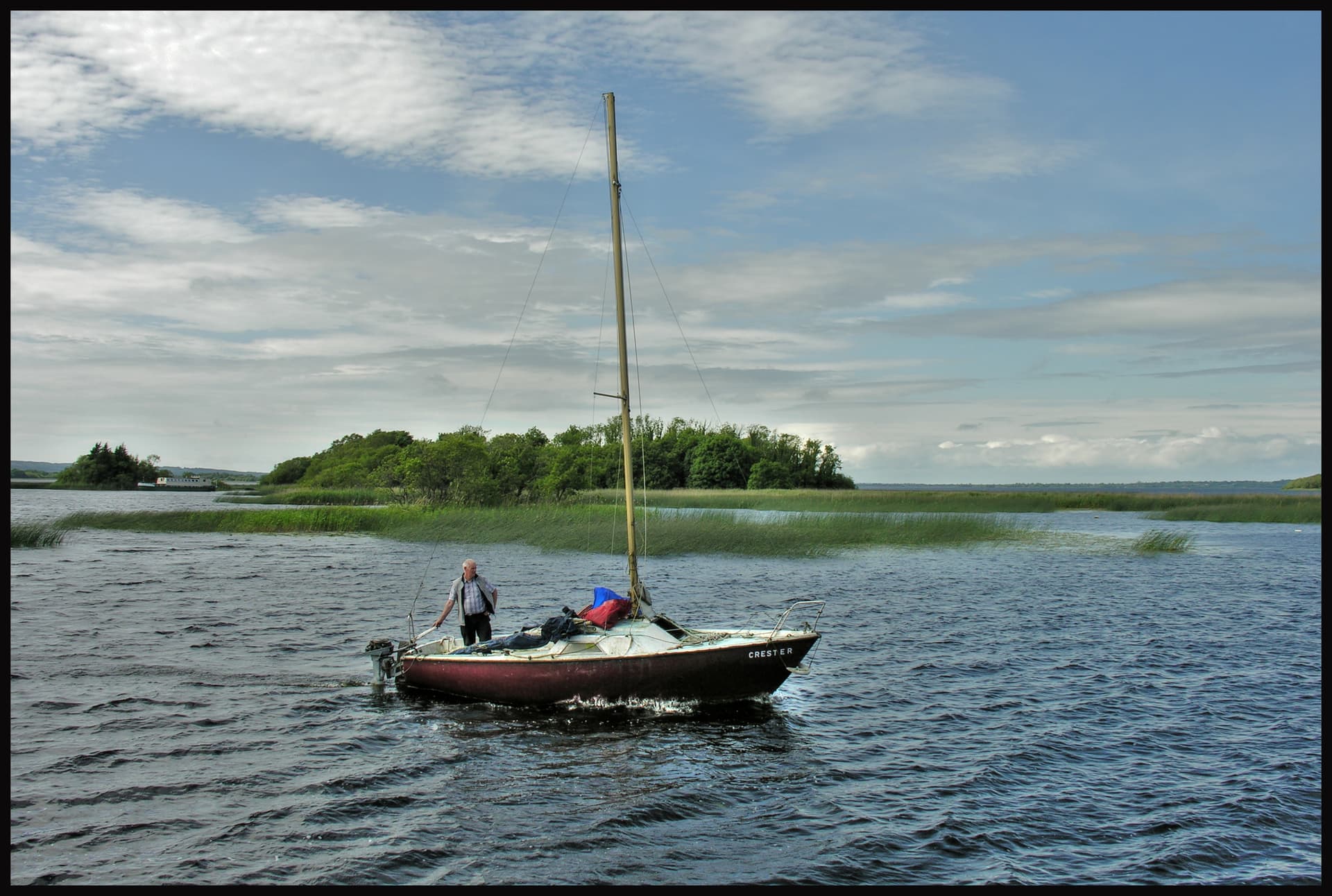


Lough Derg is the largest of the Shannon system — a limestone water of profound clarity that rewards those who slow down and learn it properly. Its drowned drumlins create a landscape of subtle contours and uncertain depths. The trout are wild browns of real weight, holding in the deeper channels and around the limestone shelves. The northern end — Mountshannon and Dromineer the traditional anchors — remains the heart of things. Boat handling matters here; the drifts demand respect, and the wind has opinions. The mayfly in May transforms the lough entirely — thick, chaotic, and short-lived, the kind of hatch that makes you plan a trip a year in advance. But fish who know Derg know something worth knowing: a water that has not been simplified or tamed, that fishes differently every day, and that rewards genuine knowledge over technique alone.
- Free state water
A patient day, if you fancy it
Good wave on — drift country. Take your time — read the water before you cast.
Conditions on the water
Some readings unavailable — check directly before fishing.
The brief
The plan
Set up a broadside drift and cover the water systematically. Work Gosling on the bob and Hare's Ear Spider on the point.
If the main plan is not working, switch to a smaller, more imitative pattern fished slower and deeper. A change of drift angle can also make a difference.
Keep an eye on changing conditions — wind shifts and cloud breaks can trigger short feeding spells.
A gentle ripple is ideal for drifting — broadside drift covering the wind lanes should be productive.
What's on, when
Numbers are intensity 0 (none) to 3 (peak) — a guide, not a guarantee.
Top pattern + the box
Why today scores what it does
- Wind conditions (breezy) are not ideal for this water.
Precipitation
Who this water suits
- Large-Water Boat Specialists. Mayfly Period Enthusiasts.
Lough Derg, on the water
Field guide · contributor-editedWhat this water is
Lough Derg is the largest of the Shannon system — a limestone water of profound clarity that rewards those who slow down and learn it properly. Its drowned drumlins create a landscape of subtle contours and uncertain depths. The trout are wild browns of real weight, holding in the deeper channels and around the limestone shelves. The northern end — Mountshannon and Dromineer the traditional anchors — remains the heart of things. Boat handling matters here; the drifts demand respect, and the wind has opinions. The mayfly in May transforms the lough entirely — thick, chaotic, and short-lived, the kind of hatch that makes you plan a trip a year in advance. But fish who know Derg know something worth knowing: a water that has not been simplified or tamed, that fishes differently every day, and that rewards genuine knowledge over technique alone.
- Lough system
- Limestone
How to get to the water
Where the rules change
- Trout1 March → 30 September
Licences, sorteo, the rules
- Shannon system lough (largest on the Shannon)
- No permit — state rod licence only
- Boats from Killaloe, Mountshannon, Dromineer
- Large water — respect weather.
Lough Derg
Lough Derg is the largest of the Shannon system — a limestone water of profound clarity that rewards those who slow down and learn it properly.
A patient day, if you fancy it
Good wave on — drift country. Take your time — read the water before you cast.
Some readings unavailable — check directly before fishing.
A reasonable day here, though wind isn't quite in the sweet spot.
Set up a broadside drift and cover the water systematically. Work Gosling on the bob and Hare's Ear Spider on the point.
If the main plan is not working, switch to a smaller, more imitative pattern fished slower and deeper. A change of drift angle can also make a difference.
Keep an eye on changing conditions — wind shifts and cloud breaks can trigger short feeding spells.
A gentle ripple is ideal for drifting — broadside drift covering the wind lanes should be productive.
- Wind conditions (breezy) are not ideal for this water.
Numbers are intensity 0 (none) to 3 (peak) — a guide, not a guarantee.
Terrain map
- Shannon system lough (largest on the Shannon)
- No permit — state rod licence only
- Boats from Killaloe, Mountshannon, Dromineer
- Large water — respect weather.
Lough Derg is the largest of the Shannon system — a limestone water of profound clarity that rewards those who slow down and learn it properly. Its drowned drumlins create a landscape of subtle contours and uncertain depths. The trout are wild browns of real weight, holding in the deeper channels and around the limestone shelves. The northern end — Mountshannon and Dromineer the traditional anchors — remains the heart of things. Boat handling matters here; the drifts demand respect, and the wind has opinions. The mayfly in May transforms the lough entirely — thick, chaotic, and short-lived, the kind of hatch that makes you plan a trip a year in advance. But fish who know Derg know something worth knowing: a water that has not been simplified or tamed, that fishes differently every day, and that rewards genuine knowledge over technique alone.
- Lough system
- Limestone
- Trout1 March → 30 September
Lough Derg is the largest of the Shannon system — a limestone water of profound clarity that rewards those who slow down and learn it properly. Its drowned drumlins create a landscape of subtle contours and uncertain depths. The trout are wild browns of real weight, holding in the deeper channels and around the limestone shelves. The northern end — Mountshannon and Dromineer the traditional anchors — remains the heart of things. Boat handling matters here; the drifts demand respect, and the wind has opinions. The mayfly in May transforms the lough entirely — thick, chaotic, and short-lived, the kind of hatch that makes you plan a trip a year in advance. But fish who know Derg know something worth knowing: a water that has not been simplified or tamed, that fishes differently every day, and that rewards genuine knowledge over technique alone.