
Loch Awe is twenty-five miles long and holds everything from small sparkling wild brown trout to ferox the size of a medium sheep, which may sound improbable until you've seen one come up on a dead bait in forty feet of water. It is Argyll's inland sea, held in a fold of high country and ruled by the Atlantic weather that rolls in off Mull and Lismore — a loch that can be flat calm and diamond-clear at breakfast and rolling white by lunchtime, which is the kind of thing the regulars find amusing and visitors find sobering. Fishing is boat work in the main — drifting the bays and island runs for wild brown trout through spring and early summer, trolling the deep water for the ferox that make Awe famous, and picking off the occasional sea trout on the lower reaches near the Awe Barrage. Pike are a genuine fly quarry here for anyone with the tackle and the inclination. The Loch Awe Improvement Association is the fishing authority and boats are available through local hotels and marinas. A proper day on Awe is the kind that stays with you for a year.
- Permit required
A patient day, if you fancy it
Useful ripple, fishable wave. Take your time — read the water before you cast.
Live now
Conditions on the water
Trends shown where the gauge supports them
Some readings unavailable — check directly before fishing.
How to fish · for brown trout
The brief
When · where · method · kit
Today's tactical plan
The plan
Plan A · Plan B · what to watch · bank or boat
Work Kate McLaren on the bob, Peter Ross on the middle dropper, and Diawl Bach on the point.
If the main plan is not working, switch to a smaller, more imitative pattern fished slower and deeper. A change of drift angle can also make a difference.
Evening tends to be the best period in summer — stay late if you can for a sedge or spinner fall.
Windy conditions suit anchoring in productive areas rather than open-water drifting.
Hatches & runs
What's on, when
Twelve months at a glance
Numbers are intensity 0 (none) to 3 (peak) — a guide, not a guarantee.
Today's fly · curated pack
Top pattern + the box
5 patterns from this venue's curated pack
Evidence
Why today scores what it does
The factors driving today's verdict
- Wind conditions (windy) are not ideal for this water.
- Lake Olive is in its seasonal window, boosting the chance of targeted feeding.
The water
On the lough
5 photos + lough map

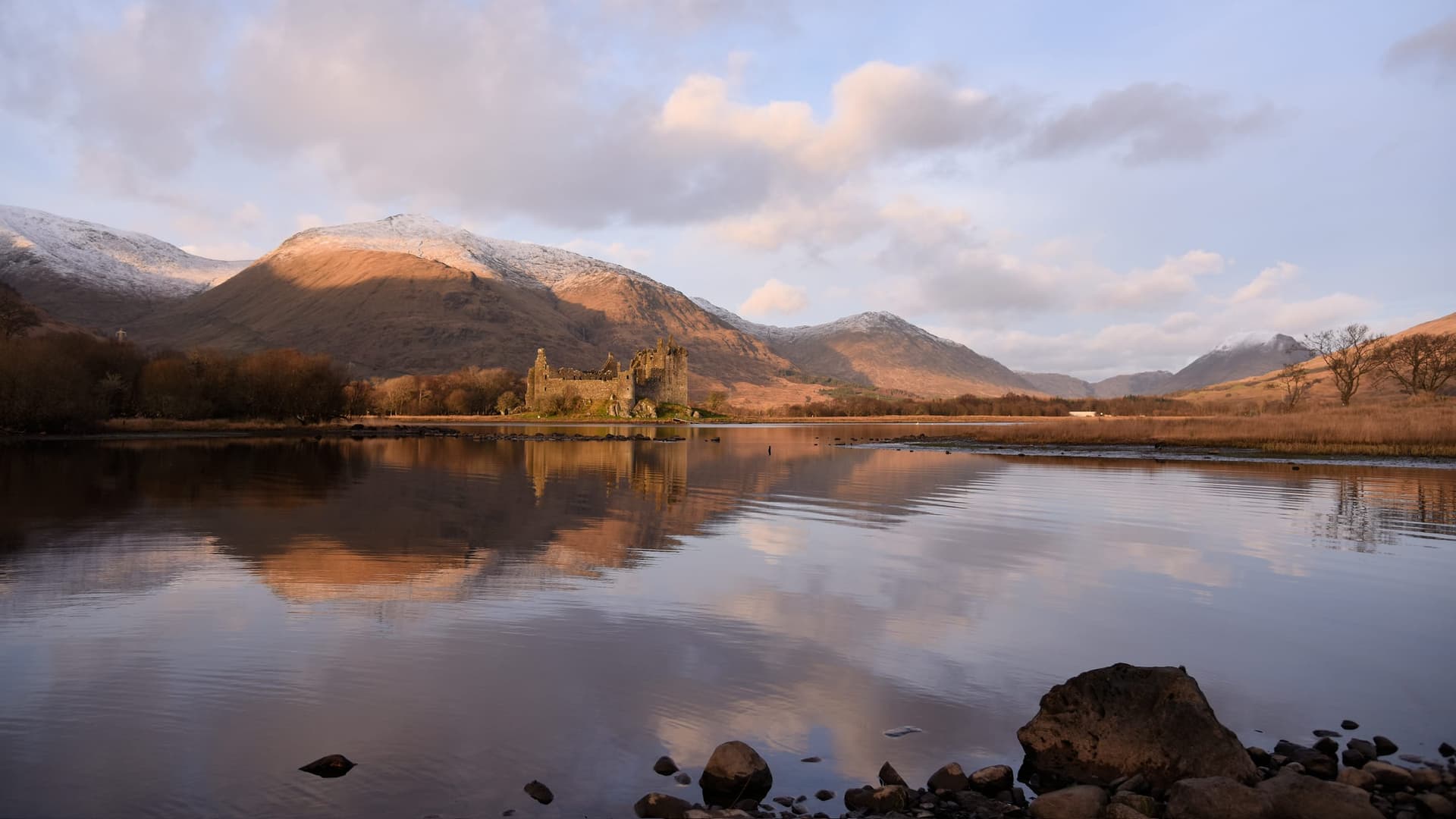
Kilchurn Castle mirrored in the still water of Loch Awe. 
The broad head of Loch Awe — classic trout, pike and ferox water. 
Dawn over Loch Awe — when ferox trout are at their most active. 
Loch Awe in spring — over 40 km of wild trout, pike and ferox water. 
Kilchurn Castle guards the head of Loch Awe — prime pike and trout territory. Terrain map
Loch Awe · profile
Who this water suits
Strengths · watch-outs · best for
Loch Awe, on the water
Field guide · contributor-editedLoch Awe · about
What this water is
Background · character · contributors
Loch Awe is twenty-five miles long and holds everything from small sparkling wild brown trout to ferox the size of a medium sheep, which may sound improbable until you've seen one come up on a dead bait in forty feet of water. It is Argyll's inland sea, held in a fold of high country and ruled by the Atlantic weather that rolls in off Mull and Lismore — a loch that can be flat calm and diamond-clear at breakfast and rolling white by lunchtime, which is the kind of thing the regulars find amusing and visitors find sobering. Fishing is boat work in the main — drifting the bays and island runs for wild brown trout through spring and early summer, trolling the deep water for the ferox that make Awe famous, and picking off the occasional sea trout on the lower reaches near the Awe Barrage. Pike are a genuine fly quarry here for anyone with the tackle and the inclination. The Loch Awe Improvement Association is the fishing authority and boats are available through local hotels and marinas. A proper day on Awe is the kind that stays with you for a year.
- Loch
- Mixed
Loch Awe · directions
How to get to the water
Loch Awe · zones
Where the rules change
Seasons · zones · per-species rules
- Salmon15 March → 6 October
- Trout15 March → 6 October
Sea trout: Variable seasonal (2026) — Loch Awe drains through the Awe Barrage (sluice-regulated outflow). Sea trout historically significant — the loch and river below the dam both held fish. West-coast sea-lice pressure has reduced runs; the barrage restricts migration. Still fishable when fish move through but not a reliable primary-target sea trout fishery.
Loch Awe · sources
Useful links
External · open in a new tab
Loch Awe · learn
Related guides
Learn-zone playbooks for this water
Loch Awe

Kilchurn Castle mirrored in the still water of Loch Awe.
Photo: "Loch Awe reflecting Kilchurn Castle" by Andrewmckie — CC BY-SA 4.0
Loch Awe is twenty-five miles long and holds everything from small sparkling wild brown trout to ferox the size of a medium sheep, which may sound improbable until you've seen one come up on a dead bait in forty feet of water.
A patient day, if you fancy it
Useful ripple, fishable wave. Take your time — read the water before you cast.
Some readings unavailable — check directly before fishing.
Conditions are away from this venue's sweet spot — it usually fishes best in ripple wind with cloud skies.
Work Kate McLaren on the bob, Peter Ross on the middle dropper, and Diawl Bach on the point.
If the main plan is not working, switch to a smaller, more imitative pattern fished slower and deeper. A change of drift angle can also make a difference.
Evening tends to be the best period in summer — stay late if you can for a sedge or spinner fall.
Windy conditions suit anchoring in productive areas rather than open-water drifting.
- Wind conditions (windy) are not ideal for this water.
- Lake Olive is in its seasonal window, boosting the chance of targeted feeding.
Numbers are intensity 0 (none) to 3 (peak) — a guide, not a guarantee.

Kilchurn Castle mirrored in the still water of Loch Awe. 
The broad head of Loch Awe — classic trout, pike and ferox water. 
Dawn over Loch Awe — when ferox trout are at their most active. 
Loch Awe in spring — over 40 km of wild trout, pike and ferox water. 
Kilchurn Castle guards the head of Loch Awe — prime pike and trout territory. Terrain map
Loch Awe is twenty-five miles long and holds everything from small sparkling wild brown trout to ferox the size of a medium sheep, which may sound improbable until you've seen one come up on a dead bait in forty feet of water. It is Argyll's inland sea, held in a fold of high country and ruled by the Atlantic weather that rolls in off Mull and Lismore — a loch that can be flat calm and diamond-clear at breakfast and rolling white by lunchtime, which is the kind of thing the regulars find amusing and visitors find sobering. Fishing is boat work in the main — drifting the bays and island runs for wild brown trout through spring and early summer, trolling the deep water for the ferox that make Awe famous, and picking off the occasional sea trout on the lower reaches near the Awe Barrage. Pike are a genuine fly quarry here for anyone with the tackle and the inclination. The Loch Awe Improvement Association is the fishing authority and boats are available through local hotels and marinas. A proper day on Awe is the kind that stays with you for a year.
- Loch
- Mixed
- Ecology: Good
- Chemical: Unknown
EA waterbody UKSC010282
- Salmon15 March → 6 October
- Trout15 March → 6 October
Sea trout: Variable seasonal (2026) — Loch Awe drains through the Awe Barrage (sluice-regulated outflow). Sea trout historically significant — the loch and river below the dam both held fish. West-coast sea-lice pressure has reduced runs; the barrage restricts migration. Still fishable when fish move through but not a reliable primary-target sea trout fishery.
Loch Awe is twenty-five miles long and holds everything from small sparkling wild brown trout to ferox the size of a medium sheep, which may sound improbable until you've seen one come up on a dead bait in forty feet of water. It is Argyll's inland sea, held in a fold of high country and ruled by the Atlantic weather that rolls in off Mull and Lismore — a loch that can be flat calm and diamond-clear at breakfast and rolling white by lunchtime, which is the kind of thing the regulars find amusing and visitors find sobering. Fishing is boat work in the main — drifting the bays and island runs for wild brown trout through spring and early summer, trolling the deep water for the ferox that make Awe famous, and picking off the occasional sea trout on the lower reaches near the Awe Barrage. Pike are a genuine fly quarry here for anyone with the tackle and the inclination. The Loch Awe Improvement Association is the fishing authority and boats are available through local hotels and marinas. A proper day on Awe is the kind that stays with you for a year.