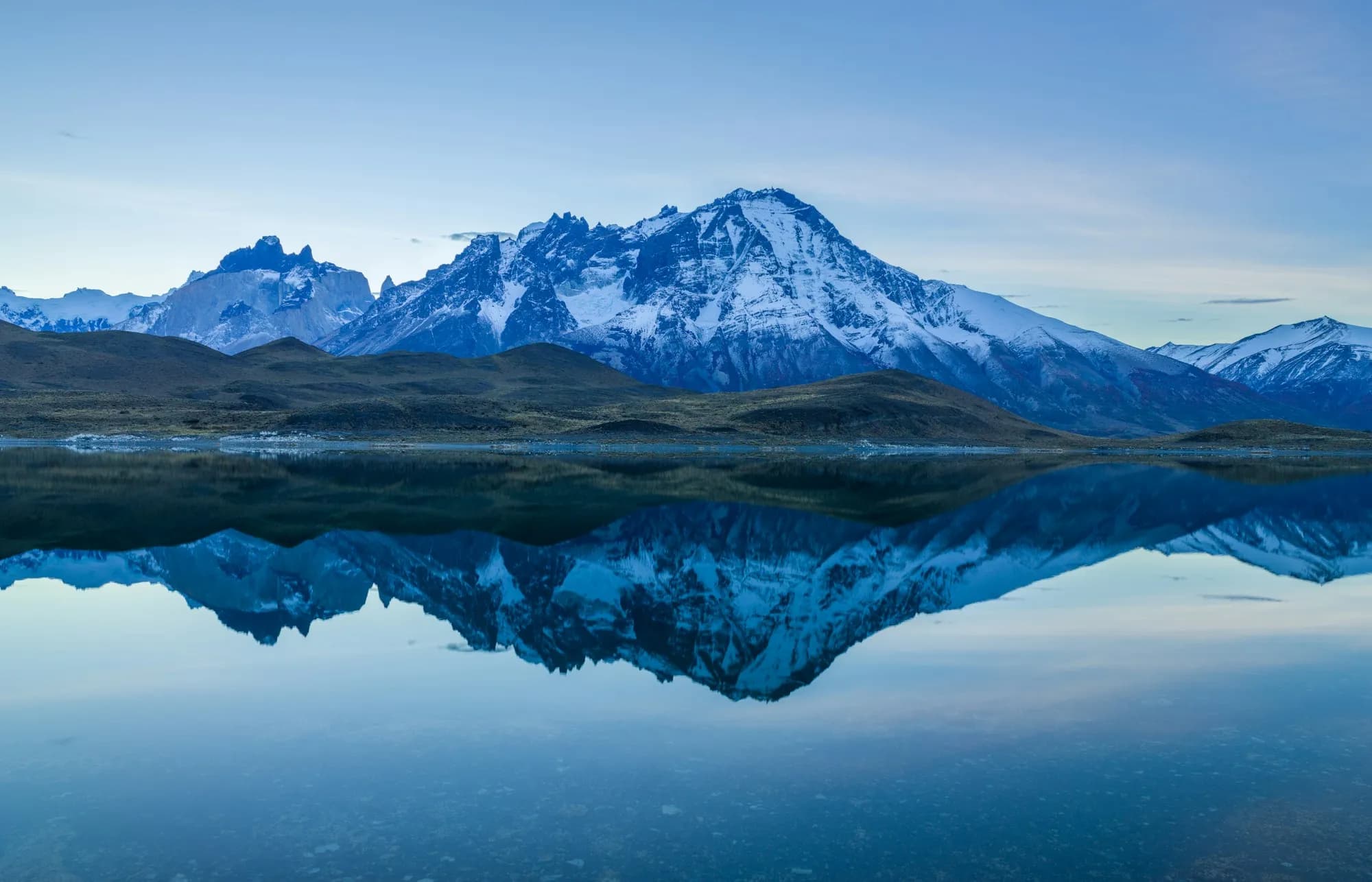
Patagonia is not one place, and the first honest thing a guide can say about it is how much of the map it covers. The Argentine Lakes District around Bariloche and San Martín de los Andes is clear volcanic water and old-fashioned dry-fly fishing; Los Alerces is a chain of short rivers so transparent that you can watch a trout decide against you; Chile adds glacial lakes under volcanoes and the big, turquoise rivers of Aysén; and out on the steppe and down at Tierra del Fuego the fish are of a different order altogether. It is also the southern hemisphere, so the whole calendar is upside down. This guide is a map of the water and a calendar for the visitor, with the licence office and the rulebook left to the people who write them.
Clear water in the north. Big water in the south. Summer in January.
Patagonia: Several Fisheries Under One Name
The word Patagonia gets used for a region about as large as a small continent, and it covers rather different fishing. The northern Argentine rivers are clear, gravelled and technical, a place where the trout have seen a great many flies and want to see yours doing something honest. The lakes are deep and glacial, with browns and rainbows (and in places brook trout) cruising the drop-offs. And the further south and east you go, the bigger and emptier it gets.
This guide is about access and timing: where each kind of water is, which towns work as bases, and who to ask about licences. Tactics are covered in the other playbooks. A caution to start with: this is a southern-hemisphere guide, so every month in it is the opposite of what a northern angler expects. Summer is December to February. If you are travelling from the northern hemisphere, February to April is often the settled window of low, clear water and fewer anglers, while November can be early and variable, with runoff, wind and high water. Many Argentine seasons close in autumn, so check dates before you book.
Bariloche and the Limay: Nahuel Huapi Country
An inland sea, a river leaving it, and two smaller rivers that suit a quiet day.
Bariloche is the natural base for Lago Nahuel Huapi, which is less a lake than a vast basin ringed by peaks, with arms and bays running for kilometres. Brook, brown and rainbow trout patrol the drop-offs and rocky points, and the usual approach is a streamer worked along a drop-off or fished from a drifting boat. The Upper Río Limay runs out of the Nahuel Huapi area towards the Traful confluence; it is a different water from the lower Limay, with different rules, flow drivers and character, so read the venue page for each.
The Río Traful leaves its lake over alluvial gravel so transparent that spotting fish is easier than fooling them. Long leaders, downstream presentations and patience matter more than fly choice. The Caleufú is a modest, clear river threading the country between Bariloche and the Limay system, with alluvial gravel and enough structure to hold fish without feeling crowded; it suits a dry-dropper rig well. The lower Limay, below Arroyito, is a regulated reach towards the Río Neuquén confluence; check its venue page and the local rules before planning around it.
Junín and San Martín de los Andes: The Lanín Rivers
Where Argentine fly fishing is said to have begun, in the shadow of a volcano.
Junín de los Andes and San Martín de los Andes are the usual bases, and Volcán Lanín is the thing you will keep looking up at. The Río Chimehuín, spring-fed clarity flowing off Lago Huechulafquen and past Junín, is often called the cradle of Argentine fly fishing, and the Boca, where the river leaves the lake, has drawn anglers for the better part of a century. Downstream the water gathers pace over gravel and volcanic cobble. Some reaches are fly-only or catch-and-release, so check the rules for the stretch you intend to fish.
Lago Huechulafquen sits directly beneath the volcano. Trolling near the river mouths, particularly where the Chimehuín drains the lake, has long been the most productive method for the big browns in the cooler water by the inflows, though streamers from shore or a drifting boat take fish too. Lago Tromen, beneath the Tromen pass on the way to the Chilean border, is small, quiet and sees a fraction of the pressure of its larger neighbours.
The Malleo is a small, technical stream out of the Lanín volcano's shadow, gin-clear over pale gravel, where trout forgive nothing. It lies within Lanín National Park in part, so check which reaches are covered by the park rules. Huechulafquen and Tromen are park waters too, and Nahuel Huapi is a national park as well, so expect the park authority's permit and rules on these waters. The Aluminé is faster, rockier and wilder, a freestone river through steppe and scattered pehuén forest, and the Collón Curá below the Chimehuín–Aluminé junction is a broader, slower river with more room to swing a streamer.
Los Alerces and Trevelin: Short Rivers, Long Looks
You can watch a trout inspect your fly for several seconds. That is either maddening or the whole appeal.
Los Alerces National Park, in Chubut, is a chain of lakes joined by short, brilliantly clear rivers. Lago Futalaufquen is its principal lake, deep, glacially cut and startlingly clear, holding brook, brown and rainbow trout along drop-offs; a Woolly Bugger or Matuka stripped slowly past structure takes most of the better fish. Wind can build there, so plan the lake for calmer hours.
The Arrayanes, linking Lago Verde to Lago Menéndez past the arrayán forest, is a set-piece river: transparent, slow enough in places to sight-fish individual browns and rainbows over pale gravel, with CDC emergers, ants and beetles on fine tippet. The Rivadavia and the Carrileufú are the same kind of water, short and glass-clear between forested banks, with well-educated fish. These are park waters, so the park authority is the place to check, not a guidebook. Park waters run gear checks for didymo and other invasives, so arrive with clean, dry waders and boots.
The Argentine Futaleufú near Trevelin is the upper river, before it crosses into Chile: clear, granite-bedded water with the unhurried character of a spring creek, slow glides and undercut banks, and fish that sip small dries with deliberation. Access arrangements are provisional and it is mostly fished with a guide, so confirm locally before you go.
The Steppe and the Far South: Strobel and Tierra del Fuego
These are not Lakes District trips. They are separate journeys, and honest ones to plan for.
It would be a mistake to treat these as add-ons. Lago Strobel, the Jurassic Lake of the fishing press, lies in Santa Cruz on windswept steppe. Its rainbows grow to a scale most anglers never see elsewhere, on a lake bed thick with scuds, in cold, clear water with fish patrolling the margins and drop-offs. It is a remote, destination trip, a long way from Bariloche; check dates and access with the operator and the Santa Cruz authority.
The Río Grande in Tierra del Fuego is the reason serious sea-trout anglers eventually go south: sea-run browns pushing up from the South Atlantic through steppe country, taking flies with the weight of migratory fish. Tactics here are specific, and the country offers little visual romance and everything that matters below the surface. This is a different fishery with its own season and rules, and access is almost entirely through lodges or estancias, booked well in advance; a rod here is booked, not improvised. The venue page and the provincial authority are where to start.
Chile: Lago Todos los Santos and the Petrohué
Emerald water under a volcano, reached mostly by boat.
Chile's lakes and rivers sit across the cordillera from the Argentine ones, and Puerto Varas and Osorno are the usual gateways. Lago Todos los Santos is inside Vicente Pérez Rosales National Park, reached mostly by boat from the Petrohué landing, which keeps the pressure low. Brown and rainbow trout are the quarry.
The Petrohué leaves the lake as a broad, glacial-turquoise river past the black cone of Osorno, inside the same park. The water is cold and heavy, which suits streamers fished deep along seams and boulder pockets more than delicate dry flies. The Chilean national fisheries service and the park are the places to check before you go.
Aysén: Coyhaique and the Big Glacial Rivers
Foam hoppers in summer, big water below, and a road that goes on for ever.
Coyhaique is the base for the Aysén region of Chile. The Simpson runs almost through the middle of the town, flows through its own national reserve, and is the most convenient serious trout water in the region; its reputation is made on terrestrials, foam hoppers and Chernobyl Ants, so it is a summer river. The Ñirehuao, east of town where the country opens into steppe, is a slow, spring-creek-style river with genuine sight-fishing for selective browns.
The Baker is Chile's largest river by volume, wide and glacial-blue as it leaves Lago General Carrera, with big browns and rainbows holding in the softer seams and back channels, and streamers fished with weight and patience the method. It is big water that needs respect, and a boat or a guide is the sensible way into it. Further south the Cochrane and the Río Blanco are among the smaller options in the region.
The Patagonian Year
Summer is December to February. For a northern visitor that is the point.
Summer (December to February) is the main season and the one for northern visitors escaping their own winter. The Aysén rivers fish big terrestrial patterns through the summer months and the Lakes District rivers are at their most open. On the big lakes, wind builds, notably on Futalaufquen, and they can be flat calm at dawn and whitecapped by lunch, so fish early.
Autumn (March to May): March and April are often the best of the year for low, clear water and fewer anglers, but many Argentine seasons close in autumn, so April and May may be closed or edge-of-season on the water you want. Little is documented here for these months; check the local season dates and conditions with the relevant authority and a local guide.
Winter (June to August) and spring (September to November): Patagonian rules often fix seasons and closures by water, and many waters are closed through the winter. Treat these months as unconfirmed, and check the current rules and the venue page for the specific water. Early spring brings runoff, wind and high water. The Tierra del Fuego sea-trout fishery runs a short, intense season, so confirm its dates with the authority before committing to a long journey. Leave spawning fish and redds alone.
Access, Gear and Licences
A five-weight for the rivers, a six or seven for the wind, and the right office on the telephone.
A nine-foot five-weight covers the Lakes District rivers and Los Alerces; fine tippet and long leaders for the clear water, a six or seven-weight and a sink-tip or streamer line for the big lakes and the Baker, and a heavier rod again for the sea-run browns of Tierra del Fuego. Take terrestrials for Aysén, and a good windproof jacket for everywhere. Check, clean and dry your waders and boots between waters, and follow local biosecurity rules.
Argentina and Chile each have their own licensing: in Argentina the province, and the national-park authority inside the parks; in Chile the national fisheries service. Exact requirements, seasons and any extra permits for particular waters change, so check the relevant authority and the Rise Daisy venue page before you travel, and confirm access and fees locally. Distances here are long, so build in travel time.