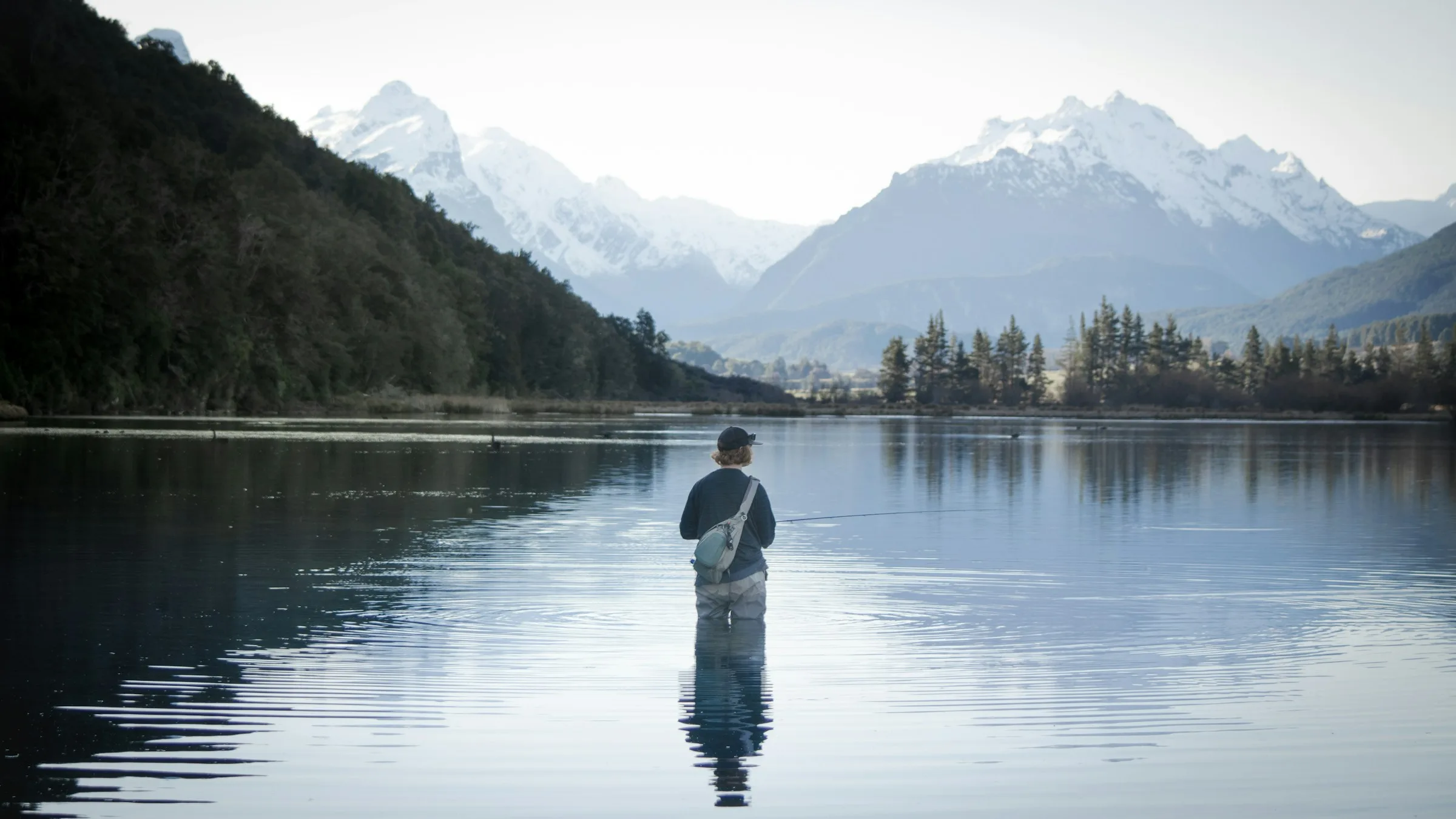
New Zealand makes fly anglers talk in postcards — gin-clear water, big browns, empty valleys, fish you can see from ten metres and still cannot catch. Most of it is true. None of it is the point. The country is best understood not as a list of famous rivers but as a set of very different fishing problems: Taupō lake-run rainbows, South Island sight fishing for browns, West Coast spate rivers that turn dangerous in an afternoon, Canterbury braids that move their own channels. Solve the problem in front of you — the right region, the right water for the day, the right licence in your pocket — and it becomes about as good as trout fishing gets.
Fish the conditions, not the calendar. Earn the take.
A Country, Not a Checklist
New Zealand has a habit of making fly anglers talk in postcards. The clichés are mostly accurate — the water really is that clear, the valleys really are that empty, and you really can spend an afternoon watching a single trout that has no intention of eating your fly. But treating the place as a list of famous rivers to tick off is the surest way to waste a long flight.
The better way to think about it is as a set of very different fishing problems. Lake-run rainbows in the Taupō district. Technical sight fishing for brown trout on the South Island. Rain-fed West Coast spate rivers that go from perfect to dangerous in an afternoon. Big braided Canterbury rivers that rearrange their own channels between visits. High-country freestone, hydro canals, spring creeks, wilderness headwaters. Each is a different puzzle, with a different answer.
Get that right and New Zealand is about as good as trout fishing gets. Get it wrong and you spend a fortnight driving past better options, fishing blown rivers, spooking everything you see, and discovering that your licence was never valid where you thought it was. So the first question is not "where are the famous rivers?" It is "what kind of fishing suits the conditions, the season, and me?"
One Good Fish Is the Day
New Zealand is not a numbers fishery. It is a place where a single trout can justify the walk in.
On the clear South Island rivers you may spend hours walking, watching, and trying to put one accurate cast over one visible brown. It feels more like stalking than casting, and the margin for error is thin — the first cast is often the only one that counts. The reward, when it comes, is out of all proportion to the number of fish in the net. This takes some adjusting to if you have come from water where success is measured in tallies.
Other waters run to a completely different rhythm. The Tongariro and the other Taupō tributaries are often fished as run fisheries, especially for rainbows pushing up out of the lake. Lakes reward wind-lane fishing, stream-mouth tactics, or quietly working the edges for cruisers. West Coast rivers can be brilliant as they drop and clear after rain, and useless or downright unsafe while they are rising. So before you fix on a target, decide what kind of day the conditions are actually offering.
Fish a Base, Not a River
A good trip is built around regions you can fish from, not single rivers you have driven a long way to find blown.
On the North Island, Taupō and Tūrangi are the obvious centres. This is the country of Lake Taupō and its tributaries — the Tongariro, the Tauranga-Taupō, the Waitahanui, the Hinemaiaia — with a strong lake-run rainbow identity, some good browns, and a long nymphing and wet-fly tradition. It is also legally distinct: the Taupō district is managed separately, so plan the licence before you plan the fishing. Further north, the Rotorua lakes — Lake Rotorua, Lake Tarawera — offer stream-mouth and edge fishing with a different feel, while inland rivers like the Mohaka and the Rangitīkei give you wilder, more conventional river days.
The South Island is where most visiting imaginations go first, and with reason. Nelson and Marlborough are classic clear-water brown country — the Motueka, the Buller, the Wairau and their tributaries running from accessible to genuinely adventurous. Southland is famous for the Mataura and its dry-fly fishing, with the Oreti carrying its trophy-brown mythology and the Aparima quietly getting on with it. Otago brings the Clutha / Mata-Au and the high-country waters; Canterbury brings the braids — the Rakaia, the Rangitata, the Waitaki, the Waimakariri — and the Mackenzie headwaters like the Ahuriri. The West Coast is wilder, wetter, and quicker to change its mind than anywhere else.
The practical point is to give yourself options within reach. If your dream river is high, brown, and angry, you want a lake, a smaller tributary, a different catchment, or another region close enough to drive to before lunch. A trip built on a single named river is a trip that depends entirely on the weather behaving.
The Licence Will Not Forgive You
Most of New Zealand is Fish & Game water. Taupō is not. And no licence anywhere grants you a path across private land.
New Zealand freshwater sports fishing is licensed through Fish & Game New Zealand — with one major exception. The Taupō Fishing District, which includes Lake Taupō and Lake Rotoaira, is administered by the Department of Conservation and requires its own licence. A Fish & Game licence does not cover Taupō, and a Taupō licence does not cover anything outside it. Many Taupō district rivers are fly-fishing only, with named exceptions. Sort out which licence you need, where, before you string a rod.
Overseas visitors must hold the correct non-resident licence. Do not assume that a resident licence, a local short-term licence, or whatever someone mentioned in a forum is the right one for you. Buy the licence that matches your status and the water you intend to fish.
A licence permits you to fish under the regulations. It does not permit you to cross private land. New Zealand has superb public access, but it is not universal, and a farm gate, a vehicle track, or a faint path is not an invitation. Use marked access points, ask permission where private land is involved, and treat access as something you earn rather than assume. Before fishing any water, settle three things: which authority manages it, whether the season is open and which methods are allowed, and whether your route in is public or permitted. This is not glamorous. It is the difference between fishing with confidence and making an expensive, embarrassing mistake.
Fish the Conditions, Not the Calendar
The best day on a spate river often comes after the rain, not before it. Learn to read water before you commit to it.
On clear brown-trout rivers, good fishing usually wants stable or falling flows, manageable wind, and enough visibility to spot fish before they spot you. Low, clear water can be magical and can also make trout impossibly alert. High sun helps you see them; cloud often makes them feed more freely. None of it is fixed — which is the whole point of looking before you decide.
West Coast spate rivers reward patience with the weather. They often fish best as they drop and clear: rising water is a warning, falling water is a possibility, and falling, clearing water at a sensible level is the green light. On the Taupō tributaries a fresh can move fish and change the whole mood of a river — the best condition is not always low and clear, and for lake-run rainbows, flow and seasonal movement matter as much as clarity. On the big braided rivers, flow alone tells you little: a river can be technically fishable but coloured, unsafe to cross, or simply too windy to fish well. Channels shift, wading demands respect, and local advice is worth more than any plan made the night before.
This is where visitors most often come unstuck. They arrive with a fixed list, drive to the famous name, and fish it whether or not the river is right. The stronger habit is to wake up, check the weather, rainfall, levels, and wind, and then choose the water type that fits the day. Rise Daisy is built to do exactly this kind of reasoning for you — read the conditions first, pick the venue second.
Slow Down
On many New Zealand rivers the walk is the fishing. Move like you are already in casting range, because you usually are.
The country punishes hurry. On a clear river, scan before you step in. Watch the edges, the bubble lines, the shadows, the pale shapes against the riverbed. You are looking for movement more than for the full outline of a fish — a fin, a tilt, a flash, a small sideways shift. A trout will often give itself away with a gesture rather than a silhouette, and if you are already wading you have probably missed it.
Most visiting anglers wade too soon, cast too soon, and walk too close to the bank. They fish the water they are standing in instead of the water they should have read from ten metres back. On pressured sight-fishing rivers the first cast is your best chance and sometimes your only one, so spend it well: know where the fish is, what it is doing, where the current will carry the fly, where the leader might flash, where your shadow will fall, and what you will do if it eats.
It sounds intense, and it is, but it is also the fun of the thing. New Zealand makes you earn the take, and the earning is most of why people come back.
Fewer Flies, Better Discipline
You do not need a thousand patterns. You need a sensible box and the discipline to present it properly.
For South Island browns, carry a working range of dries, terrestrials, mayfly imitations, small nymphs, weighted nymphs, and dry-dropper rigs. A Parachute Adams, a Royal Wulff, a Gold Ribbed Hare's Ear, a Pheasant Tail Nymph, a Copper John and a Hare's Ear Nymph will cover most situations. Summer brings the terrestrials, and a Cicada, a Willow Grub, a Hopper or a Passion Vine Hopper can be the pattern of the day — but they are not magic. Slim nymphs, careful leaders, and an accurate cast matter more than any fly in the box.
For Taupō and similar rainbow water, weighted nymphs, wet flies, a Glo Bug, and streamers like a Woolly Bugger come into their own. For lakes, think wind lanes, edges, and stream mouths — smelt patterns, a Damsel Nymph, buzzers, and searching flies. For big or coloured water a streamer earns its place; on technical flat water it is usually the wrong tool entirely.
The real secret was never the fly. It is matching the fly, the leader, and the cast to the water in front of you. New Zealand trout are not unbeatable, but they are very good at exposing lazy presentation. Every pattern named here links through to the Fly Box if you want the tying notes and the when-and-why.
Read the Air
Wind is not background weather in New Zealand. It is a primary fishing condition.
Wind governs casting, spotting, dry-fly drift, boat control, and how close you can get to a fish. A light ripple conceals you; a hard nor'wester can turn a dream sight-fishing day into a wrestling match. On lakes, wind direction concentrates food and fish along particular shores. On open high-country rivers it decides which bank you fish, which method you use, and sometimes whether you fish at all.
Plan the day around it. Ask whether you can cast accurately, whether you can see fish, which bank is sheltered, and whether a lake edge, a smaller stream, or a forested river would fish better than the exposed water you had in mind. Ask whether to set aside the delicate dries for a robust dry-dropper or a nymph rig. A good New Zealand angler reads water and air together, and adjusts before the wind forces the issue.
Behave Like a Guest
Fame has a cost, and on fragile sight-fishing water the damage is social as much as ecological.
Some backcountry fisheries are under real pressure from visiting anglers, guides, and the steady drip of social media and dropped map-pins. Crowding named pools, posting exact fish-holding spots, or pushing into sensitive headwaters because someone shared a location ruins the experience for everyone, and on the most delicate waters it does lasting harm.
The best visitors behave like guests. Give other anglers room and do not leapfrog them closely. Keep precise locations to yourself. Be wary of driving straight to a tiny, sensitive stream because it surfaced online. Use well-known public access responsibly. There is nothing wrong with wanting a memorable fish — there is something wrong with taking the value out of a place and leaving pressure, litter, or bad feeling behind.
Check, Clean, Dry
Didymo is established in the South Island and not the North. Moving dirty gear between catchments is how that changes.
New Zealand takes freshwater biosecurity seriously, and so should every angler who fishes there. Check, Clean, Dry is not a slogan to skim past. Clean mud, weed, and water from boots, waders, nets, and any gear before you move between waterways, and pay particular attention to absorbent materials. Felt soles are a known problem because they are so difficult to clean properly — many anglers travelling to New Zealand simply leave them at home.
This matters because pests such as didymo spread when people carry them between rivers on damp gear. Didymo is presently established in South Island waters but not the North — which is exactly why discipline between catchments, and above all between islands, is non-negotiable. Once established, these organisms are extremely difficult or impossible to remove.
On a travelling itinerary, where you may fish several catchments in a week, the cleaning routine has to be built into the day. Carry what you need, allow the time, and never move wet, dirty gear from one river to the next on the assumption that it will not matter. It does.
Match Ambition to Ability
New Zealand can flatter a good angler and humble an average one. That is a reason to choose the right fishing, not to stay home.
If you are newer to the fly, lean toward more forgiving water — lakes, guided days, accessible or stocked fisheries, and rivers where blind nymphing is realistic. If you cast well but have not done much sight fishing, give yourself time to learn to see fish before you expect to catch them. And if you are chasing trophy browns in clear water, accept that blank days are part of the bargain rather than a sign something has gone wrong.
A guide can be worth a great deal, especially early in a trip. Not because you cannot fish without one, but because a good local will teach you to see fish, approach water, read conditions, and avoid wasting days on poor choices. The best outcome is not the fish you catch with the guide; it is how much better prepared you are for all the unguided days that follow.
Have Three Plans
New Zealand rewards planning and punishes rigidity. Book the essentials, then stay loose.
Carry a primary plan, a backup, and a bad-weather plan. Know which rivers rise quickly, which lakes fish in wind, and which smaller streams clear fastest. Know when a day is better spent moving region, scouting, drying gear, or talking to a local tackle shop than flogging blown water. The strongest trips have structure without obsession: book the key things, learn the legal basics, mark the regions, watch the weather, and adapt.
A fortnight might run: several days around Taupō and Tūrangi for lake-run rainbows and the tributaries; a move to Nelson or Marlborough for clear-water browns; a Southland block for the Mataura and its neighbours; a flexible West Coast or Otago section dictated by the forecast; and one or two guided days placed early enough to improve everything after them. That shape gives you variety and resilience — several versions of New Zealand fly fishing rather than one famous river carrying the whole holiday.
A note on the braids: the Canterbury rivers — the Rakaia, the Rangitata, the Waitaki, the Waimakariri — hold chinook (quinnat) salmon as well as trout, but the runs have collapsed in recent years and bag limits are severely restricted, sometimes to a single fish or closed entirely. Treat any salmon as a bonus, check the current regulations before you keep one, and go in expecting trout.
Ambition, Not Entitlement
Go with ambition and leave entitlement at home. The country owes you nothing, and gives more for it.
You are not owed a trophy brown because you flew a long way. You are not owed an empty pool because you saw it in a film, nor private access because the river looked public on a map, nor perfect conditions in a country built of mountains, rain, wind, and fast-changing rivers. New Zealand is indifferent to your itinerary, which is part of what makes it worth the trip.
But slow down, read the water, check the rules, clean your gear, respect access, adapt to the conditions, and fish with patience, and it gives you something better than easy numbers. It gives you fishing you remember in detail: the shape of one trout holding under a willow shadow, the refusal that taught you something, the cicada drift you watched for a second too long, the river dropping into condition, the first proper cast of the morning, the brown that appeared from nowhere and made the whole journey make sense.
That is the real appeal of the place. Not that it is easy — that it can still make fly fishing feel wild, exacting, and completely alive.