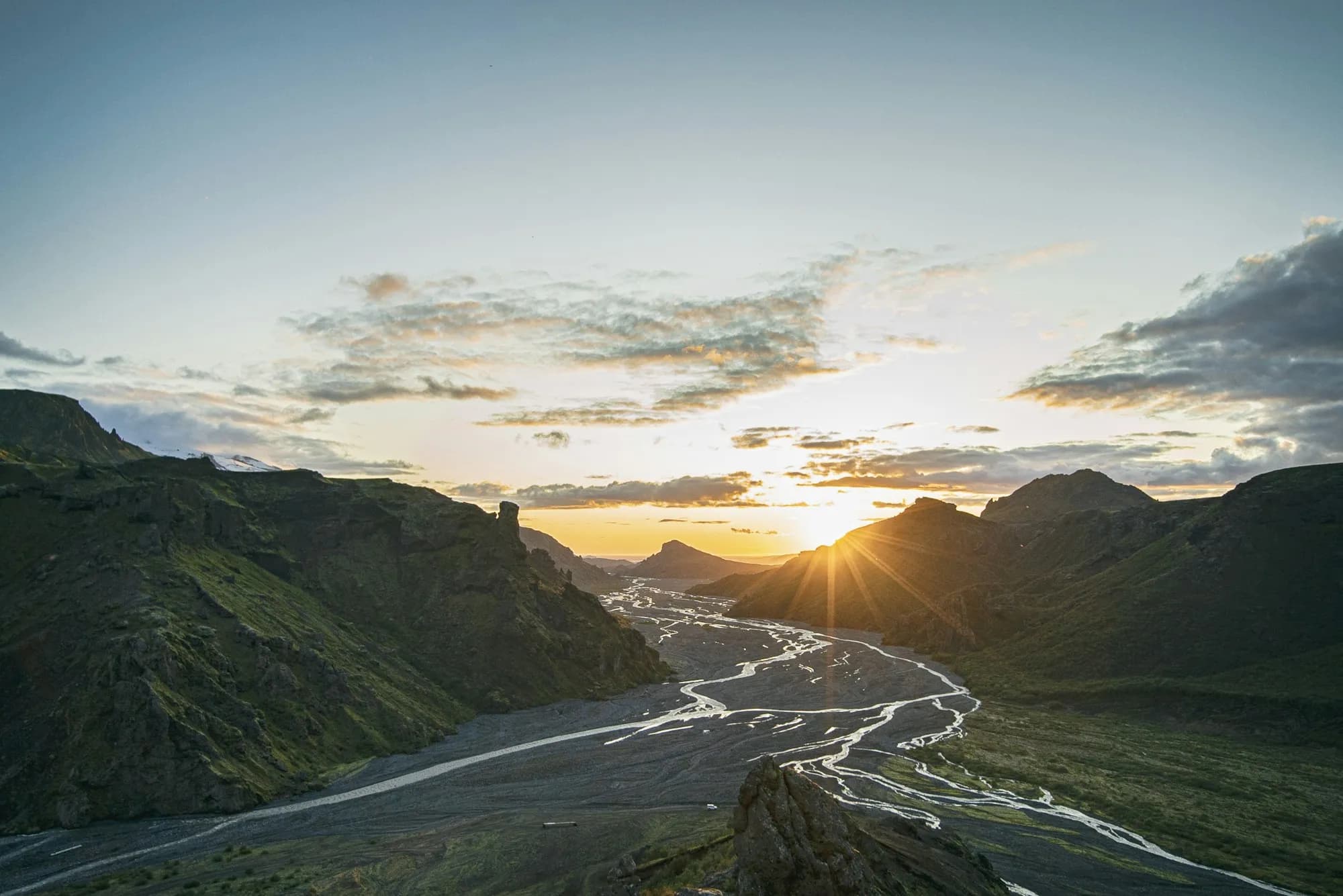
The Iceland playbook is about method: the three kinds of river, small flies, the hitch. This guide is about the map and the calendar. Where do you base yourself, which direction do you drive, and what is actually fishing when you arrive? Reykjavik sits at the south-west corner, and a surprising amount of good water is within a morning's drive of it. The rest is a long way off, in the north and the east, and the season on most of it is short. Iceland rewards the angler who has done the booking and the checking long before the plane lands.
Start from Reykjavik. Choose the water by the month. Check who holds the rights before you set out.
Iceland as a Map and a Calendar
Most visitors arrive with a rod and a salmon in mind and discover that Iceland is really two or three trips. There is the south-west, near Reykjavik, with salmon rivers a short drive from the airport. There is the south coast with its sea-trout waters. There is the north around Mývatn, where the trout and char are the point. And there is the long way east and north-west, where the big rivers sit. Each has its own window, and the windows hardly overlap.
This guide lays those regions out in the order you would drive them. Method is covered in the Iceland playbook and is not repeated here. Everything below comes with one standing caveat: the rights holder or booking agent decides who fishes, when and how many rods, and the venue page is the first place to check.
The South-West: Salmon Within Reach of Reykjavik
Compact rivers, short drives and a base in the capital.
Laxá í Kjós is the one closest to Reykjavik: a productive salmon river with a strong sea-trout side, compact water with easy wading, and a realistic south-west option rather than an ultra-exclusive one.
Further into Borgarfjörður and Vesturland sit the classic spate rivers. Norðurá is powerful water with canyon pools and falls and a strong hitch tradition. Grímsá is intimate and pool-rich, among the most productive per rod-day. Þverá/Kjarrá runs some 64 kilometres through Borgarfjörður and ranks among the top producers. These are rod-limited, lodge-based rivers: ask the rights holder or booking agent what is available.
The South: Rangá, Stóra-Laxá and the Inland Rivers
Big salmon water to the east of the capital, and a river tied to a lake.
Eystri-Rangá is the east branch of the Rangá system, volcanic-country water with salmon and sea trout. The description gives its rule plainly: up to three fish per rod per session under 70 cm may be taken, and every salmon over 70 cm must be released. Vestari-Rangá is the west branch, more commercially developed. Both Rangá rivers lean heavily on ocean-ranched salmon, which is worth knowing when you decide what to keep.
Stóra-Laxá lies roughly 150 km east of Reykjavik, about 90 kilometres from Lake Grænavatn to the Hvítá, with four beats working over 110 pools. Its season runs late June to late September, with early July to mid-August as prime time, and it holds large multi-sea-winter fish alongside sea trout.
The Sog is the outflow of the Þingvallavatn system, and it is one of the more complete multi-species fisheries in the south-west, with char, trout and salmon.
The South Coast: Sea Trout Around Kirkjubæjarklaustur
The small rivers that carry the south coast sea-run browns.
The south coast around Kirkjubæjarklaustur is the heartland of Icelandic sea-trout fishing. Geirlandsá is a small, intimate river of about 22 kilometres rising at Geirlandsbotnar, with two waterfalls and the main sea-trout water in the lower beats, and Arctic char are also present. Fossálar is a Skaftá tributary running through the Laki lava fields; sea trout are the main catch and char are present. Both are fished as one system with Vatnamót.
Vatnamót is a famous south-Iceland sea-trout system whose headline draw is very large sea-run brown trout. Tungufljót, the south-coast one (there is another river of the name in Biskupstungur, so make sure which you are booking), is one of the best-known sea-trout rivers, famous for big sea-run browns and serious late-season fishing, and Litlaá is a smaller spring-fed south-Iceland river known for sea-run brown trout. Spring fishing is for fish that overwintered in the river, often thin and in poor condition, so handle them gently and check the release rules; the main runs come in late summer and autumn. Because the system is shared, ask the rights holder how the beats and rods are arranged.
Mývatn and the North: Trout and Char on Spring Water
The water you go to when you would rather be looking than counting.
Mývatn means midge lake, and the name is accurate. It is a shallow volcanic lake with huge midge hatches and brown trout, with Arctic char also present, with June to August prime. Out of it flows Laxá í Mývatnssveit, a brown trout and char river with prolific midge and caddis hatches and trophy browns to five pounds or more. It is a separate fishery from the salmon Laxá.
Further down the same system is Laxá í Aðaldal, spring-fed and gin-clear, with selective browns and proper dry-fly and sight-fishing. The river carries salmon as well as trout, so ask the rights holder how the beats are run, and it is slow to respond to rain, 48 hours or more, because it is groundwater-fed. The Mývatn and Laxá area has its own protection rules and strict local regulations, so ask before you fish. In practice this is the water that stays fishable when the rain-fed rivers elsewhere have gone out of shape.
Þingvallavatn, the East and the Long Drive
A rift lake close to the capital, and big rivers that take a day to reach.
Þingvallavatn is Iceland's largest natural lake, partly in Þingvellir National Park, famous for trophy brown trout and several forms of Arctic char. The practical season in the national-park area runs from 20 April to 15 September, with stricter early-season fly-only and brown-trout-release rules. It opens in April, ahead of the salmon rivers. Villingavatn, in the same region, is a serious brown-trout-and-char stillwater.
East Iceland is a different journey. Jökla lies about 40 kilometres north-west of Egilsstaðir and is a combined fishery of five rivers managed as one system. It is later running, with August as the peak month and the season extending into September. Blanda in the north is a large glacial-fed river known for big multi-sea-winter fish, and Laxá í Dölum near Búðardalur is another August-peaking river. These are long drives, so plan them around a single base and check the rights holder before you commit.
The Icelandic Year
Short for salmon, longer for trout, and honestly quiet in winter.
Winter (December to February): there is no season. The salmon, sea-trout and trout waters here are closed or frozen, and the earliest fishing is in April, with the south-coast sea trout and the Þingvallavatn opening. Winter is the time to book.
Spring (March to May): from April the south coast offers spring fishing for sea trout that overwintered in the river, rather than the main run, which makes it the early option. Þingvallavatn's national-park season opens on 20 April under stricter early-season rules. Salmon rivers are not yet open.
Summer (June to August): the main season. Most salmon seasons run from June to late September, so check each river's dates; Mývatn is listed as prime from June to August, and Stóra-Laxá is at its best from early July to mid-August. Jökla and Laxá í Dölum come on in August.
Autumn (September to November): most salmon seasons close around the end of September, though some rivers, the Rangá among them, run later. The main sea-trout run comes in late summer and autumn and can carry on after the salmon rivers close, and Þingvallavatn's season ends on 15 September. Beyond that, check each water directly.
Booking, Rules and Gear
Ask early, read the rules, and bring clean kit.
Icelandic salmon rivers are commonly managed by the rights holder under rod limits and bag rules. We do not describe the booking systems for individual waters, so use the venue page and ask the rights holder or booking agent directly. Salmon rules vary from river to river: Blanda allows one male salmon under 68 cm per shift before catch-and-release applies, and Eystri-Rangá has its own limits. Read the rule for the river you have booked.
Gear follows the playbook: a single-handed rod for the trout and char waters, something heavier for the big salmon rivers, and fine tippet for the spring-fed rivers. Your gear must be disinfected or certified before it enters the country, as the playbook explains. Bring rubber soles and a weatherproof layer, whatever the forecast says.