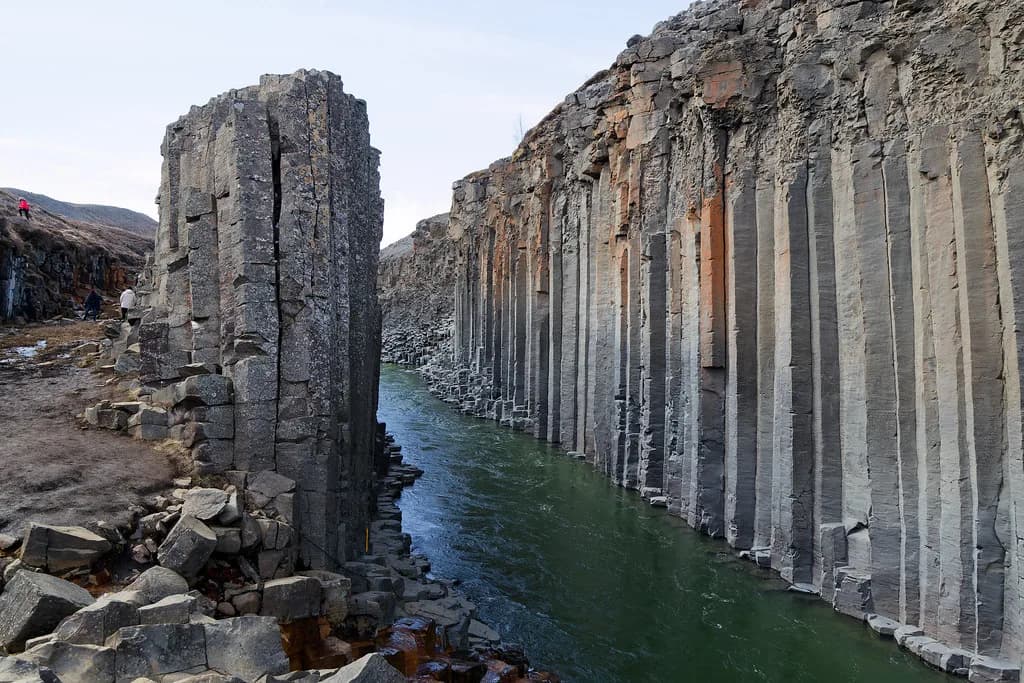
Iceland asks more of an angler's hours than almost anywhere else, and gives fewer of them. The salmon season runs barely three months. The water is cold and usually very clear, which means small flies fished near the surface and a fish that sees everything you do. And the rivers come in three kinds — glacial, spring-fed, and direct runoff — that respond to completely different weather, so that two rivers forty kilometres apart will fish nothing alike on the same afternoon.
Find out which of the three kinds of river you are standing in. Then go smaller than you think.
The Three Kinds of Icelandic River
Iceland gives an angler less time than almost anywhere else and asks more of the hours it gives. The salmon season is barely three months long. The rivers run cold enough that a fly which works on the Spey in July is often too big here in any month. And the weather does not so much change as rearrange itself, twice, while you are tying on.
What makes it navigable is that Icelandic rivers come in three kinds. A glacial river is fed from the ice caps. It carries rock flour, runs opaque, and rises with warm weather rather than with rain — which is the opposite of the instinct most visiting anglers arrive with. The Skaftá and the Jökulsá rivers are glacial, and so, in their lower reaches, are Ölfusá and Þjórsá. On these rivers clarity is the number that matters, not level.
A spring-fed river has been filtered through lava. It is clear, cold, and astonishingly steady — the same river in August as in June, give or take a few centimetres. Laxá í Mývatnssveit and Brúará are the examples worth travelling for. Insect life is rich, the fish are educated, and the water is almost insultingly transparent.
A direct-runoff river takes rain and snowmelt straight off the fells. It rises and falls fast, much as a Scottish spate river does, only colder and usually clearer. Most of the classic salmon rivers of the west and north behave this way: Norðurá, Þverá, Grímsá, Langá, Miðfjarðará, Vatnsdalsá.
A spring creek and a glacial river forty kilometres apart will fish nothing alike on the same afternoon. Anyone who treats Iceland as a single place will spend a week fishing the wrong half of it.
A Season Measured in Rod-Hours
Three months for salmon, two runs for sea trout, and a day split into two sessions with the river rested in between.
Salmon rivers open around the third week of June and close in late September. Rod numbers are strictly limited and beats are booked well in advance — often a year or more on the best water. A fishing day is usually divided into two sessions, roughly seven in the morning until one, then four in the afternoon until ten at night, with the river rested between them. The arithmetic of a trip is done in rod-days, not in weeks.
In late June you fish the evening session in broad daylight at eleven at night, which takes some adjusting to and is one of the genuine pleasures of the place. By September the light is going properly again, and the fish behave as though they know it.
Sea trout run to a different clock entirely — a spring run from April into May, and an autumn run that carries on after the salmon rivers have closed. Brown trout and char fish through the whole of it, and are at their best when everyone else has gone home.
Salmon: Small Flies in Clear Water
Cold, clear water means small flies fished near the surface — and a fish that can see everything you do.
The Atlantic salmon does not feed in fresh water. Everything the salmon angler does in Iceland follows from that, and from one further fact: the water is cold and usually very clear.
Start smaller than instinct suggests. A size 14 or 16 double, or a micro tube of an inch, covers most Icelandic summer water. Go up only when the river is carrying colour after rain, and come down again as it drops. Fish the pool from the neck through to the tail, a step between casts, and cover the water properly before you change anything. When you do change, change size before pattern.
The riffling hitch is not a trick here. It is the first thing to try, not the last. A half-hitch behind the head sets the fly skating across the current, dragging a small V of wake behind it. It works because the fish lie in clear, shallow, fast water and will come a long way up through it for something moving on the surface. Fish it on a floating line, across and slightly downstream.
Do not strike when the wake disappears. Wait until the line tightens. This is the hardest instruction to follow and the most important one on the page.
Patterns worth carrying: a Sunray Shadow for fish that will not move to anything slower, stripped fast and square; small Frances tubes in red and black when nothing is showing; Snælda, an Icelandic tube in blue and gold, for bright water; and a box of small plastic hitch tubes, which will do more work than anything else you bring.
Two rivers behave unlike the rest. The Rangá rivers in the south are supported by smolt release on a large scale and produce numbers no wild river can match — they fish more like a fishery than a wilderness, and there is no shame in that. The great northern rivers — Laxá í Aðaldal, Selá, Hofsá, Vatnsdalsá, Miðfjarðará — are wild, harder, and hold the fish most anglers come for.
Sea Trout in the South
Where the glacial Skaftá meets clear spring water, and the seam between them moves through the day.
The sea trout fishing sits in the south, in the cluster of waters around Kirkjubæjarklaustur where the glacial Skaftá runs into a set of clear spring-fed streams: Vatnamót, Geirlandsá, Fossálar, Tungufljót. Vatnamót means the meeting of waters. That is exactly what it is, and exactly why the fish are there.
There are two runs. Fish enter in spring, from April into May, and again in autumn as the salmon season closes. The autumn fish are larger and in better condition, and the autumn fishing is the reason to plan a trip around this corner of the country.
Unlike sea trout in Wales or Cumbria, these are not primarily a night quarry. The fishing is done in daylight. The deciding variable is not darkness but clarity — specifically, where the glacial water is mixing with the clear.
Fish the seam. Where opaque meets clear, a sea trout can see your fly without being able to see you, and that band shifts through the day as glacial input rises and falls with the sun on the ice. A team of small wets, or a single weighted fly worked slowly through the mixing line, is the method. Black and blue, sizes 10 to 14.
The Fishing Nobody Flies In For
Two of these waters are among the best of their kind anywhere, and most visitors never get around to them.
Laxá í Mývatnssveit is a spring creek in the way the Test is a spring creek, except that it runs over black lava through a treeless valley and holds wild brown trout that average rather more than anything in Hampshire. The flow barely changes all summer. The insect life is extraordinary, and the clouds you walk through are blackfly rather than midge — which matters, because the fish are eating them. Fish small, fish fine, and expect to be inspected. These trout have seen a great deal of fur and feather.
Þingvallavatn is the other one, and it is genuinely strange. The lake sits in the rift where two continental plates are pulling apart. It is fed through fissures in the lava rather than by rivers, and it holds four separate forms of Arctic char that evolved in place, alongside brown trout that reach sizes people tend not to believe until they are shown a photograph. It is not easy fishing. It is not meant to be.
Char are everywhere else too, and they are the most obliging fish in the country. Worth knowing about on the afternoon when the salmon river is unfishable and you would still rather be standing in water than not.
Reading the Gauge Before You Leave the Car
The three river types respond to completely different things, which is what makes an Icelandic gauge worth reading.
On a direct-runoff river, watch the level. It rises within hours of rain and fishes best on the drop, exactly as a Scottish spate river does. This is the familiar case, and the one most visiting anglers already know how to read.
On a glacial river, level is close to useless and temperature is the tell. Warm, still weather melts ice, and the river dirties while the sun shines. These rivers can fall out of condition on the finest day of the week — which is counter-intuitive enough that it catches people out every season.
On a spring-fed river, almost nothing moves, and that is the point. When every other river in the region is either flooded or bones, the spring creek is fishing as it was a fortnight ago. It is the obvious fallback on a bad week, and the reason to keep one within reach of wherever you are staying.