North Country Spiders
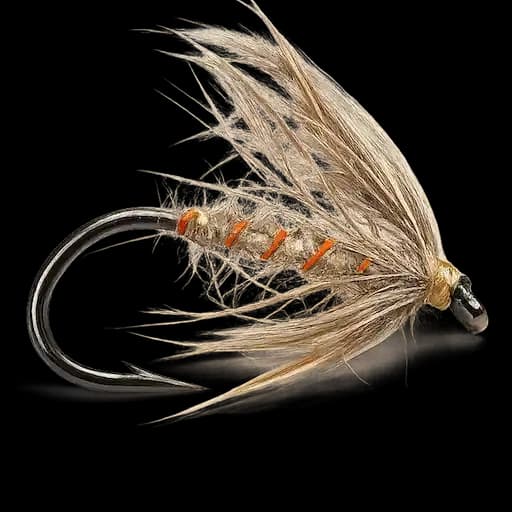
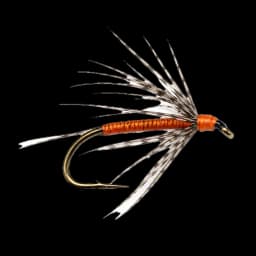
A North Country spider is about as far from a modern fly as fly fishing gets: one or two turns of partridge or waterhen hackle round a silk body, no wing, no flash, tied so sparse the hook barely disappears. Codified by T.E. Pritt in 1885, it is one of the oldest continuously fished fly patterns in the English-speaking world, and on its home water it still out-fishes everything else in the box.
When & Where
Essential Gear
The core team on size 14–16 hooks, point to top dropper: March Brown Spider (hare's ear body, brown partridge hackle), Waterhen Bloa (mole fur body, waterhen hackle), Partridge and Orange (orange silk body, grey partridge hackle). Tie them sparse — a fat spider repels trout. A 9ft leader tapered to 4-5x carries all three comfortably.
How It Works
Cast 45 degrees across and slightly downstream with a high rod. Let the current swing the flies through a quarter-circle arc on a short line of 10-12 yards — no mending, no stripping. At the end of the swing, twitch the rod tip to trigger any fish following the top dropper. The take feels like a handshake, not a snatch: lift the rod to set, never strip-strike.
Common Mistakes
Adjusting the Method
By season
Peak trout months are April through June, when olives and March browns are hatching steadily. The method goes quiet in high summer once hatches thin out, then comes back for grayling from September to February, fishing well even in near-freezing water.
By species
Wild brown trout take spiders confidently in the film during a hatch. Grayling, feeding from the bottom with an inferior mouth, take the swung spider on the drop or at the hang far more readily than trout do once the water cools — this is arguably a better grayling method than a trout one.
By water
Developed on Yorkshire and Derbyshire freestone streams but effective on any clear, broken river with a decent hatch — the same team works on Pennine becks, the Welsh Marches, and comparable water across northern Europe.
More in Wet Fly
The river is the hero, not the app. · © 2026 Rise Daisy