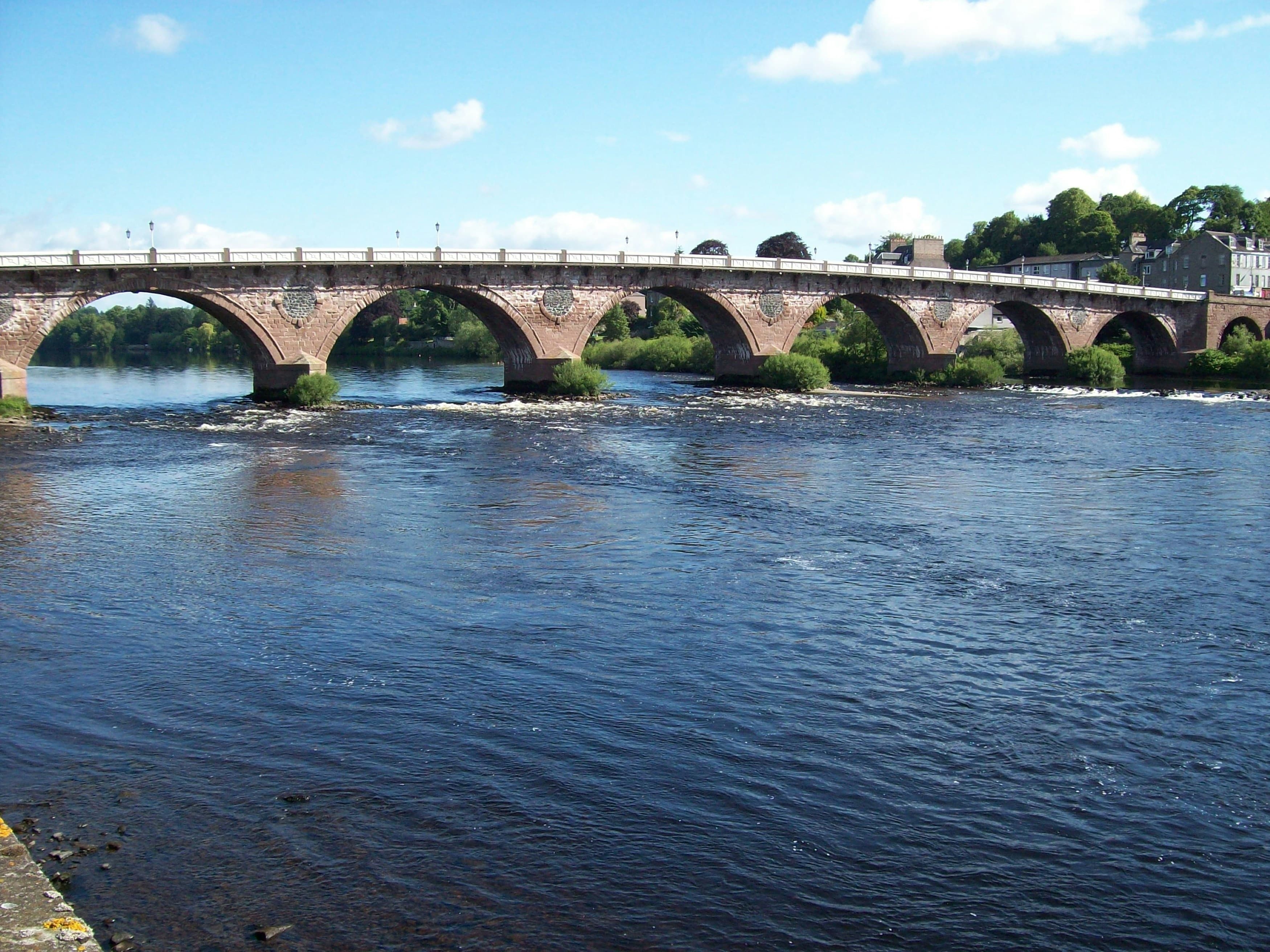
Perth does not have to work hard to justify itself as a fly-fishing base, because the River Tay runs directly through the middle of it — the longest river in Scotland, and the one most associated with big spring salmon.
The Tay is the headline, but the River Earn joins a few miles south with its own quieter trout and salmon fishing, and Loch Leven — one of the most storied wild brown trout fisheries anywhere — is forty minutes away near Kinross.
The Tay for the big spring day. The Earn when the Tay is too much river. Loch Leven for boat-fished wild browns with more than a century of reputation behind them.
Fly Fishing from Perth: The Fair City on the Tay
Perth does not have to work hard to justify itself as a fly-fishing base, because the River Tay runs directly through the middle of it. That is not a metaphor about civic pride. It is the actual river — the longest in Scotland, and the one most associated with big spring salmon — flowing past the city on its way to the Firth of Tay, and a fly angler based in Perth is standing in salmon water before the coffee has gone cold.
The Tay is the headline, but it is not the whole story. The River Earn joins a few miles to the south, quieter and more intimate, with its own trout and salmon runs. And Loch Leven, forty minutes south towards Kinross, is a name that carries weight well beyond Scotland — a wild brown trout fishery that anglers have travelled to fish for well over a century, and one that is still boat-only, still fly-only, and still run the way it has more or less always been run.
The Legal Bit, Briefly
Scotland has no state rod licence — but fishing for salmon without legal right or written permission is a criminal offence, and access is controlled by riparian owners, clubs and associations.
Scotland works differently from England here, and it catches visiting anglers out more often than it should. There is no national rod licence to buy. What there is instead is a legal requirement to have the right — through ownership, lease, club membership or a purchased permit — to fish a particular stretch of water for salmon. Fish without it and it is a criminal matter, not a civil one.
In practice this means permission is everything. Perth & District Anglers Association (PDAA) controls trout and salmon beats on both the Tay and the Earn and, unusually for a Scottish angling club, full membership is open to anyone regardless of where they live — not just local residents. For visitors who want a single day rather than a season's membership, day permits for Tay salmon fishing are also sold independently through local beat agents. Check current terms before you travel; beats, rules and prices are the kind of thing that change from one season to the next.
The Tay and the Earn: PDAA Water
Roughly 3,000 rod days a season across Tay and Earn beats, salmon and brown trout, and a club that lets you join no matter where you live.
Perth & District Anglers Association is the natural starting point, and it is a genuinely large operation for a club of its kind — something in the region of 3,000 rod days a season across its Tay and Earn beats between salmon and brown trout fishing. That scale matters: it means the water is being properly managed for volume, not rationed out to a handful of members while everyone else queues.
The Tay itself is broad, powerful, and demands respect — wading depths change quickly, currents are stronger than they look from the bank, and a local's judgement about a beat's safe water is worth more than confidence borrowed from a smaller river. Spring fishing here is built around big springers running up from the sea while the water is still cold; a floating or intermediate line with a decent-sized tube or Waddington covers most early-season situations. As the season warms, fly sizes come down and presentation gets more considered.
The Earn is the gentler alternative a few miles south — narrower, more intimate, easier to read, and a sensible choice on a day when the Tay is running high or simply feels like too much river for the conditions. Brown trout fishing on both rivers rewards a fairly conventional approach: upstream nymph or a searching dry in bright, low water; something with a bit more movement when the river is carrying colour.
Loch Leven: Worth the Reputation
Boat-only, fly-only, and one of the most famous wild brown trout fisheries anywhere — forty minutes from Perth, run by Loch Leven Fisheries out of Kinross harbour.
Loch Leven earns its reputation honestly. It is boat-fishing only — no bank fishing permitted — and strictly fly, managed by Loch Leven Fisheries from the harbour at Kinross, on the loch's south-west shore. The season runs roughly April into early October, with day, evening and early-Saturday-morning sessions available through the season.
What makes it worth the drive is the fish themselves: wild brown trout in a loch large enough to hold genuinely good numbers of them, fished from a boat with an outboard so you can cover water rather than being anchored to whatever the bank allows. Traditional wet-fly teams on a drift work as well here as they ever have — the loch has not needed reinventing. Watch for hatches of buzzer and olives through the season, and fish the drift with the wind rather than against it whenever the boat allows.
Book ahead, particularly for a summer weekend. This is not a quiet secret any more, and has not been for a very long time.
The Perth Year
Spring for early Tay springers and Loch Leven waking up. Summer for Earn brown trout and Loch Leven at its best. Autumn for the Tay's back-end salmon run.
Spring is Tay salmon country at its most classic — big fish running up from the sea into cold water, fished with sink-tip lines and bigger flies before things warm through into summer. Loch Leven opens for the season around this time too, though the loch typically fishes better once the water has had a few weeks to warm.
Summer shifts the emphasis to brown trout on the Earn and dry fly on both rivers when conditions allow, alongside Loch Leven at its most consistent — buzzer hatches, warmer water, and the boats out in numbers on a settled evening.
Autumn brings the Tay's back-end salmon run, historically one of the most reliable stretches of the Scottish salmon calendar, as fish continue to move upstream into the cooling water. It is worth checking each beat's exact season dates before planning a trip — they are set annually and do shift.
What to Carry
A 13'–15' double-hander with sink-tip and floating lines for the Tay. A 9'–9'6" 5–6 weight for the Earn and Loch Leven's dries. Wading boots rated for the Tay's pace, not just its depth.
For the Tay: a 13' to 15' double-handed rod covers most spring and back-end situations, with both a sink-tip and a floating line so you can adjust to water height and temperature without a second trip to the car. Tubes and Waddingtons in the 1–2 inch range for cold water, scaling down as the season warms.
For the Earn and Loch Leven's wild browns: a 9' to 9'6" 5- or 6-weight single-hander is the honest all-rounder — nymphs and searching dries on the Earn, traditional wet-fly teams from the boat on Leven. Bring a proper wading staff and boots rated for genuine current, not just depth; the Tay's pace surprises people who have only fished smaller rivers.
Check season dates, beat rules and permit requirements before travelling on all three waters — Scottish salmon fishing in particular carries real legal weight around permission, not just etiquette.
The Final Verdict
The Tay for the big spring day. The Earn when the Tay is too much river. Loch Leven when you want boat-fished wild browns and don't mind sharing the reputation with everyone else who knows about it.
Not many cities anywhere have a river like the Tay running through the middle of them, let alone one with the Earn a few miles further on and a loch like Leven within easy reach. Perth's case as a fly-fishing base does not need much dressing up — the geography does the work.
The Tay for the big spring day, fished with respect for a river that is genuinely powerful. The Earn when you want something gentler, or when the Tay is running too high to fish comfortably. Loch Leven when you want a boat, a wind on the water, and wild brown trout that have earned their reputation the honest way — over more than a century of anglers coming back for exactly this.