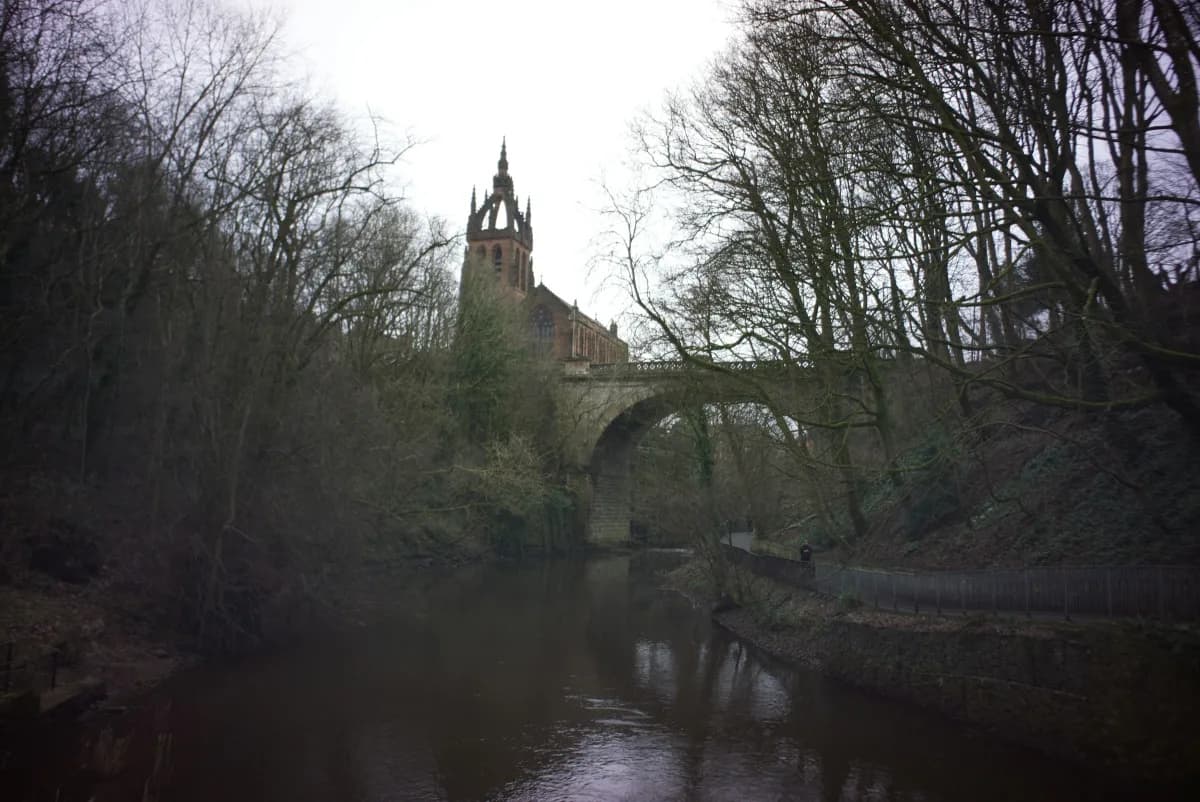
The first thing to understand about fly fishing from Glasgow is that the geography does most of the work for you. An hour's drive in almost any direction puts you on water that would justify a holiday in itself. The Clyde, with its wild brown trout and grayling, is closer than most of the city's commuters think. Loch Lomond and the River Leven, which together form one of the great salmon and sea-trout systems of central Scotland, are barely further. And if you want nothing more complicated than a stocked rainbow that will pull line — the kind of evening that doesn't ask anything difficult of you — Carbeth and Woodburn are half an hour out of town.
Clyde for wild trout. Menteith for the proper stillwater day. Leven and Lomond for the salmon gamble.
Fly Fishing from Glasgow: Better Than You'd Think
Glasgow sits in an awkwardly good spot. The Clyde itself runs through the city, but the fishable trout and grayling water — managed by United Clyde Angling Protective Association (UCAPA) — starts upstream of the worst of the urban stretch and runs for something like 130 bank miles. To the north, the Endrick and the Leven feed Loch Lomond. To the east, the Carron Valley reservoir holds wild brown trout in a thousand acres of windswept water. To the north-east, the Lake of Menteith is one of the prestige stillwater fisheries in central Scotland. None of it is more than an hour away.
This guide is about access — where to go, what kind of fishing it offers, and what to expect when you arrive. The method lives in the playbooks: the Spate River Playbook for the Clyde and Endrick, the Salmon Playbook for the Leven and Lomond system, the Big Stillwater Playbook for Menteith and Carron Valley, the Small Stillwater Playbook for everything else. What the Glasgow angler needs first is the map.
The Legal Bit, Briefly
Scotland does not have a general freshwater rod licence. You still need permission for every water you fish.
This catches English visitors out every time. In Scotland there is no equivalent of the Environment Agency rod licence — you do not buy an annual permit from the government. What you need instead is a permit, club ticket, or written permission for the specific water you intend to fish. Without it you are poaching, regardless of whether you bought a national licence somewhere else.
The other rules to know: salmon fishing is prohibited on Sundays across Scotland. The national brown trout close season runs from 7 October to 14 March — fish caught outside the season, even incidentally, must be returned. Individual fisheries layer their own rules on top: barbless hooks, catch-and-release, fly-only stretches, season dates that may be tighter than the national minimum. Check before you go.
The River Clyde: Wild Trout and Grayling Within an Hour
The strongest "proper river" option near Glasgow. UCAPA waters cover roughly 130 bank miles of trout and grayling water, with migratory permits available for the salmon and sea-trout months.
The Clyde isn't pretty in the lower city, but go thirty minutes upstream and it turns into the kind of river a fly angler dreams about — riffles, glides, pocket water, and wild brown trout that fight harder than their size suggests. UCAPA controls the bulk of the fishable water and sells day and season tickets for both freshwater (trout and grayling) and migratory (salmon and sea trout). The brown trout season runs 15 March to 6 October; grayling kicks in for the winter months from 7 October to 14 March; the salmon season runs 11 February to 31 October.
A typical Clyde year goes like this. In March and early April the river fishes with March browns and dark olives — heavy, swimming nymphs in the morning, dries in the afternoon if the wind drops. From May into June the olives and needle flies build into the most reliable surface fishing of the season; sedges take over for the evenings of June and into July. By high summer the trout get harder to find on dry fly, and the bigger fish are reported to switch into a more predatory mode — minnow-feeding in the slacks, which is when a small sculpin or olive zonker fished with intent through a long glide can produce the surprise fish of the season. September brings the autumn olives, the river cooling, and the last of the trout fishing before grayling take over for the winter.
For grayling — and the Clyde holds a genuinely good grayling population — think Czech and Euro nymphing through the pockets and faster runs, or a small dry on a still afternoon when the fly is in the air. The fish are willing in cold water that would put the trout into hiding, which is what makes them the specialist's reward through November, December and January.
Lake of Menteith: The Prestige Stillwater Day
The serious stillwater choice within an hour. Boat fishing for stocked rainbows on one of central Scotland's best-known trout waters.
If you only do one stillwater day a year from Glasgow, do it on Menteith. It is the kind of water that takes itself a little seriously and earns the right to — rods hired at the lodge, boats on the moorings, the wind coming through the gap in the trees and putting the perfect wave on the surface. Late sessions are typically available through the summer, which means you can fish into the evening when the buzzers come off and the trout start porpoising in the lanes.
This is buzzer water for half the year and a sedge water in summer. Two rods up on a long leader, washing-line through the wave, the bob fly worked just enough to hold a fish's attention without scaring it. The fish are not small — a good Menteith trout in the back end can be a properly heavy fish — and the wind does the work that defines loch-style fishing. Hire a boat, take a drogue, fish with someone who knows the drifts if you can.
Carron Valley Reservoir: The Wild Trout Day
Membership-style wild brown trout fishing in a thousand-acre central Scotland reservoir, about an hour from the city.
Carron Valley is what you do when Menteith feels too civilised. The fish are wild — not stocked — and they fight with the kind of conviction that wild trout in cold, deep water tend to have. The reservoir is over a thousand acres, set in moorland that catches every wind off the Campsies, and on the right day it produces fish that justify the drive twice over.
Approach it as a loch-style water: drift broadside on a moderate wave, teams of wet flies for the bob, the middle and the point, and a willingness to change up and down through the water column as the light shifts. The Bibio, Kate McLaren, Soldier Palmer family on the bob; a small Diawl Bach or Hare's Ear in the middle; an olive nymph or Pheasant Tail on the point. When the fly is on the water in the evening, watch the wind lanes for the rise that suggests where a fish is cruising, and put your team across his line.
River Leven and Loch Lomond: The Salmon and Sea-Trout System
Central Scotland's premier migratory fishery. Day and weekly tickets through LLAIA cover the Leven, Endrick mouth, and Loch Lomond itself.
The Leven runs from the southern end of Loch Lomond down to the Clyde estuary at Dumbarton. It is short, holding water along its whole length, and it carries every salmon and sea trout that enters the Lomond system. The Loch Lomond Angling Improvement Association (LLAIA) describes the Leven as the premier salmon and sea-trout fishery of central Scotland, and the description is accurate. Day, weekly and season tickets are available through local retailers.
Fish the Leven as a small-to-medium salmon river. In high water, big tubes and intermediate or sink-tip lines down and across through the holding pools — the classic broadside swing, working the fly slowly through the taking line at the speed the fish wants. As the river drops and clears, scale down: size 8 and 10 doubles, floating lines, lighter leaders. Fresh-run fish move on every tide that pushes them up out of the estuary, and a fish that has only been in fresh water for a few hours is the most takeable salmon you will ever cover.
On Loch Lomond itself, fish from a boat — drifting the bays and the shore-line on a moderate wave, working three wet flies or a small dap, watching the shore structure. Pike and coarse fish share the loch with the migratory game; this is genuine multi-species water if you choose to use it that way.
The brown trout fishing on Lomond is also worth the effort, although it lives in the shadow of the salmon and sea-trout reputation. Wild fish, sometimes very wild, in clear water that asks for a quiet approach.
The River Endrick: The Spate Gamble
Spate-dependent salmon and sea-trout fishing on the principal Loch Lomond tributary. Best after rain when the river is falling and clearing.
The Endrick is the river that teaches a Glasgow angler to read a rain gauge. In low water it holds very little — the salmon and sea trout sit in the loch and wait. After a meaningful spate, fish push up off the loch into the river, and for a window of perhaps two or three days the Endrick fishes as well as anywhere in the central belt. LLAIA tickets cover the lower river, with the upper water typically club or estate water.
Night fishing for sea trout on the Endrick after a spate, in July or August, is the classic British sea-trout pursuit in its purest form. Walk the beat in daylight, mark the wading line and the obstructions, fish a Medicine or a small Surface Lure across and down through the pool tails as the dark comes in, and let the fly swing slowly. The takes, when they come, are unmistakable. Bring midge nets. You will need them.
Stocked Stillwaters Within Half an Hour
Carbeth, Woodburn, Wellsfield, Black Loch, Swanswater. The dependable evening sport.
For the after-work session that doesn't ask anything heroic, the central belt has plenty. Carbeth Fishery is the closest — twenty-five to thirty-five minutes out of Glasgow, open seven days, fly and bait ponds, with brown trout returned to keep a residual wild population alive. Woodburn, on the Campsies side, stocks trout from two pounds to over twenty, which is sensational or absurd depending on what you came for. Wellsfield, towards Stirling, runs three stocked lochans with seventy bank pegs, rod hire, tackle, food, and accessible platforms — a good first-time fly fishing venue. Black Loch at Limerigg is a 124-acre water with both boat and bank fishing, more of a proper stillwater day than a small pond session. Swanswater near Stirling adds float-tube fishing to the bank and boat options, with a separate bait water on the Millpond if you have non-fly anglers in the group.
None of these is the Test, and none of them pretends to be. What they are is a guaranteed bend in the rod within forty-five minutes of the city, which is more than most cities in the world can offer.
The Forth & Clyde Canal: The Urban Curiosity
Perch and pike on small streamers, towpath access, an SFCA canal season ticket required.
Not classic game fishing, but worth knowing about for the urban explorer. The Forth & Clyde Canal runs through the north of the city and is fishable on an SFCA canal season ticket. Perch on small streamers, pike on bigger ones, fish that must be returned, fishing from the towpath side only. As an evening's diversion within twenty minutes of central Glasgow it is genuinely interesting, and a four- or five-weight rod with a floating line and a few perch buggers will keep you entertained.
Gear: The Glasgow Kit
A nine-foot five-weight covers the rivers and the small stillwaters; a ten-foot seven-weight handles Lomond, Menteith and Carron Valley.
The standard Glasgow trout outfit is a nine-foot five-weight with a weight-forward floating line — it handles the Clyde, the small stillwaters, and any reasonable size of fly from a size 18 olive to a size 12 sedge. Add a ten-foot seven-weight with a floating and an intermediate line for the bigger stillwater days at Menteith, Carron Valley and Lomond. For the Leven in spring high water, a fourteen- to fifteen-foot double-handed rod with a Skagit head and a range of sink tips is the right tool; in summer low water, a thirteen-footer with a floating line and a small double is more useful.
Flies: the Clyde wants March browns and dark olives in March and April, olive and needle-fly patterns in May–June, sedges through summer, autumn olives in September, and small zonkers or olive sculpins for the predatory window in high summer. Grayling: heavy tungsten nymphs in 14 and 16, with a small dry on a calm afternoon. Menteith and Carron Valley: black buzzers, Diawl Bachs, Hare's Ears, the standard loch-style team of Bibio, Kate McLaren, Soldier Palmer, and a few damsel patterns for summer. Leven salmon: Cascades, Park Shrimps, Stoats Tails in sizes from 6 doubles down to 14 trebles, with a few small tubes for high water.
Barbless throughout, regardless of whether the fishery requires it. A small wading staff for the Clyde is worth more than it weighs.
The Glasgow Angler's Year
Trout March to October, grayling October to March, salmon February to October, sea trout June to August, stillwaters effectively year-round.
Spring — March through May: the Clyde opens for trout on 15 March with March browns and dark olives. The Leven salmon season is already running (open 11 February); spring fish are the prize and a small number do come. Stocked stillwaters fish well as water warms. Menteith opens; Carron Valley starts to come into form by late April.
Summer — June through August: peak surface fishing on the Clyde, with sedges and olives. Sea trout fishing on the Leven and Endrick begins properly — night fishing after rain. Menteith and Carron Valley reach their best, with buzzer hatches into evening, sedges after dark. Bigger Clyde trout move into a more predatory feeding pattern; small streamers and minnow-imitations earn their place. Salmon on the Leven and Lomond move on every push of water.
Autumn — September through October: the autumn olives return on the Clyde. Trout feed hard before the season closes on 6 October. Salmon fishing on the Leven is at its most consistent through September. Sea trout settle in the pools. Stocked stillwaters fish well in the cool, settled weather.
Winter — November through February: grayling on the Clyde for the dedicated. Most stocked stillwaters continue. The salmon rivers are closed; the trout rivers are closed; the grayling and the stillwater fish are what you have. It is enough.
Getting There: From the City Centre
Drive times, mostly — public transport to most central Scotland fisheries is workable but slow.
Carbeth and Woodburn: 25–35 minutes by car via the A81/A803. The most convenient stocked options.
Forth & Clyde Canal: 5–30 minutes depending which stretch — Maryhill, Bishopbriggs and Kirkintilloch all sit on the canal. Walk or cycle the towpath.
River Clyde (UCAPA water): 35–60 minutes, depending on which beat. The Lanark and Crawford stretches are at the longer end; closer water is on the A74(M) corridor.
River Leven / Loch Lomond: 35–55 minutes via the A82 to Dumbarton (Leven) or Balloch (Lomond). LLAIA permits sold through local retailers; check the website for current outlets.
Lake of Menteith: 50–60 minutes via the A811 through Stirling. Boats and rods hired at the fishery lodge.
Carron Valley Reservoir: 45–60 minutes via the A803/B818. Membership-style fishery — check current access before travelling.
River Endrick: 45–60 minutes via the A809 to Drymen. LLAIA covers the lower river; upper water is club or estate.
Wellsfield, Swanswater, Black Loch: 35–55 minutes, all to the north-east of the city via Stirling or Falkirk.
Midweek is consistently better on the popular stillwaters — Menteith, Carron Valley, Woodburn — for the same reason it is everywhere: fewer rods, less pressure, and on the stocked waters, fish that have had time to settle after the weekend.