Edinburgh is not a fly-fishing city the way Inverness or Pitlochry are. Nobody flies into Waverley with a rod tube and a serious plan. Most visitors are here for the festival, the castle, the dramatic skyline you can see from Calton Hill, or because someone has booked them onto a whisky tour. That, in a quietly satisfying way, turns out to be the point. Edinburgh is the kind of place where a fishing day is something you build around the edges of a different trip, and where the geography does most of the work for you.
Within an hour or so of the city you can fish stocked trout reservoirs in the Pentland Hills, wild brown trout streams in East Lothian, a small urban river that flows under your hotel window, or — if you have the time and the inclination — head south to the Tweed, which is the most famous fly water in southern Scotland and a fishery that does not really need defending. It is not the Highlands. It does not pretend to be. But for a city break with a serious day on the water built in, Edinburgh is one of the easiest bases in Europe.
Harlaw and Threipmuir are the local stocked answer. Clubbiedean is the easy fallback. The Tyne is the affordable wild river. The Tweed is the day-trip prize. The Water of Leith is the city curiosity.
The Legal Bit, Briefly
A small piece of housekeeping before anything else. Scotland, alone of the four nations of the British Isles, has no rod-licence system for trout and coarse fish. What you do need, in nearly every case, is permission — a day ticket, a club permit, a fishery booking, or the goodwill of a landowner. The bailiffs are politer than you might expect, but only once.
The general Scottish trout season runs from 15 March to 6 October, though individual fisheries set their own dates either side. Sea trout and salmon vary by river. Always check the specific venue before you drive.
Fly Fishing in Edinburgh Itself
The Water of Leith runs twelve miles through the city. It holds wild brown trout. They are not large, but a half-hour with a 7-foot 3-weight and a box of small dries is a strange and quietly enjoyable thing to do between a museum and a pub.
This is the part everyone asks about first, mostly because the question is irresistible. Can you actually fish in central Edinburgh? The answer is yes, sort of, on one piece of water, with caveats.
The Water of Leith runs from Balerno through Colinton, the Dean Village, Stockbridge and out to Leith — twelve miles of small river that the city has spent the last twenty years rehabilitating. It holds wild brown trout. They are not large. Fishing is permitted along the stretch from Balerno Bridge down to Bonnington under permit from the City of Edinburgh Council, with no fishing outside the 1 April to 30 September season. Permits are free but required, which is exactly the sort of paperwork that catches out the casual visitor.
What to expect: a small, often shallow burn moving past stonework, gardens, and stretches of genuinely pleasant woodland. The fish are wild. They are also small, often spooky, and they live a lot of their lives in the company of dog walkers and joggers. It is not, in any meaningful sense, trophy water. It is, however, a real fishery, and a half-hour with a 7-foot 3-weight and a box of small dries is a strange and quietly enjoyable thing to do between a museum and a pub.
The angling argument for the Water of Leith is that it exists at all — a wild brown trout fishery flowing through a UNESCO World Heritage city. Treat it as a curiosity and you will leave happy. Treat it as a destination and you will not.
The Pentland Hills Reservoirs
Harlaw and Threipmuir within twenty-five minutes. Clubbiedean for the beginner or the bad-weather day. Between them, the best stocked trout offer available from any UK city centre.
This is the section that does the real work. The Pentlands sit immediately south-west of Edinburgh — visible from the south side of the city, walkable from Balerno, and within a short drive of almost any postcode in the central belt. They are the easiest 'proper fly fishing near Edinburgh' pitch there is.
Harlaw and Threipmuir are the two reservoirs that matter. Harlaw is the smaller, more sheltered water; Threipmuir is bigger, more exposed, and tends to hold the heavier fish. Both are stocked principally with rainbow trout, with some browns, and both are run as bank-only fly fishing reservoirs. The season runs from 1 April to 31 October. Permits must be bought online in advance, fishing starts from 8am, and anglers are expected to sign in with the bailiff before fishing. None of this is onerous. It is the kind of light structure that means you can rock up from a hotel in Old Town, drive twenty-five minutes, and be on the water with paperwork in order before nine.
Take a 9-foot 6-weight, a floating line, a midge-tip or intermediate for the colder months, and a box that contains some Diawl Bachs, Damsel nymphs, a few small black buzzers, a Cormorant or two, and whatever your favourite lure pattern happens to be. The fishing rewards mobility — keep moving until you find feeding fish, then settle.
Clubbiedean Trout Fishery is the other Pentlands answer, and it deserves a separate pitch. Clubbiedean is a managed trout fishery offering boat and bank fly fishing, parking, rod hire, basic tackle for sale, a canteen and WC, disabled access, and a family-friendly setup. That is a lot of words to say what really matters to the visiting angler: you can arrive without your kit and still fish properly. If you are in Edinburgh for a festival weekend and have, by some Tuesday-morning impulse, decided you want a fly rod in your hand by Wednesday lunchtime, Clubbiedean is your venue. Stocked species include rainbow, brown, blue and tiger trout, with some wild brown trout in the system as well.
Between them, Harlaw, Threipmuir and Clubbiedean give Edinburgh a stocked trout offer that almost no other UK city centre can match for sheer convenience.
East Lothian Rivers
The River Tyne, East Lothian — the closest wild-river day, roughly £10 to £15 for a day permit, and that is a serious bargain in modern fly-fishing money.
East Lothian is the unfussy answer to a wild-river day, and it sits about thirty-five to fifty minutes east of the city. The headline water is the River Tyne — Scotland's smaller, less famous Tyne, not the Geordie one — running from the Lammermuir Hills through Haddington and out into the Forth at Tyninghame. The East Lothian Angling Association manages most of the trout fishing on the river, and day permits are available online, typically from around £10. That is a serious bargain in modern fly-fishing money.
The Tyne is a brown trout river first and foremost. There are sea trout from late spring, and salmon are an occasional bonus rather than the point. The trout season runs 15 March to 6 October; sea trout extend to 31 October. The fishing rewards mobile, presentation-led tactics: small dries to rising fish where you find them, dry-dropper through the riffles, and a single nymph through the deeper runs. Wading is generally easy. The river has a comforting kind of character — not big enough to be intimidating, not small enough to feel cramped, and quiet enough on a midweek morning that you can fish a mile of water without seeing another angler.
This is the venue I would point a visiting fly angler at if they had one half-day, a hire car, and no particular interest in being impressed. It is a working trout river that does what trout rivers are meant to do, run by an angling association that has done what angling associations are meant to do, at a price that has not yet caught up with the rest of the world.
Musselburgh and the Esk
A local brown trout river with a sea-trout chapter. Twenty-five to thirty minutes from the city. Watch the gauge, fish it on a falling stage.
The River Esk flows through Musselburgh and into the Forth, twenty-five to thirty minutes from Edinburgh city centre. It is best understood as a local brown trout river with a sea-trout chapter rather than as a migratory destination. The Musselburgh District Angling Association runs the trout water; the primary quarry is wild brown trout, with sea trout arriving from May onwards and the river becoming much more interesting after the first proper summer or autumn spate, especially in September.
Treat the Esk as you would treat any spate-driven local river: watch the gauge, fish it on a falling stage rather than a rising one, and do not expect numbers. You are fishing for the better wild brown trout in town and for the possibility of an unannounced sea trout that turns a quiet evening into something else. It is not a planned destination from London or New York. For a resident of Edinburgh with a couple of hours after work, it is one of the most interesting small waters within easy reach.
The Tweed: Edinburgh's Great Fly-Fishing Day Trip
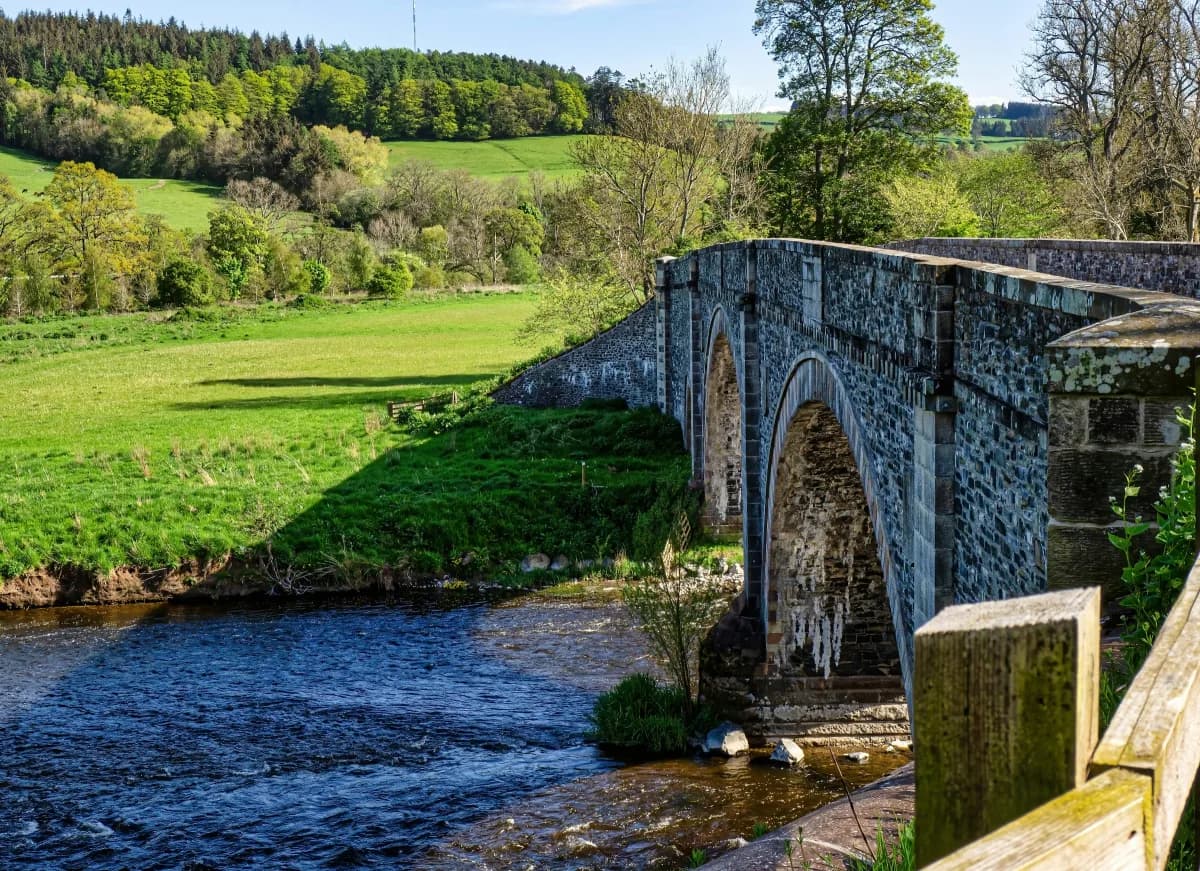
One hour to Peebles, ninety minutes to the middle beats. The Tweed does two things — association trout and grayling at perfectly reasonable prices, and salmon on the most productive fly river in Britain.
If you are visiting Edinburgh and want one serious fishing day, this is the one. The River Tweed rises in the Borders hills west of Peebles and runs east for ninety-odd miles through some of the loveliest fly-fishing country in Britain, eventually emptying into the North Sea at Berwick. From Edinburgh, you can be on the upper river at Peebles in about an hour, and on the middle and lower river — Kelso, Coldstream — in not much more.
The Tweed does two things, and it does both better than nearly anywhere else.
The trout and grayling side. The Tweed has, by some counts, more than twenty club and association trout fisheries along its length, most of which sell daily, weekly and season permits at perfectly reasonable prices. The Peeblesshire Trout Fishing Association alone gives access to around twenty-three miles of Tweed and five miles of the Lyne Water for brown trout and grayling. This is the unfashionable but quietly brilliant version of a Tweed day: a £15 to £40 ticket, a 9-foot 5-weight, and as many miles of varied water as you can physically cover before dark. The brown trout season runs 1 April to 30 September on most beats; grayling are fished principally through the winter, from October to March.
Tweed trout and grayling fishing is one of the great underrated experiences in British fly fishing, and it is genuinely within reach of a hotel in Edinburgh.
The salmon side. Different rules now apply. The Tweed produces more salmon to the fly than any other river in Britain. Beats are privately let, organised through FishTweed and FishPal, and run on the rotating beat system that has governed Tweed salmon fishing for generations. Spring fishing is the historical glamour slot; autumn — September through to the end of November — is when the river runs in its strongest form. Late October on the middle Tweed, with fresh fish in the pools and the trees turning, is one of the experiences a serious salmon angler is meant to have at least once.
For the visiting angler the practical play is straightforward: book a guided day, through FishTweed or a reputable local outfitter, on a middle-river beat. Expect to fish a 13- or 14-foot double-handed rod, a sinking-tip or Skagit setup depending on the height of water, and a fly chosen by your ghillie for the conditions of the day. The job is to fish the pool methodically — across, downstream, on the swing — and to do what your ghillie tells you. A taking salmon, if one is present, will tell you about it during the swing.
Stretch Options: Whiteadder and the Tay
Two waters fall outside the comfortable hour but inside the comfortable day. For the angler who has already done the Tweed and wants a third or fourth day in the diary.
The Whiteadder Water rises in the Lammermuir Hills and joins the Tweed near Berwick. The associated Whiteadder Reservoir is fly-only, bank and boat, and requires a valid permit bought in advance. The river itself offers Borders trout and grayling fishing in genuinely scenic country, somewhere between East Lothian and Northumberland in feel. If you have already done the Tweed once and want a quieter, more exploratory follow-up, Whiteadder is the answer.
The River Tay, an hour to an hour-and-three-quarters north, is the premium salmon water of central Scotland and the natural rival to the Tweed. It is too far for a casual Edinburgh afternoon but well within reach of an early start and a guided day. The Tay is heavier, more imposing water than most of the Tweed beats — bigger pools, longer casts, harder wading — and it rewards anglers who have already done some salmon fishing somewhere else. Spring (February–April) and autumn (September–October) are the strong seasons.
Neither of these is the Edinburgh answer for the casual visitor. Both are the answer for an angler who has already done the Pentland reservoirs and the Tweed and wants a third or fourth day in the diary.
A Short Closing Word
Edinburgh is one of the few major European cities where, with a hire car and a permit or two, you can build a credible fly-fishing day inside the same trip that took you to a museum, a festival, or a meeting in the New Town.
Edinburgh is one of the few major European cities where, with a hire car and a permit or two, you can build a credible fly-fishing day inside the same trip that took you to a museum, a festival, or a meeting in the New Town. None of the water around the city is the best in Scotland. Most of it is not even close. But for the visiting angler who has accepted that this is a city break with fishing built in, rather than a fishing trip with a city attached, the geography around Edinburgh is more generous than the city itself ever lets on.