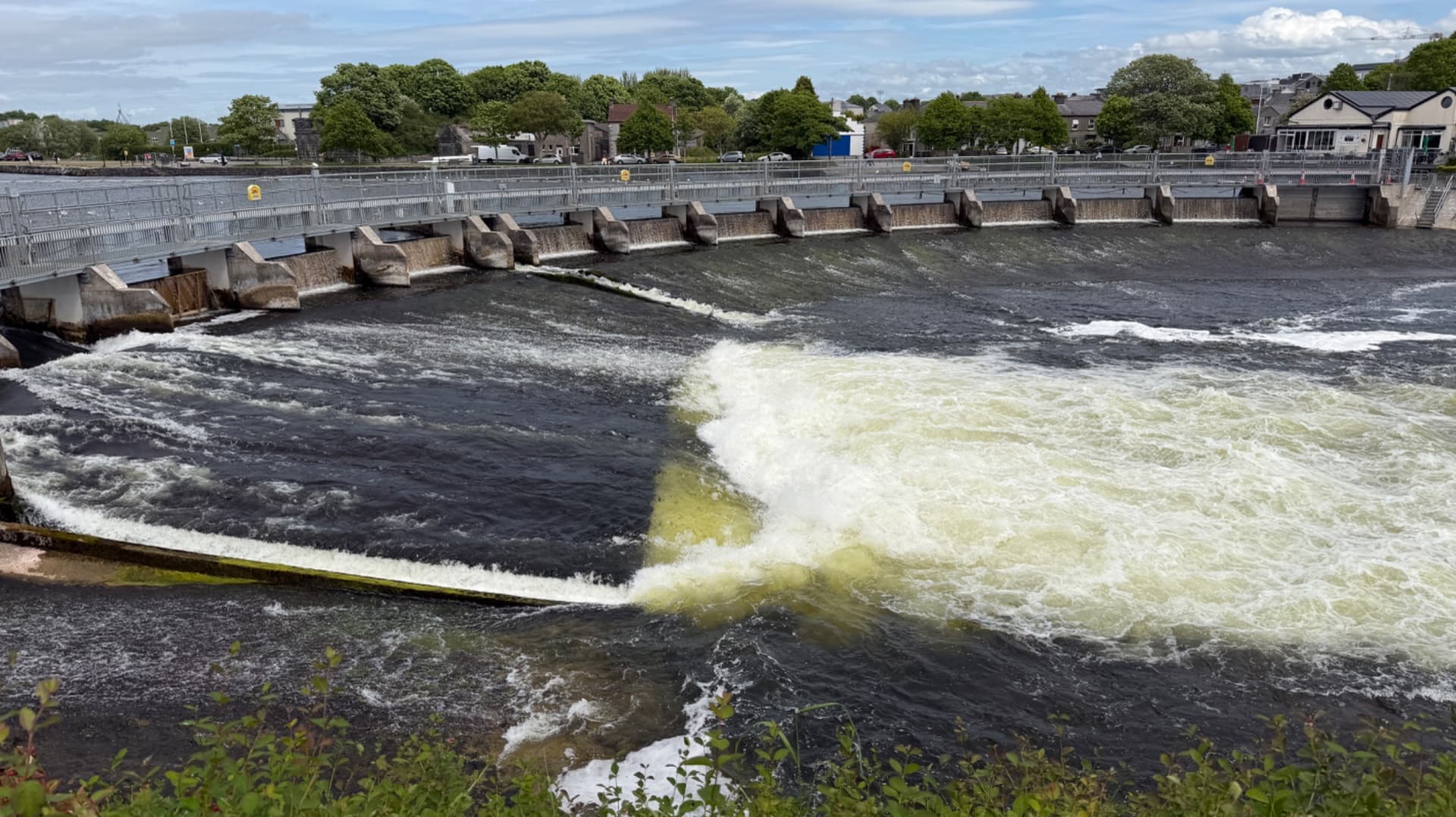
There are not many cities where you can watch salmon stacking below a weir from a bridge in the middle of town, but Galway is one of them. The Galway Fishery on the Corrib is a world-renowned salmon beat right in the city itself.
West of town, Connemara opens up into one of the great salmon and sea trout landscapes of Ireland — Ballynahinch, Costello/Fermoyle, Screebe/Gowla — all within an hour.
The Galway Fishery for salmon in the city itself. Lough Corrib for the mayfly. Ballynahinch and the Connemara systems for the full western Irish experience.
Fly Fishing from Galway: A Salmon Weir in the City Centre
There are not many cities anywhere where you can watch salmon stacking below a weir from a bridge in the middle of town, but Galway is one of them. The Galway Fishery on the River Corrib, right in the heart of the city, is a world-renowned salmon beat — a short stretch of water that has drawn anglers to Galway for generations, precisely because of what happens at that weir every spring and summer.
West of the city, Connemara opens up into one of the great salmon and sea trout landscapes of Ireland — lough-and-river systems threading through bog and granite, each with its own character. Ballynahinch, Costello/Fermoyle, Screebe/Gowla: these are names with real weight in Irish game fishing, and all of them sit within an hour of Galway.
The Legal Bit, Briefly
Ireland requires a State salmon and sea trout licence for these species specifically, on top of whichever fishery's own permit governs the water — and killing any sea trout is banned outright across the Galway, Connemara and Ballinakill systems.
Fishing for salmon or sea trout anywhere in the Republic of Ireland requires a State rod licence for those species, bought separately from any fishery permit. On top of that, each fishery — the Galway Fishery, Ballynahinch, and the rest — sells its own permits, and most genuinely do sell to visitors rather than restricting access to members.
One rule worth knowing before you fish anywhere in this region: it is illegal to kill any sea trout on the Galway, Connemara or Ballinakill river systems — catch-and-release only, no exceptions, and fly fishing only across the Ballynahinch system specifically. This reflects decades of sea trout population pressure across the west of Ireland, and it is enforced, not a suggestion.
The Corrib and Galway Fishery: Start in the City
Prolific salmon runs through the heart of Galway, season running February to September, with May to August generally the strongest fishing depending on water levels.
The Galway Fishery itself needs little introduction to anyone who follows Irish salmon fishing — a short, intensively-managed stretch of the Corrib right where the river leaves Lough Corrib and heads for Galway Bay, with a season running from February through September and the best of it typically between May and August, water levels permitting.
Lough Corrib itself, Ireland's second-largest lake, sits just upstream and holds its own substantial wild brown trout population alongside the salmon passing through — worth a day in its own right for anyone visiting Galway with a rod, particularly during the mayfly.
Connemara: Ballynahinch and the Western Systems
The Ballynahinch River runs beneath the Castle for three kilometres to the Atlantic at Bertraghboy Bay — every salmon and sea trout on the system passes directly below the hotel. Costello/Fermoyle and Screebe/Gowla extend the same lough-and-river character further north.
Ballynahinch is the best-known of the Connemara systems, and for good reason: the Ballynahinch River runs beneath Ballynahinch Castle for around three kilometres before reaching the Atlantic at Bertraghboy Bay, meaning every salmon and sea trout entering the system must pass directly below the estate. Fishing rights belong exclusively to Ballynahinch Castle Hotel, which sells permits (with guided and lodge options for those who want them) across a system that stretches from the estuary north through the Inagh Valley and east towards Maam Cross.
Costello/Fermoyle and Screebe/Gowla, further north towards Connemara's Atlantic coast, offer the same essential character — lough-and-river systems built for fly fishing, with multiple owners between them and permits generally available to visitors. Each system has its own personality and its own timing; local knowledge of that season's water levels matters more here than almost anywhere else covered in these guides.
The Galway Year
February to May for early Corrib springers. May through August for the fishery's strongest run and Connemara sea trout coming on. Mayfly on Lough Corrib in late May.
The Galway Fishery season opens in February, with the strongest fishing typically arriving from May through August as more fish push into the system — always dependent on that season's water levels, which anglers here watch as closely as the calendar.
Lough Corrib's mayfly hatch, generally through May, is a genuine event in its own right and worth timing a visit around if wild brown trout on a big Irish lough is part of the plan alongside salmon.
In Connemara, sea trout and salmon move through the lough-and-river systems across summer, with local operators the best source of current timing — these systems respond to rain and water levels in ways that shift the calendar year to year more than a river with a stable flow regime would.
What to Carry
A 12'–14' double-hander for the Corrib's salmon water. A 9'6" 6–7 weight single-hander for Connemara loughs and sea trout. Fly only is mandatory across the Ballynahinch system.
For the Galway Fishery: a 12' to 14' double-handed rod with floating and sink-tip lines covers most conditions on this stretch of the Corrib. Standard Irish salmon patterns — Cascade, Ally's Shrimp, Silver Stoat — in a range of sizes for varying water heights.
For Connemara lough and river fishing: a 9'6" rod of 6 to 7 weight is the versatile choice across sea trout and salmon on smaller water, with traditional Irish wet-fly teams working well from a drifting boat on the loughs. Remember: fly only, and sea trout go back, across the whole Ballynahinch system.
Buy your State salmon and sea trout licence before you arrive, and carry whichever fishery permit covers the specific water — the Galway Fishery, Ballynahinch and the northern Connemara systems are all separately managed.
The Final Verdict
The Galway Fishery for salmon in the city itself. Lough Corrib for the mayfly and wild brown trout. Ballynahinch and the Connemara systems when you want the full western Irish lough-and-river experience.
Few cities anywhere hand an angler a world-renowned salmon beat within walking distance of the shops, and Galway does exactly that. Start at the fishery itself to understand why anglers have made this pilgrimage for generations, spend a mayfly week on Lough Corrib if the timing allows, and give at least one day to Connemara — Ballynahinch if you want the full estate experience, Costello/Fermoyle or Screebe/Gowla if you want the quieter, more self-directed version of the same story.