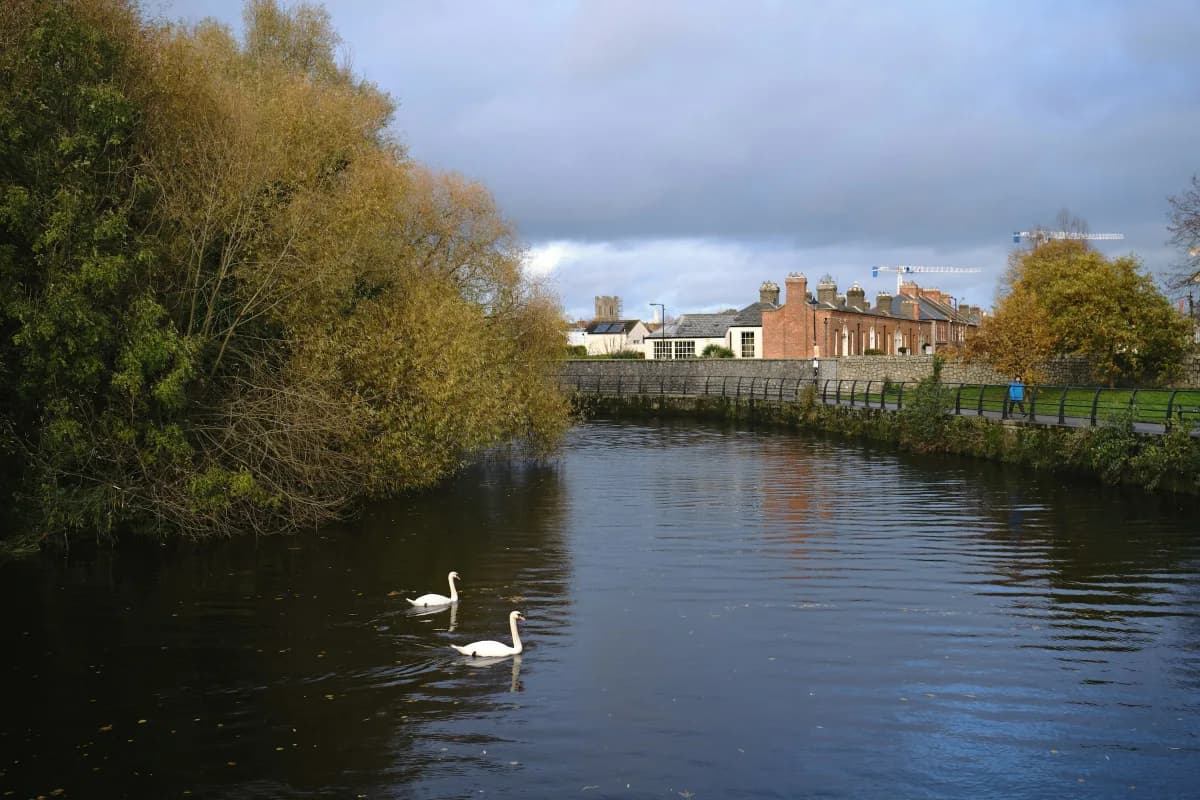
The first thing to understand about fly fishing from Dublin is that the city has been quietly underrated for a long time. It is not Galway-next-to-Corrib, and it is not London-with-chalkstreams. There is no single famous trout river running through the centre that everyone has heard of. What there is, within ninety minutes of the Liffey bridges, is a much broader menu than most people realise — urban wild trout, stocked rainbows, mountain reservoirs, a sea-trout river, pike on fly, and one genuinely strong wild brown trout system in the Boyne.
Dodder for a session after work. Annamoe or Courtlough when the rod just needs to bend. Boyne and Kells Blackwater for the proper day.
Fly Fishing from Dublin: Better Than You'd Think
The honest version is this. Dublin is not Ireland's glamour fly-fishing capital — that title belongs to the West, the Corrib system, the Moy, the Loughs of Connemara — but it is a surprisingly useful base. The Liffey runs through the city and into trout water within twenty minutes of the M50. The Dodder, once written off as a sad urban culvert, has become an actual wild trout river again with sea trout and salmon nosing into it from the estuary. To the south, the Wicklow hills give you the Dargle, the Vartry, and Annamoe within an hour. To the west, the Blessington reservoir gives you a thousand-acre body of water that you can drive to before breakfast. To the north, the Boyne — old, slow, weedy, full of fish — gives you the wild brown trout day that a Dublin angler can plan for on a Tuesday and execute on a Saturday.
This guide is about access — where to go, what kind of fishing it offers, and what to expect when you arrive. The methods themselves live in the playbooks: the Spate River Playbook for the Dodder after rain, the Trout River Playbook for the Liffey and the Boyne, the Small Stillwater Playbook for Annamoe and Courtlough, the Big Stillwater Playbook for Blessington, the Sea Trout Playbook for the Dargle. What the Dublin angler needs first is the map.
The Legal Bit, Briefly
Brown trout in Ireland doesn't need a State licence. Salmon and sea trout do — and access is almost always controlled locally, even where the fishing looks free.
This catches people out. There is no general State rod licence for brown trout in Ireland. What you do need, for almost every river within reach of Dublin, is permission for the specific water — a club ticket, a riparian permit, or a day pass from the local fishery. Inland Fisheries Ireland is clear about this: trout river fishing is usually controlled locally, with permits sold through clubs or shops near the water. Don't assume a bank is free because it looks open.
For salmon and sea trout, the rules tighten. A State Licence is required. Tagging and logbook rules apply to salmon and to sea trout over 40 cm. The 2026 framework sets a national annual bag limit of seven fish on rivers where retention is permitted, and several rivers — including the Boyne — are closed entirely for salmon and sea trout in 2026 even though the trout fishing carries on as normal.
There are also waters with their own bye-laws layered on top. The Dodder downstream of Clonskeagh Road Bridge is fly-only, single barbless, catch-and-release for all species from 1 June to 30 September. The Vartry runs under a sea-trout conservation order that allows one fish of 40 cm or less per day in season and nothing larger. The Kells Blackwater is barbless and no-worm below Nine Eyed Bridge. None of this is onerous — it is the price of fishing waters that are being managed for the long term — but it pays to know the rules before you go.
The River Dodder: Urban Trout, Closer Than You Think
The most interesting "inside the city" option in Dublin. Wild brown trout with sea trout and salmon in the lower stretches, fly-only and catch-and-release from June through September.
The Dodder is the surprise of the Dublin fly-fishing year. For a long time it was thought of — when it was thought of at all — as the sort of urban watercourse that nobody fishes seriously. That has changed. The river has recovered to the point where it now holds a self-sustaining wild brown trout population, with sea trout and the occasional salmon working in from the estuary at Ringsend. Inland Fisheries Ireland list it as one of Dublin's principal trout rivers, which a decade ago would have read as a kindness.
The 2025 bye-law on the lower river is the thing to know. From Clonskeagh Road Bridge downstream to the Liffey at Ringsend, the river is fly-only, single barbless hook, catch-and-release for all species from 1 June to 30 September. That is the stretch a city-living angler is most likely to fish — Milltown, Donnybrook, Ballsbridge — and the rules are not unreasonable. They are the reason the river is fishable at all.
Treat the Dodder like a small spate stream that happens to run through a city. Short casts, light tippet, small dark nymphs, spiders, tiny olives, midges and sedges. Fish the glides above the riffles, the broken water below the weirs, and the shaded pockets under the trees where the trout hold against the urban heat. After rain the river colours and rises quickly and can fish very well for an hour or two before it goes the wrong way. In low summer water it becomes a stealth game — long leaders, careful approach, fish that are not stupid.
This is the river where Rise Daisy earns its keep. The Dodder is the textbook conditions-aware venue: a small rise after a dry spell can transform it; heavy urban runoff can spoil it just as fast. Read the gauges, watch the rain radar, and don't drive into town hoping. Get the timing right and you have a wild trout river inside the M50.
The River Liffey: Proper Wild Trout Within an Hour
The natural spine of Dublin trout fishing. Substantial water, decent fish, and the most reliable river-trout day inside a sixty-minute drive of the city.
The Liffey is what you fish when you want a proper river day without committing to the Boyne. From Leixlip up through Lucan, Celbridge, and Straffan, the river opens out into the kind of water that actually rewards the long rod — riffles, glides, weed beds, the occasional deep pool under a beech tree. Inland Fisheries Ireland describe the Celbridge–Straffan section as a rich trout water with fish over a pound taken regularly. By Irish standards that is a genuinely good trout river.
Access is mixed. Some of the best water is controlled by angling associations, some by riparian owners, and a useful stretch upstream of Leixlip Bridge runs on free fishing on the left bank up to the confluence of the Rye Water. The section from the Rye to Leixlip Dam itself is prohibited. The principle is simple — find out who controls each beat before you walk down to it, and don't assume access from a satellite image.
Bring a nine-foot four- or five-weight. In spring and early summer, nymphs and wets are the reliable methods — Hare's Ear, Pheasant Tail, Greenwell's Glory, March Brown wet — and on settled afternoons you'll get olives, the occasional sedge, and the evening rise if the wind drops. The trout aren't always easy, particularly in the slower middle sections where the water clarifies and the fish have time to inspect everything. When that happens, go down a tippet size and put on something small and dull. The Liffey is the river where the slightly overdressed fly gets refused with the kind of slow turn that haunts a fly fisher for years.
The Rye Water: A Tributary Worth Knowing
A Liffey tributary listed by IFI as part of the Dublin trout-river network. Patchy access, but a useful local option for the angler who learns it properly.
The Rye Water is the tributary that nobody outside the immediate area fishes much, which is more or less the definition of an interesting little river. Inland Fisheries Ireland include it on the Dublin-area trout list alongside the Liffey, Dodder, Dargle, and Tolka. The useful angling is patchy and access is local. This is not a turn-up-and-wander river.
If you live nearby or know somebody who does, the Rye repays the small-stream approach — dry-dropper, spiders, small Pheasant Tails, Partridge & Orange, the occasional Hare's Ear weighted enough to get under a piece of cover. The trout are not large but they are wild, and a wild trout from a tributary you have learned yourself is worth two stocked rainbows from anywhere else.
The Tolka: A Local Option, Not a Destination
The Tolka is on the IFI Dublin trout-river list. It is not a first-choice visitor venue — but it is another urban wild-trout possibility for an angler who knows the access.
The Tolka is the third river on the IFI Dublin trout list, after the Liffey and the Dodder. It is honest to say that it is not a destination — you are not flying into Dublin to fish the Tolka — but it gives the local angler another option when the conditions and the access line up. Think of it as a "between the showers, after work, ten minutes from home" river rather than a planned day. If you live within a short walk of it and have learned where the trout hold, it will repay attention. If you don't, the Dodder is the better urban call.
The River Dargle and Tinnehinch: Sea Trout Within Striking Distance
The closest serious sea-trout flavour to Dublin. Best from May to September, often fished into the evening, with a fly-only fishery at Tinnehinch under Enniskerry.
The Dargle is the river that gives Dublin a real sea-trout option. Inland Fisheries Ireland describe it as one of Ireland's prime sea-trout waters, with the season running from May to September and the best of it from midsummer into early autumn. The Tinnehinch Fishery, downstream of the bridge at Enniskerry, is the fly-only stretch most visitors will fish — about a mile of water down to the top of the Dargle Glen gorge, with evening tickets traditionally available and the best sea-trout fishing reported at and after dusk.
Sea trout are the fish that teach you to be patient and quiet at the same time. They lie up through the daylight hours and start to move as the light goes. The classic Welsh-and-Irish night-fishing tradition still applies on the Dargle: small wets fished across and down, a methodical working of each pool from the tail upward, no hurry, no torch waved about, no commotion. Teal Blue & Silver, Black Pennell, Peter Ross, a small Stoat's Tail or a sparse Medicine-style shrimp will cover most situations. In low clear water, fish small and quiet. After a fresh, larger flies and a slightly faster swing come into their own.
The licence rules tighten here, because sea trout are involved. A State Licence is required, the bye-laws apply, and the fishery rules at Tinnehinch are layered on top. Check the current year's status before you travel — sea-trout regulations in Ireland are reviewed annually and the Dargle is the kind of water where this season's rules may not be last season's.
The River Vartry: Mark It, Don't Oversell It
A Wicklow sea-trout river under a conservation bye-law. Worth knowing about, but not the place to plan a sea-trout holiday around.
The Vartry sits in the same Wicklow geography as the Dargle but on its own terms. The conservation order means that in 2026 the river is closed for salmon and for sea trout over 40 cm, while permitting one sea trout of 40 cm or less per day in the open season. That is a narrow window with a strong conservation framing around it, and it is the right way to handle this river — but it is not what you build a trip around.
Rise Daisy's approach to the Vartry is to flag it honestly: sea trout are present, the river matters for the broader Dublin sea-trout picture, and the rules are designed to keep it that way. If you fish it, fish it carefully, hold the fish in the water, get it back quickly, and treat the day as a privilege rather than a quota.
Annamoe Trout Fishery: The Easy Day
A four-acre fly-fishing lake in the Wicklow valleys, stocked with brown and rainbow trout, open year-round from 10 a.m. to dusk on the fly lake.
If you have a beginner, a rusty cousin, or a Saturday when the rivers are out of order, Annamoe is the answer. It is a managed fly fishery in a pretty valley setting beside the Avonmore, stocked with brown and rainbow trout, open year-round, with the fly lake running from ten in the morning until dusk. Nothing about it is complicated, and on a quiet weekday it is a pleasant place to spend three or four hours without anyone needing to know what a tippet ring is.
The fishing is standard small-stillwater stuff. Buzzers and Diawl Bachs under the wind, a Damsel or a Cruncher pulled slowly through the wave, a small Cat's Whisker or a Hare's Ear lure when nothing else is producing, a few small dries for the warm afternoons when the rainbows come up. Confidence-builder fishing — and the kind of day that reminds a more serious angler why we started in the first place.
Pollaphuca / Blessington Lakes: The Reservoir Day
The biggest stillwater fly water within an hour of Dublin. Stocked brown and rainbow trout, a small population of wild fish, plus pike on the fly in suitable areas and seasons.
Pollaphuca — Blessington to most people — is what you fish when you want big water, big sky, and the feeling of being further from Dublin than you actually are. The ESB stocks brown and rainbow trout into a substantial reservoir that already holds a small head of wild brown trout, and the season runs from 1 March to 30 September on a single-rod, daylight-only permit with a daily trout bag limit. The lake also holds a serious pike population, and Inland Fisheries Ireland specifically flag the east of Ireland — Blessington included — as productive for fly fishing for pike.
The trout fishing here is a hatch-led affair when it works. Duckfly in early spring, buzzers building through April and May, sedges and terrestrials through the summer, the occasional fall of black ants on a warm breezy afternoon. Fish an intermediate line with a Diawl Bach, a small Damsel, or a Sedgehog on the top dropper. Cover the wind lanes when the lake is rippled and the bays when it's flat. A small lure pulled fast through the early-season cold can find a fish when nothing else will.
For pike on the fly, this is one of the better waters within easy reach of Dublin. Eight- or nine-weight rod, wire trace, large bait-fish patterns in perch, roach, and chartreuse-and-white. Pike fishing on the fly is its own discipline and its own respect — careful handling, unhooking gloves, long-nose pliers, and a willingness to read the fishery's rules about where and when this is permitted. It is also one of the most addictive things a trout angler can stumble into.
Courtlough Trout Fishery: The North-Side Convenience
A stocked rainbow trout fishery on the north side of the city. Useful for short sessions, coaching, and winter sport when the rivers are off.
Courtlough sits up by Balbriggan and turns up regularly in Inland Fisheries Ireland's east-region trout reports, including the winter fly fishing rounds. This is not wild-trout country — it is a managed stillwater stocked with rainbows — but it fills a specific and useful role for the Dublin angler. Close to the city. Reliable. Good for an hour's casting practice with a beginner. Good for a winter Saturday when the rivers are coloured and you want a fish in the net before driving home for lunch.
Fish it like any small stillwater — buzzers, small Damsels, Diawl Bachs, a Cat's Whisker or Black & Green lure when the fish are sulking, and a small dry pattern in summer if anything is rising. Nothing here is going to make a long story. That isn't always what you want from a day's fishing anyway.
The River Boyne: The Best Wild Trout Day From Dublin
Ireland's wild brown trout headline within ninety minutes of the M50. Oldbridge to Navan is the strongest stretch; Trim and Kells extend it. Trout fishing as normal in 2026; salmon and sea trout closed.
If you want a proper wild brown trout day from Dublin, the Boyne is where you go. Inland Fisheries Ireland describe the Oldbridge-to-Navan section as one of Ireland's top wild brown trout fisheries, with good stocks of trout, an average around three-quarters of a pound, and the kind of two- to five-pound fish that turn up for patient anglers who learn the water. The wider Boyne Valley guide recommends mid-May to mid-September as the prime window, with permits available through tackle outlets in Drogheda, Navan, Kells, Trim, Ballivor, Longwood, and Enfield.
The Boyne is a slow, rich, weed-grown river — closer in character to a chalk stream than to a spate river — and it rewards a different kind of attention than a fast Wicklow brook. Spring fishes well on nymphs and wets — Hare's Ear, Pheasant Tail, March Brown, Greenwell's Glory, small olive patterns. May and June bring the mayfly and the spent gnat in the right years, and the spent gnat fishing here is the kind of evening that anyone who has done it once will tell you about for the rest of their life. Summer evenings are sedges, Blue-Winged Olives, small dries, and the occasional larger trout doing exactly what you hope for in the failing light. In coloured water, swing a wet fly or a small streamer down through a glide and trust it.
The 2026 salmon and sea-trout closure on the Boyne is worth holding in mind. The river is closed for migratory species this year, which means the salmon and sea-trout dimension that historically sat alongside the trout fishing is off the table — but the trout fishing itself runs as normal. If you only do one day-trip from Dublin this season, do it here.
The Kells Blackwater: The Quiet Stretch Behind the Boyne
A Boyne tributary at the edge of the ninety-minute drive. Wild brown trout, fishing from 1 March to 30 September, barbless and no-worm below Nine Eyed Bridge.
The Kells Blackwater is the river you fish when the Boyne is busy or the wind is wrong, or when you fancy something a little smaller and a little more intimate. It is a wild brown trout river — IFI list dry fly, wet fly, and nymph as the productive methods — with a sensible season from 1 March to 30 September and a barbless, no-worm restriction below Nine Eyed Bridge that tells you something about how it is being managed.
The IFI fly list for the Blackwater is one of those quietly perfect inventories that someone who actually fished the river clearly compiled: Grey Flag, Grey Duster, Hare's Ear, the olive patterns including Sherry Spinner, March Brown, Wickham's Fancy, Greenwell's Glory, a few goldhead nymphs, and a Sawyer-style for the deeper runs. Bring a nine-foot four or five weight, a floating line, a small dry box, a wet-fly and spider box, and a couple of slim nymphs. That is the entire kit. You will use most of it.
A Little Further: Lough Lene and the Upper Boyne Lakes
When the ninety-minute window stretches a fraction. Brown trout, stocked rainbows, mayfly hatches — boats and permits available locally.
If you can leave a little earlier, the upper Boyne lakes start to come into range. Lough Lene is the headline — a sizeable managed trout lake with wild brown trout, stocked browns, and triploid rainbows; duckfly and mayfly in the right months; sedge hatches through summer; and the kind of lough-style boat fishing that the West of Ireland is more famous for. It is not quite a "nip out after work" venue, but it belongs in the Dublin orbit for anyone happy to stretch the day.
Bring a long leader, a team of three flies (a bushy bob fly, a slim middle dropper, a buzzer or nymph on the point), and a drogue. Loch-style is more than the kit, though — it is the rhythm of the drift, the short casts, the bob-fly worked into the wave. Lough Lene is a good place to learn that rhythm without travelling to the Corrib.
Sea Fly Fishing from Dublin
Bass, mullet, and the occasional pollack on the coast. A specialised game, but the fly tackle adds a real saltwater option to the Dublin menu.
Inland Fisheries Ireland note bass on beaches north and south of Dublin and in the estuaries at Rogerstown, Malahide, and the Liffey, with autumn evening tides offering the better chances. Saltwater fly fishing in Ireland is more specialised than the trout fishing — you need the right tide, the right wind, safe wading, and a tolerance for blanks — but if you have an eight- or nine-weight, a clear intermediate line, and a box of Clousers and Surf Candies, the city's coastline opens up another season's worth of fishing. Bass on the fly off an autumn beach is one of the better hours a saltwater angler can have anywhere in these islands.
Best Dublin-Area Fly Choices
A short box that covers the lot — urban trout, Liffey and Boyne, Wicklow sea trout, stillwater rainbows, Blessington pike, and the Dublin coast.
Urban trout (Dodder, Tolka, Rye Water) — Griffith's Gnat, a CDC midge, a tiny Klinkhammer, small olive dries, Hare's Ear, Pheasant Tail, Partridge & Orange, Waterhen Bloa, a small black spider.
Liffey and Boyne trout — olive nymphs, Hare's Ear, Pheasant Tail, March Brown wet, Greenwell's Glory, Wickham's Fancy, Grey Duster, spent gnat in mayfly season, sedges through summer, Blue-Winged Olive in the evenings, a small streamer for coloured water.
Wicklow sea trout — Teal Blue & Silver, Black Pennell, Peter Ross, a small Stoat's Tail, a sparse Medicine-style shrimp, a small dark muddler. Smaller and quieter than you think you need.
Stillwater trout (Annamoe, Courtlough, Pollaphuca) — buzzers in three sizes, Diawl Bach, a Damsel, a Hare's Ear, a Cruncher, a Bibio, a Sedgehog, a Shipman's Buzzer, and a small lure for the cold months.
Pike on the fly (Blessington) — large perch and roach baitfish patterns, black-and-orange, chartreuse-and-white, natural pike-fry imitations. Always with a wire trace.
Saltwater (Dublin coast) — Clousers in chartreuse-and-white and olive-and-white, small Surf Candies, a Deceiver for the bigger marks.
What to Pack
A nine-foot four-weight covers most of the river fishing. A six-weight handles the stillwaters. An eight or nine for pike and the coast.
A nine-foot four-weight covers most of the river fishing — Dodder, Liffey, Rye Water, Boyne, Kells Blackwater. A nine-foot six-weight is the better choice for Pollaphuca, Annamoe, and Courtlough on a windy day, and is the rod a beginner will be happier with on a stocked lake. An eight- or nine-weight gets you into the pike and saltwater options. A floating line for most of it, a clear intermediate for the reservoir and the coast, and a sink-tip if you intend to swing flies on the bigger rivers in coloured water.
Beyond that: barbless hooks (mandatory in places, sensible everywhere), a small thermometer to make sense of the trout's day, a landing net with a knotless mesh, a pair of forceps, polarised glasses, and a willingness to drive an hour for a fish you may not catch. That last one is the most important bit of kit on the list.
Best First Trips by Angler Type
Ninety minutes from the Liffey bridges puts you on urban wild trout, stocked rainbows, reservoir browns, Wicklow sea trout, pike on a fly, or one of the country's best wild brown trout systems.
The beginner — Annamoe or Courtlough on a quiet weekday. Casting room, willing fish, no permit complications, and you go home with the rod arm slightly tired and the right kind of fish stories.
The visitor with one day — the Boyne between Oldbridge and Navan, with permits arranged from a tackle shop in Drogheda or Navan in advance. This is the day a Dublin fly fisher would take a friend on.
The local with an evening — the Dodder, properly. Walk a piece of the lower river before you fish it, look for rising fish or feeding lies, and treat it like the small wild river it has quietly become.
The sea-trout curious — the Dargle at Tinnehinch in late June or July, into the evening and the dusk. Take a small fly box, a sensible leader, and the patience to fish a pool from the tail upward without rushing.
The reservoir angler — Pollaphuca with a boat or a long bank session, an intermediate line, and the patience to fish the wind lanes. Bring a thermos. Bring the second thermos.
Dublin is not the headline. It is the surprise. Ninety minutes from the Liffey bridges you can be on urban wild trout, on stocked rainbows, on reservoir browns, on sea trout in a Wicklow river, on pike on a fly, or on one of the country's best wild brown trout systems. Pick the day, read the conditions, and go.