Bottom-Contact Nymphing for Barbel
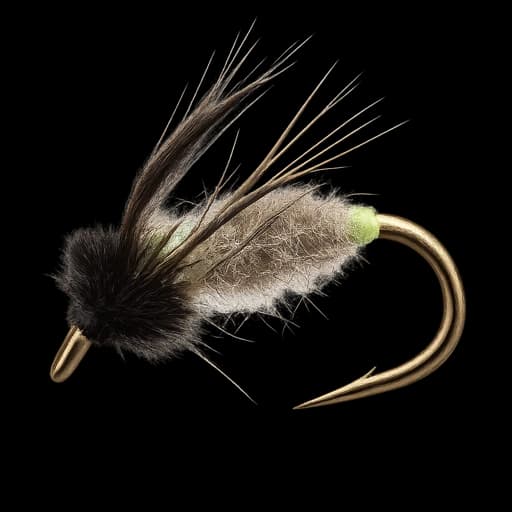
A barbel looks like something designed by a committee that only cared about current. Low-slung, heavy-shouldered, mouth pointed at the gravel, it spends its life in the sort of pushy water most fish avoid and eats almost everything it finds down there. Which makes it, on paper, an easy mark for a nymph. The catch is that word DOWN: a barbel nymph drifting a foot off the bottom might as well be in another river. Get the fly onto the stones and everything else follows.
When & Where
Gravel runs, riffle tails, and the seams where fast water slides against slow. Barbel hold in more current than you would credit, tucked behind stones and in the smooth slot on the bottom where the flow is slower than the surface suggests. Fish the water, not the rise — this is a blind method and a visible fish is a bonus. Warm months and moderate heights are best; a river low and clear in summer lets you spot fish on the gravel and cast to them individually, which is the finest version of it.
Essential Gear
A 10 foot rod in 5 to 7 weight for the reach to hold line off the water. Floating line, or a long euro-style leader straight to the fly. One heavy nymph: a tungsten hare's ear or cased-caddis imitation in size 8 to 12, weighted enough to hold bottom in the flow you are fishing, with the weight IN the fly rather than strung along the leader. Tippet of 6 to 10 lb — barbel are powerful and you are fishing over stone. Carry a range of weights rather than a range of patterns; depth is the variable that matters.
How It Works
Read the run and pick the seam. Cast up and across, far enough upstream that the fly is on the bottom by the time it reaches the water you actually want to fish — in pushy water that can mean several metres of lead-in. Lead the fly down with the rod tip, line off the surface, just enough contact to feel it ticking the stones. That tick is the method: if you cannot feel bottom, add weight. Takes range from a solid stop to nothing more than the ticking going quiet. Set on anything that changes. And when the fly lifts at the end of the drift, let it — the induced rise takes a surprising number of fish.
Common Mistakes
Adjusting the Method
By season
Mid-June to autumn on English and Welsh rivers, which are closed to coarse fishing from 15 March to 15 June, with high summer the peak. Elsewhere, check the local close season. Barbel feed hardest in warm, well-oxygenated water and lose interest as the river cools. Spawning is a spring event and fish over the redds should be left alone. In hot, low water they move to the faster, better-oxygenated runs — which are also the hardest to hold bottom in, so that is exactly when weight matters most. Autumn fish are heavy and feed well before the water drops away.
By species
Common barbel is the quarry across Europe, and the Iberian barbel species behave similarly and share the same water in Spain and Portugal. Carp are frequently present in these rivers but want a different approach entirely — slower, shallower, sight-fished. Chub take the same nymph readily and are the usual by-catch. In China the equivalent bottom fish are 军鱼 (光倒刺鲃) and 溪石斑 (光唇鱼), which hold deep among stone in exactly the same way and take exactly the same fly, only smaller.
By water
Spain and Portugal are the strongest European barbel fly waters: the Extremadura and Duero systems, the lower Júcar, the Magro, the Ebro through Zaragoza. Rules vary by confederation rather than by country, and several basins carry cyprinid closed seasons — one to check per water rather than assume. Northern Italy's Po basin offers the same fishing in slower, deeper water. In China the same method takes 军鱼 and 溪石斑 on the Zhejiang streams, scaled down: hook 12 to 16 rather than 8 to 12, because the fish are smaller and the water thinner. Every step here is written for ONE fly, and that is deliberate rather than cautious: a single fly is legal on every water this guide covers, and a dropper rig is not. China caps natural waters at one rod, one line and two hook points nationwide (revised fisheries law, in force 1 May 2026, fines to ¥50,000), and Sichuan's Yangtze-basin waters add a hook gape under 2 cm, no boats, rafts or floating platforms, no fish finders, and a daily retention of about 2.5 kg. Spanish and Portuguese cyprinid rules vary by confederation and basin and several carry closed seasons — check the water, not the country. Where droppers are permitted they are an option, never a requirement; nothing above depends on one.
More in Cyprinid Specialist
The river is the hero, not the app. · © 2026 Rise Daisy