Newcastle is one of northern England's better bases for a fly angler. Stocked reservoir trout within forty minutes of the city. The Tyne — England's premier salmon river — running practically through it. The Coquet winding through Northumberland hills an hour to the north. The Wear making its case quietly to the south.
It is not quite as compact as Glasgow for highland loch trout, but it makes up for that with range: reservoirs for reliable sport, wild spate rivers for character, and migratory fishing that does not require a long drive to Scotland.
Derwent for reliability. The Coquet for character. The Tyne for the migratory game — earn it. Kielder when you want the full day.
Fly Fishing from Newcastle: A Better Base Than Most
Newcastle is one of northern England's better bases for a fly angler. Stocked reservoir trout within forty minutes of the city. The Tyne — England's premier salmon river — running practically through it. The Coquet winding through Northumberland hills an hour to the north. The Wear making its case quietly to the south. It is not quite as compact as Glasgow for highland loch trout, but it makes up for that with range: reservoirs for reliable sport, wild spate rivers for character, and migratory fishing that does not require a long drive to Scotland.
The practical answer, first. For reliable sport on any given day, go to Derwent, Fontburn, Grassholme or Kielder. For wild fishing that will stay with you, build your season around the Tyne system, the Coquet, the Wear and the upper tributaries of the North Tyne.
Derwent Reservoir: The Default Option
Close enough to decide at breakfast. Stocked regularly enough that catching something is realistic. Northumbrian Water day tickets, parking included, eight-fish full day or catch-and-release sporting permit.
Derwent is the Newcastle angler's default answer to the question 'where should I go this morning?' It is close enough that you can decide at breakfast, stocked regularly enough that catching something is a realistic expectation, and run by Northumbrian Water's Waterside Parks operation with day tickets available at the water. The 2026 permit includes an eight-fish full-day option (£31), a catch-and-release sporting permit for fly and spinning (£22), and under-17 tickets. Parking is included.
It is not a romantic water. Nobody writes poetry about Derwent. But treat it as a bank-fishing reservoir on its own terms — work the wind lanes, fish buzzers and diawl bachs on calm spring mornings, switch to an intermediate and a damsel in the heat of summer — and you will fish it well. On mild, overcast days, the margins produce. On bright, warm days, go deeper. It is a useful venue to know properly.
Best on overcast westerly days in April, May and September. Fly box: buzzers, diawl bachs, damsels, black and olive lures, a few small dries for when things get interesting.
Fontburn and Grassholme: Two More Strings
Fontburn for a contained, friendly day close to the city. Grassholme for something more interesting — four miles of Teesdale bank with multiple inlets and productive named areas.
Fontburn is smaller and friendlier than Derwent — more manageable for a beginner or for an angler who wants a contained, relaxed day without the exposure of Kielder or the scale of Grassholme. It has an accessible fishing platform on the north shore, which makes it a genuinely inclusive water. Waterside Parks lists it as reopening on 7 March 2026, fishing from 8am to 8pm or sunset. Day permits run £27–31, C&R sporting permit £22, under-17s £13.
Grassholme is Teesdale rather than Tyneside, which makes it a longer proposition from north Newcastle — but a genuinely worthwhile one. Waterside Parks describes it as having four miles of bank with multiple inlets and bays, and names productive areas explicitly: the Witches Hat to Easter Bay stretch, the North Shore/White Post to Pebble Beach section, and the West End, with the north shore especially noted for fly fishing. It reopens 14 March 2026. The extra drive earns you a more interesting water. Worth building a day around rather than treating as a quick evening option.
Kielder Water: The Proper Day Out
Seventy-five minutes and a full commitment. Boats must be pre-booked. Scale, scenery, boat fishing options — and Kielder Burn, Lewisburn and the Rede in the afternoon.
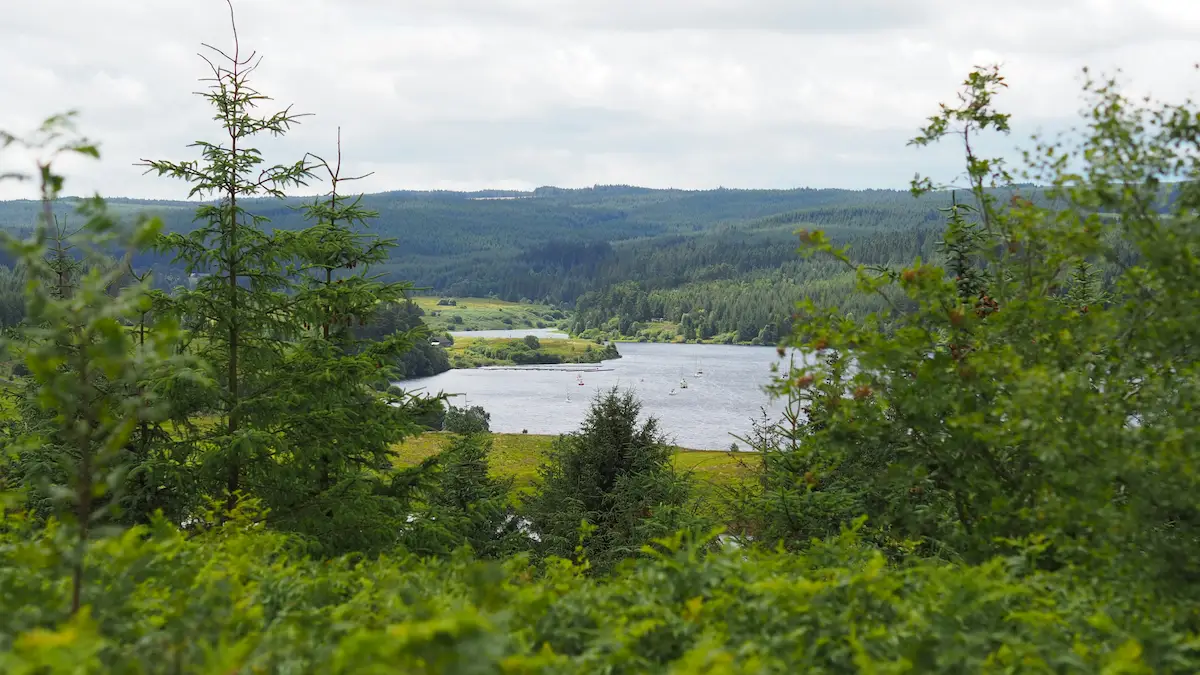
Kielder is not the casual choice. It is seventy-five to a hundred minutes from the city, and it demands commitment. What it gives back is scale, scenery, boat fishing options, and the infrastructure to make a family fishing day work. Boats must be pre-booked through Waterside Parks. The 2026 permit is £29 for an eight-fish day; the C&R sporting permit is £22. Up to two under-17s fish free when a parent or guardian buys a standard ticket.
From a boat, think traditional reservoir tactics: a floating line with a team of three flies, buzzers on top dropper, a diawl bach or cruncher in the middle, a damsel or small lure on the point. Let the drift do the work. From the bank, wind direction matters more than on any other water near Newcastle. Choose your bank carefully.
The Kielder trip also unlocks a second layer: Kielder Burn, Lewisburn and the River Rede at Cottonshopeburn are fishable on separate permits booked through Forestry England or FishTyne. If the reservoir is bright and difficult, a morning on a Kielder tributary is a very good use of time.
River Tyne: England's Premier Salmon River
Not tourism copy — the assessment of people who have fished most of the others. After recovery from twentieth-century pollution, the Tyne now holds healthy salmon and sea-trout runs with wild brown trout and grayling in the tributaries.
The Tyne is England's premier salmon river. That is not tourism copy; it is the assessment of people who have fished most of the others. After the catastrophic pollution of the twentieth century and the recovery that followed, the Tyne now holds healthy salmon and sea-trout runs alongside wild brown trout and grayling in its headwaters and tributaries. The Tyne Rivers Trust notes particularly strong wild trout populations in the Derwent, where grayling also figure in angling returns.
The Tyne is not a casual venue. It is a system of beats — some booked privately, some through club membership, some via FishPal or FishTyne — and it rewards those who learn it properly. Run in two spines — the North Tyne (regulated in part by Kielder releases) and the South Tyne — and joining below Hexham, the river is too varied and too extensive to fish without a plan.
For salmon and sea trout, work the lower and middle Tyne beats after a rise. North Tyne and South Tyne offer different character; check Kielder release timing before you plan a North Tyne day, as releases can transform the river's fishability. Summer and autumn are the prime migratory windows; late autumn can be exceptional for fresh fish. On smaller or lower-water stretches, a single-hander is workable for trout and grayling. The salmon and sea-trout game generally favours a switch or double-hander — 12 to 13 feet, matched to the water and the season. In low summer water, scale everything down: smaller flies, lighter tippet, slower presentation. If you are new to the Tyne, hire a guide for the first session. It is that kind of river.
River Coquet: The Best Editorial River Near Newcastle
Rises in the Cheviot Hills, runs forty miles to Amble, holds wild brown trout throughout, sea trout and salmon in the lower reaches. Northumberland Anglers Federation visitor permits available, season 1 February to 31 October.
The Coquet is probably the most characterful Northumberland river within day-trip range of Newcastle. It rises in the Cheviot Hills, runs roughly forty miles to the sea at Amble, and holds wild brown trout throughout, with sea trout and occasional salmon in the lower reaches. Northumberland Anglers Federation controls much of the fishing — upper waters around Linbriggs, the Rothbury-area holding pools, lower salmon water near Felton and Warkworth, and the tidal section. The season runs 1 February to 31 October. Visitor day tickets are available, including a brown-trout-only Coquet permit. Anglers must carry a water map to avoid trespass.
For wild trout in the upland reaches, fish it as you would any Northumbrian spate river: spider and wet-fly patterns on a short line in broken water, dry flies in slower glides when there is surface activity, light nymphing in the pools. The Coquet rewards an attentive approach and punishes the angler who wades before they look.
For sea trout, the later season is the story. Fish run in summer and autumn; a late-summer flood pushes fish through quickly and concentrates activity. Night fishing on the lower Coquet, with the right conditions, is the Coquet at its most compelling.
River Wear: The Quieter Rival
Serious sea-trout and salmon fishing with wild brown trout and grayling as a bonus. Night sea-trout fishing around Durham gives it a particular identity. Sea trout in earnest from May; large numbers of salmon and sea trout in autumn.
The Wear is the Tyne's quieter rival — serious sea-trout and salmon fishing with wild brown trout and grayling as a bonus, and night sea-trout fishing around Durham that gives it a particular identity. The sea-trout season is in earnest from May, with September and October seeing large numbers of salmon and sea trout spread through the middle and lower river after summer floods push fish in.
There are method restrictions worth knowing: before 16 June, salmon may only be fished for with artificial fly or artificial lure. The North East regional byelaws confirm this applies across the Northumbria byelaw area, which covers the Tees, Wear, Tyne, Blyth, Wansbeck, Aln and Coquet catchments.
The Wear suits the angler who likes an urban or semi-urban river — accessible, with Durham's infrastructure close by — fished properly on its own terms rather than as a Tyne substitute.
The Newcastle Year
March–April for reservoirs. May–June for the best balance of venue types. July–August for the night game and early-morning rivers. September–October is the migratory peak. Winter for grayling and the Kielder tributaries.
March and April is reservoir season first, river season cautiously. Derwent, Fontburn, Grassholme and Kielder all fish from mid-March. Upland river trout fishing opens, but cold water and thin flows mean it is worth waiting. Buzzers, small black and olive patterns, diawl bachs.
May and June is the most balanced period. Reservoirs are active and more interesting to fish — evening hatches, dries becoming viable, intermediate lines worth carrying. Wild river trout fishing comes into its own. Wear sea trout begin to matter from late May. Spiders, wet flies, olives, small dries in the evenings.
July and August rewards early and late. Reservoir fish move deeper in warm weather; an intermediate or slow-sink line often outperforms a floater in July. Sea-trout fishing on the Wear, Tyne and Coquet becomes a night game under full summer conditions. Carefully, and with attention to water temperature, avoid river trout on stressed low-summer water.
September and October is the migratory peak. The Tyne, Wear and Coquet come into their best after autumn rain lifts river levels and pushes fresh fish through. Salmon and sea trout concentrate and, in good conditions, take a fly with conviction. Reservoirs fish well again as the water cools. Autumn evenings have a quality that summer evenings rarely match.
Winter is reservoirs, coarse fishing, and grayling where it is permitted. Northumberland Anglers Federation lists a visitor grayling permit for 1 December to 31 January — worth noting for anyone who wants to keep fishing river water through the cold months.
Access, Licences and Permissions
All anglers aged 12 and over need an EA rod licence. River access belongs to beats, clubs and private owners. The method restriction before 16 June on North East rivers applies even with a current licence and club ticket.
All anglers aged 12 and over fishing in England need the correct Environment Agency rod licence. Beyond that, access is the real subject. It is unlawful to fish for non-migratory trout in rivers from 1 October to 21 March (both dates inclusive). For salmon and migratory species, the method restriction before 16 June on North East rivers applies even with a current licence and club ticket: artificial fly or artificial lure only.
A pleasant-looking riverbank does not mean fishable water. Tyne, Coquet and Wear fishing belongs to beats, clubs and private owners. Buy the right permit, carry it, know your water boundary. The Northumberland Anglers Federation's requirement to carry a water map is not bureaucratic — it is there because the boundaries are complicated and trespass on salmon rivers is taken seriously.
For Northumbrian Water reservoirs (Derwent, Fontburn, Kielder, Grassholme), day tickets are straightforward. For the rivers, use FishPal, FishTyne, or contact the relevant clubs directly.
The First Five
Derwent for reliability. The Coquet for the best editorial river. The Tyne for the migratory game — book a guide day first. Fontburn for a quieter option. Kielder plus Rede tributaries for a full day. Then add the Wear if you are south of the city.
For a Newcastle-based fly angler coming to the area with a season ahead: start at Derwent — the reliable, low-friction trout option. Go early in the season and learn it. Then go to the Coquet, which is probably the best editorial river near Newcastle: wild trout, sea trout, and Northumberland character. Join the Northumberland Anglers Federation or buy visitor permits. Earn the Tyne — book a guide day first, then consider club membership. It is that kind of river. Fontburn is a second reservoir string, useful when Derwent is busy or when you want a quieter day. Build a Kielder day properly: reservoir in the morning, wild water on the Rede or North Tyne tributaries in the afternoon.
Then add the Wear if you are south of the city or want a sea-trout night fishing option that isn't the Tyne. Add Grassholme if you are willing to drive into Teesdale for a more interesting reservoir day.
Newcastle is a good place to fish from. It takes a season to understand it properly, which is about right.