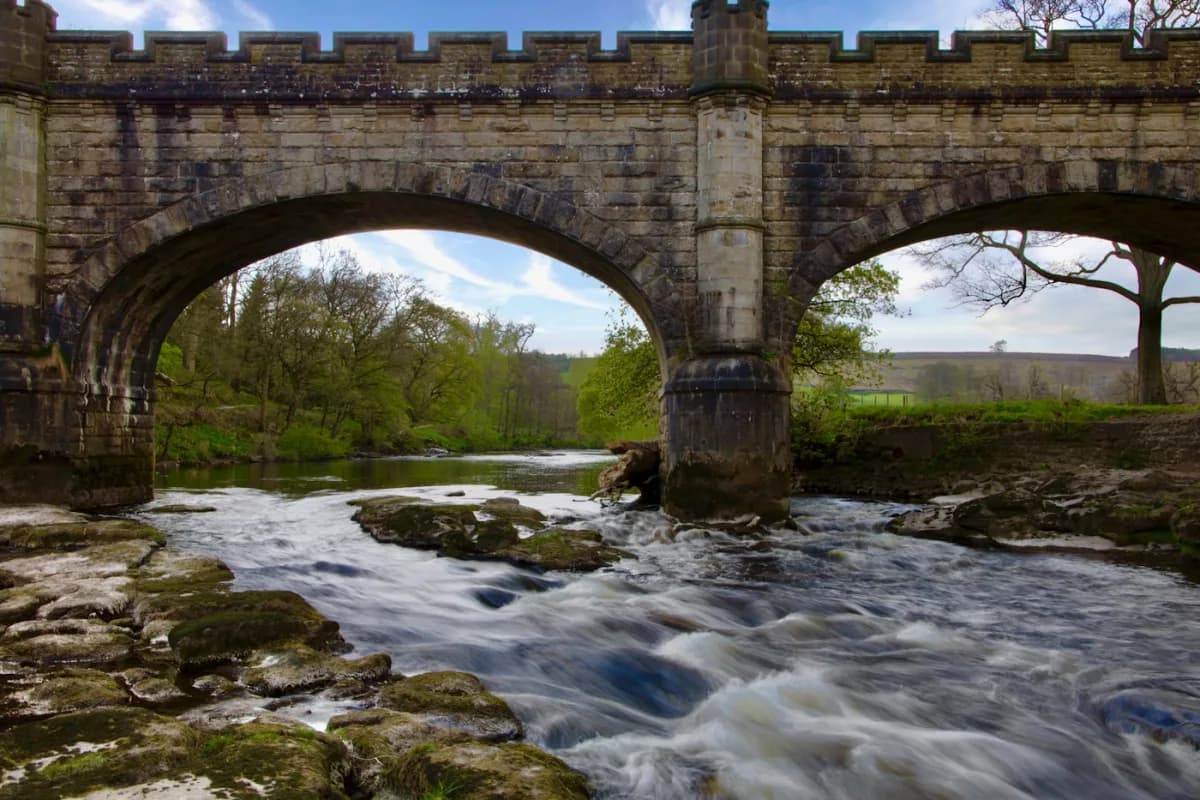
Leeds is not a city that announces itself as a fly-fishing base. It announces itself as a city, which is the sort of thing Leeds has always been good at. But head north and west on a Tuesday morning, before the day has really got going, and you are standing in the Wharfe in thirty-five minutes. That fact alone is worth knowing.
The strength of Leeds as a starting point is not any single water but the variety sitting just beyond it. A wild trout and grayling river. Reservoir trout in the Washburn Valley without a three-hour drive. Club waters in Nidderdale that reward the angler who joins. And upper Wharfedale if you have the appetite for a longer day. A decent hand, even if the city does not realise it is holding it.
Bolton Abbey for the prestige day. Ilkley for the accessible one. Fewston when the rivers are off. The Nidd when you want something quieter. Kilnsey when you want to ask harder questions.
Fly Fishing from Leeds: A Better Base Than It Lets On
Leeds is not a city that announces itself as a fly-fishing base. It announces itself as a city, which is the sort of thing Leeds has always been good at. But head north and west on a Tuesday morning, before the day has really got going, and you are standing in the Wharfe in thirty-five minutes. That fact alone is worth knowing.
The strength of Leeds as a starting point is not any single water but the variety sitting just beyond it. A wild trout and grayling river. A clutch of Yorkshire Water reservoirs that give you the reservoir trout experience without a three-hour drive. Club waters in Nidderdale that reward the angler who joins rather than the one who just turns up. And further up Wharfedale, if you have the appetite for a longer day, the kind of limestone beck-fed brown trout fishing that makes people come to Yorkshire from considerably further afield. It is a decent hand, even if the city does not realise it is holding it.
The Legal Bit, Briefly
An Environment Agency rod licence covers fly fishing on rod and line throughout England. Fishery permits, club tickets and beat rules are layered on top, and access matters more than the geography suggests.
Anyone fishing with rod and line for trout, salmon, freshwater fish, smelt or eel in England and Wales needs the correct Environment Agency rod licence — on club water, day-ticket water, even private lakes. GOV.UK sells one-day, eight-day and twelve-month versions. The enforcement officers are politer about it than you might expect, but only the first time.
Keep two things separate in your head: the rod licence makes you legal nationally; the fishery permit gives you permission to fish that particular water. Access on the Wharfe and its tributaries is overwhelmingly club or association controlled. There is very little free fishing of any quality, and what looks like an unattended stretch of river is almost always somebody's leased water. Read the rules of the specific fishery before you stand in it — some are upstream dry only, some barbless mandatory, some no wading. None of this is onerous. It is the price of fishing waters that are being managed for the long term.
The River Wharfe at Ilkley: Start Here
The natural centrepiece. Brown trout and grayling in numbers, walkable from Ilkley station, and a visitor-friendly club that actually means it.
The River Wharfe is the natural centrepiece — riffles, glides, gravel runs, the occasional awkward bend that forces you into water deeper than you planned — and it holds both brown trout and grayling in numbers that make most non-Yorkshire anglers quietly envious.
The accessible starting point is Ilkley. Ilkley Angling Association runs visitor access on this stretch, and it is genuinely visitor-friendly in a way that a lot of Yorkshire club water is not. Day permits, reasonable prices, multiple riverside parking spots, and — a detail that stands out — the fishing is walkable from Ilkley train station. Trout fishing runs from 25 March to 30 September; grayling from 16 June through to 14 March, which neatly covers the autumn and winter period when grayling fishing can be at its best. No spinning.
In spring, the Ilkley Wharfe rewards patience and small nymphs. The water will still be carrying a bit of colour from winter, and trout will be stacked in the slack water behind boulders and in the softer runs along the near bank. A Hare's Ear or Pheasant Tail on a long leader will account for fish that refuse to acknowledge a dry fly exists. Give it time. The river is waking up.
Summer is the complicated season, as it is on most rivers. Low, clear water means careful wading, longer leaders, and an honest assessment of water temperature before catch-and-release. Summer evenings can be excellent — sedges and spinners, rising fish, the light dropping just as things get interesting. Autumn gives you grayling coming into their best, feeding confidently before the cold sets in.
Bolton Abbey: The Flag Water
Book it, drive there, fish it without needing to join anything first. Five miles of the Wharfe, six day tickets per day, brown trout and grayling on a beat with a priory in the background.
If someone is visiting Leeds and wants the cleanest river experience — book it, drive there, fish it without needing to join anything first — Bolton Abbey is the answer.
The estate's fly-fishing beat covers five miles of the Wharfe. Trout from 25 March to 30 September, grayling from 16 June to 14 March, and day tickets available from 1 June. Six day tickets per day. That last detail matters: it means you are not sharing the bank with forty other people, which on a five-mile beat with five tickets out would be fine anyway, but the intention is clear.
The upper Wharfe around Bolton Abbey has a Dales character that the Ilkley stretch does not quite match — wider valley, wilder-feeling, the priory ruins giving the place an atmosphere that does not require embellishment from a fishing guide. On a May morning with a Pale Watery hatch coming off, this is the kind of water that makes you understand why people arrange entire holidays around a single day on a river.
Estate rules and ticket availability are worth checking before travelling. These things change.
Washburn Valley: When You Want a Reservoir Day
Fewston, Thruscross and Swinsty within forty-five minutes of Leeds. The right answer on a spate day, or any day when you want something that will hold still long enough to fish.
There will be days — after heavy rain, when the Wharfe is running copper-coloured — when the right answer is a reservoir. Yorkshire Water's Washburn Valley Fishery puts three of them in reach: Fewston, Swinsty and Thruscross, all within forty-five minutes of Leeds.
Fewston is the straightforward recommendation for most fly anglers. Fly only, barbless hooks, bank fishing with wading to knee level. The classic reservoir toolkit applies: buzzers and Diawl Bachs fished slow in the surface film in the morning, a damsel or small lure if the wind picks up and the trout start moving. Watch the margins, watch the wind lanes, watch where the natural food is accumulating. The fish know this better than you do and they will tell you where to look, if you are paying attention.
Thruscross has a different character — larger, wilder-feeling, with limited bank space and the shifting water levels that come with any reservoir that is actually being used as a reservoir. It holds a head of wild brown trout that make the extra thought worthwhile. Better suited to an angler who has already spent a morning on Fewston and wants to understand what they are getting into before making the drive.
Swinsty allows spinning and coarse fishing alongside fly fishing, which makes it useful context but pushes it to the edge of a pure fly-fishing guide. Worth knowing it exists.
The River Nidd: The Quieter Option
Not the obvious first call for a visitor. The right second river for a Leeds-based angler once the Wharfe is known — four miles of wild trout and grayling that has not been stocked in years.
Not every good river makes itself obvious. The River Nidd runs through Nidderdale at a slight remove from the Wharfe's pull, and as a result it tends to be fished by people who already know it is there rather than visitors working from a guidebook.
Harrogate FlyFishers' Club controls around four miles of mainly double-bank wild trout and grayling fishing, and they have not stocked with trout for several years. That tells you something useful: the wild fish are there in good numbers, the habitat supports them without artificial help, and the club is confident enough in the river's natural population to leave it alone. Grayling numbers are reportedly increasing, which is the kind of news that makes an autumn trip sound more appealing than it already was.
The Nidd is not the obvious first call for a one-off visitor — club membership is the route in, and joining a Yorkshire angling club requires a degree of commitment that a weekend trip does not justify. For a Leeds-based angler fishing regularly, it is a strong second river: a place to go when the Wharfe is known and you want something quieter.
Upper Wharfedale and Kilnsey: Worth the Drive
Eighteen miles of water — the Wharfe, the Skirfare, Oughtershaw Beck, Greenfield Beck, Cray Gill. Gin-clear limestone, trout that have developed opinions about flies, and Kilnsey Park for the angler who wants a clear answer quickly.
For a more committed day, Kilnsey and upper Wharfedale are the answer to 'what if you drove another thirty minutes?' Kilnsey Angling Club controls around eighteen miles of water — the Wharfe itself, plus the Skirfare, Oughtershaw Beck, Greenfield Beck and Cray Gill. This is a different scale of fishing from the near-city options. Limestone-fed, gin-clear on a settled summer day, the kind of water where the trout have seen enough artificial flies to have developed opinions about them.
The beginner-friendly option in this part of the valley is Kilnsey Park, a managed stocked fishery that removes the uncertainty from a first trout-on-the-fly experience. There is nothing wrong with this. Not every angler who comes to Yorkshire wants to spend half the morning deciphering access rules and the other half wondering what they are doing wrong. Kilnsey Park gives a clear answer quickly, and some people need that before they graduate to the harder question of why the wild fish keep refusing their fly.
The Leeds Year
Spring for trout waking up on the Wharfe. Summer evenings and reservoir days. Autumn is arguably the best season — grayling in form on both the Wharfe and the Nidd. Winter for grayling and Washburn.
Spring is promising — trout and grayling waking up, early olives on the Wharfe and Nidd, the Washburn reservoirs fishing well from the first warm weeks. Give the river time before switching to a dry fly. The nymph is the honest spring instrument.
Summer requires choosing the time of day: evenings and early mornings on the rivers, cooler conditions on the reservoirs. Low, clear water on a hot afternoon is a test of patience, fly selection and, in July, of whether you should have just gone to Fewston instead.
Autumn is arguably the best season for a Leeds-based angler, because the grayling comes into its own just as the trout season winds down, and both the Wharfe and the Nidd can fish beautifully through October and into November. Book a Bolton Abbey day in September and see what the river looks like when the pressure is off and the fish are feeding.
Winter is grayling and reservoir, with the usual caveats about flooded rivers, icy banks, and the limits of optimism. The Wharfe grayling season runs into March. Washburn is open where conditions allow. There is always somewhere to go if you are willing to be realistic about what the day will look like.
What to Carry
An 8'6" to 10' rod of 3 to 5 weight covers the rivers. A 9'6" to 10' 6-weight with floating and intermediate covers the Washburn. Polarised glasses for both. A thermometer in summer.
For the Wharfe and Nidd: an 8'6" to 10' rod of 3 to 5 weight with a floating line covers the range of conditions you will encounter. Long tapered leaders for low water, something a bit stouter when the river is carrying more pace. Small dries, spiders, Pheasant Tail and Hare's Ear nymphs in sizes 12 to 16, a few grayling bugs for autumn. Polarised glasses. A wading staff if you are not confident on uneven river gravel. A thermometer in summer, because care matters when the water temperature is approaching the upper end of what trout tolerate comfortably.
For Washburn: move to a 9'6" to 10' rod of 6 weight and bring both a floating and an intermediate line. Buzzers, Diawl Bachs, damsels, and a few lures for when the fish are moving. Barbless hooks are required on Fewston and Thruscross — either buy them that way or carry a pair of pliers and deal with it before you start.
For all venues: check the current ticket rules, method restrictions, catch limits and access details before you leave. A guide article is always behind the river.
The Final Verdict
Bolton Abbey for the prestige day. Ilkley for the easy one. Fewston when the rivers are off. The Nidd when you want something quieter. Upper Wharfedale when you want to ask harder questions. A better hand than Leeds admits to holding.
The thing that makes Leeds unusual as a fly-fishing base is the geography sitting directly behind it. Most cities have one good river within reach. Leeds has the Wharfe across two different registers — the visitor-friendly Ilkley stretch and the estate water at Bolton Abbey — plus a reservoir valley that works when the rivers do not, a quieter club river in Nidderdale for the angler who has joined, and upper Wharfedale for the day when a longer drive is the right answer.
Bolton Abbey for the prestige day. Ilkley for the accessible one. Fewston when the Wharfe is copper-coloured and unfishable. The Nidd when you want something quieter and know someone in Harrogate FlyFishers. Kilnsey for the limestone question. Kilnsey Park when you just need a fish in the net.
That is a strong six waters. It is more than most people give Leeds credit for, and it is enough — for an angler who is paying attention — to build a season around.