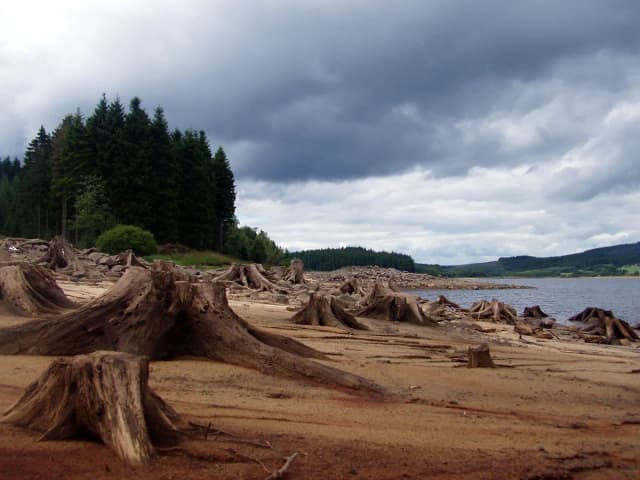
England's largest reservoir by volume — 2,700 acres of cold, peat-stained water pressed against the Scottish border. The low-nutrient character means the fish rely heavily on terrestrials blown in from the surrounding moorland, which is why almost everything that matters at Kielder happens within a long cast of the bank. Open-water boat drifts are rarely worth the fuel unless the surface is flat calm. The productive ground shifts with the wind: Plashetts holds the most natural feeding all year and draws the bigger fish; Whickhope Anchorage is binary — when the wind piles in, it fills with fish, and when the wind reverses, they leave. A wind that has held in one quadrant for three or four days is the highest-confidence signal the water produces, stacking trout progressively into the windward end until conditions change.
A respectable few hours, if you choose your moments
Good wave on — drift country. A useful wave. Work the productive shore.
Conditions on the water
Some readings unavailable — check directly before fishing.
The brief
The plan
Set up a broadside drift and cover the water systematically. Work Dry Fly on the bob and Emerger on the point. In the ripple, a bushy searching dry (Hopper, Shipman's, Elk Hair Caddis) outperforms flush emergers — it stays visible and holds the surface tension.
If the main plan is not working, switch to a smaller, more imitative pattern fished slower and deeper. A change of drift angle can also make a difference.
Keep an eye on changing conditions — wind shifts and cloud breaks can trigger short feeding spells.
A gentle ripple is ideal for drifting — broadside drift covering the wind lanes should be productive.
What's on, when
Numbers are intensity 0 (none) to 3 (peak) — a guide, not a guarantee.
Top pattern + the box
Why today scores what it does
- Wind conditions (ripple) closely match what this water fishes best in.
- Hawthorn Fly is in its seasonal window, boosting the chance of targeted feeding.
Precipitation
Who this water suits
Kielder Water, on the water
Field guide · contributor-editedWhat this water is
England's largest reservoir by volume — 2,700 acres of cold, peat-stained water pressed against the Scottish border. The low-nutrient character means the fish rely heavily on terrestrials blown in from the surrounding moorland, which is why almost everything that matters at Kielder happens within a long cast of the bank. Open-water boat drifts are rarely worth the fuel unless the surface is flat calm. The productive ground shifts with the wind: Plashetts holds the most natural feeding all year and draws the bigger fish; Whickhope Anchorage is binary — when the wind piles in, it fills with fish, and when the wind reverses, they leave. A wind that has held in one quadrant for three or four days is the highest-confidence signal the water produces, stacking trout progressively into the windward end until conditions change.
- Reservoir
- Peat
How to get to the water
Where the rules change
- Trout1 April → 31 October
Kielder Water
No photos yet for this water.
England's largest reservoir by volume — 2,700 acres of cold, peat-stained water pressed against the Scottish border.
A respectable few hours, if you choose your moments
Good wave on — drift country. A useful wave. Work the productive shore.
Some readings unavailable — check directly before fishing.
A reasonable day here, though temperature isn't quite in the sweet spot.
Set up a broadside drift and cover the water systematically. Work Dry Fly on the bob and Emerger on the point. In the ripple, a bushy searching dry (Hopper, Shipman's, Elk Hair Caddis) outperforms flush emergers — it stays visible and holds the surface tension.
If the main plan is not working, switch to a smaller, more imitative pattern fished slower and deeper. A change of drift angle can also make a difference.
Keep an eye on changing conditions — wind shifts and cloud breaks can trigger short feeding spells.
A gentle ripple is ideal for drifting — broadside drift covering the wind lanes should be productive.
- Wind conditions (ripple) closely match what this water fishes best in.
- Hawthorn Fly is in its seasonal window, boosting the chance of targeted feeding.
Numbers are intensity 0 (none) to 3 (peak) — a guide, not a guarantee.
England's largest reservoir by volume — 2,700 acres of cold, peat-stained water pressed against the Scottish border. The low-nutrient character means the fish rely heavily on terrestrials blown in from the surrounding moorland, which is why almost everything that matters at Kielder happens within a long cast of the bank. Open-water boat drifts are rarely worth the fuel unless the surface is flat calm. The productive ground shifts with the wind: Plashetts holds the most natural feeding all year and draws the bigger fish; Whickhope Anchorage is binary — when the wind piles in, it fills with fish, and when the wind reverses, they leave. A wind that has held in one quadrant for three or four days is the highest-confidence signal the water produces, stacking trout progressively into the windward end until conditions change.
- Reservoir
- Peat
- Trout1 April → 31 October
England's largest reservoir by volume — 2,700 acres of cold, peat-stained water pressed against the Scottish border. The low-nutrient character means the fish rely heavily on terrestrials blown in from the surrounding moorland, which is why almost everything that matters at Kielder happens within a long cast of the bank. Open-water boat drifts are rarely worth the fuel unless the surface is flat calm. The productive ground shifts with the wind: Plashetts holds the most natural feeding all year and draws the bigger fish; Whickhope Anchorage is binary — when the wind piles in, it fills with fish, and when the wind reverses, they leave. A wind that has held in one quadrant for three or four days is the highest-confidence signal the water produces, stacking trout progressively into the windward end until conditions change.