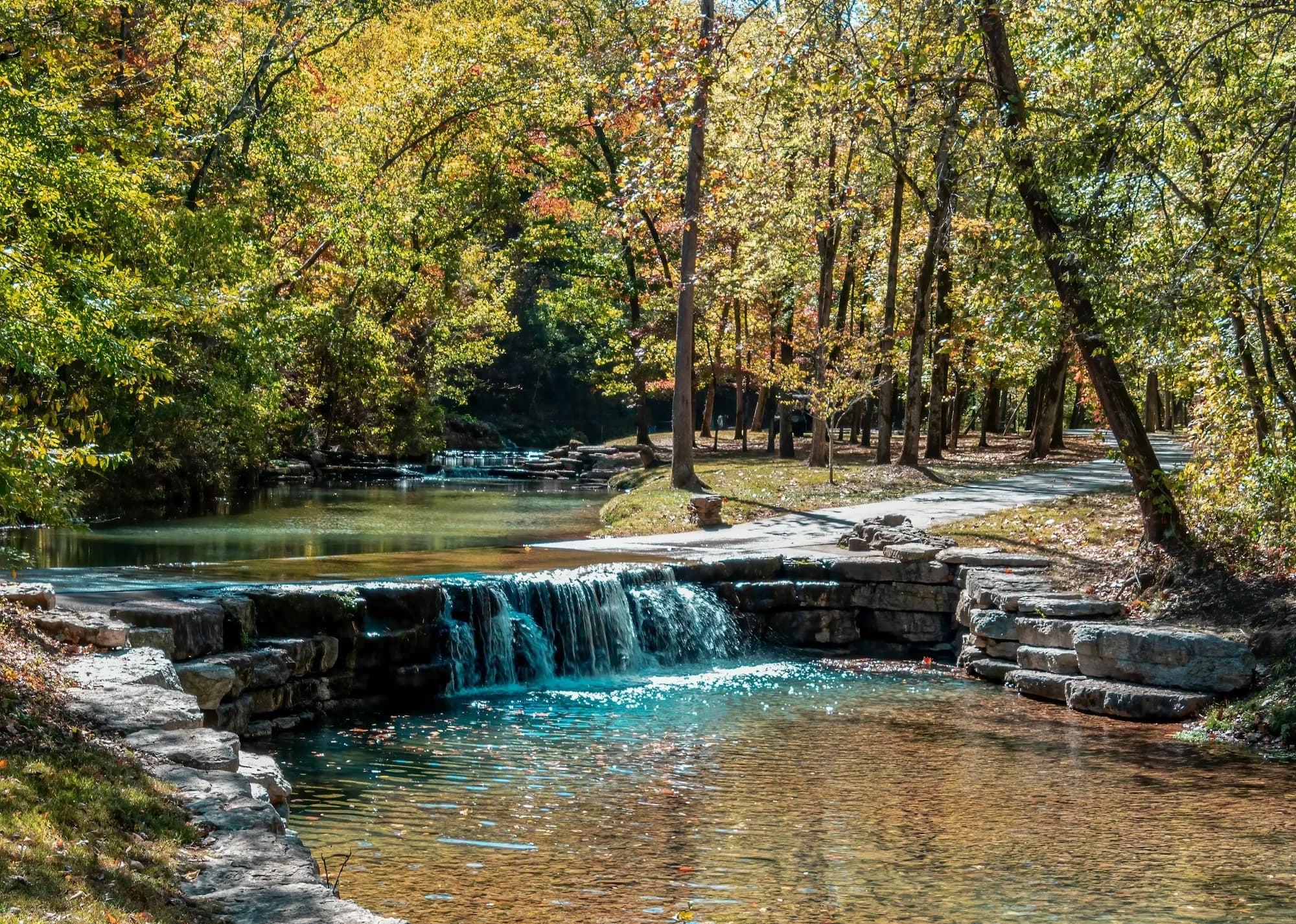
Arkansas and Missouri are not where most people expect to find a trout river. The Ozarks are warm, green and far from the high mountains. But there are two sources of cold water here. Big reservoirs release it from the bottom, and the limestone country lets it up from the ground in springs. Between them they give you a region that fishes through the winter, when much of the country has packed its rods away. It also gives you two quite different ways to spend a day: a river that changes with the dam, or a river that does not change at all. Knowing which one you are standing in is most of the skill.
Check the dam first. Tailwaters for the big water, springs for the steady water, small creeks for the quiet.
Trout in the Middle of America
It takes a moment to adjust to the idea. You are driving through low, wooded hills with a hot-weather feel to them, past lakes, past towns that sell boat motors, and then you cross a bridge over water so clear and cold that your fly box begins to feel important. After the dams were built, trout were stocked in the cold releases below them, and the limestone country keeps its own cold water in the ground.
This guide covers both halves. In Arkansas, that is the big tailwaters, a spring-fed river and two small southern tailwaters. In Missouri, it is Lake Taneycomo below Table Rock Dam, the springs, the state trout parks and a handful of small wild-trout creeks. All of it is better planned with a rules sheet open beside the map. Licensing, permits and zone boundaries differ from water to water, and from season to season, so treat the regulators as the last word.
The Big Tailwaters: Fishing on the Dam's Terms
The White, the Norfork, the Little Red and the Beaver: the water level belongs to the powerhouse.
The White below Bull Shoals is a long, cold lowland river spilling out of a deep reservoir. It holds brown trout that grow large, and stocked rainbows that keep the numbers up. The Norfork is its short, intensely fished neighbor below Norfork Dam. On low water the Norfork is delicate, technical fishing with midges, scuds and sowbugs, and special regulations apply on parts of the river. The Little Red below Greers Ferry is the central Arkansas tailwater, cold and rich, with wade fishing on low water and drift-boat fishing when the dam is running. The Beaver tailwater in the northwest is shorter and gentler, mainly a stocked-rainbow fishery with a quieter population of browns, and a sensible place to learn how generation works.
The rule on all of them is the same: find out what the dam is doing before you step in. On low water you can wade gravel and weed beds with small nymphs on fine tippet. When the units come on, the river rises and speeds up, the wading disappears, and it becomes streamer water from a boat. The Norfork is short enough that one unit coming on can change the river quickly. Check the release schedule, plan an exit, and never trust a gravel bar you reached on low water.
Lake Taneycomo: A Lake on the Map
Cold water from Table Rock Dam makes a serious trout river in the middle of Branson.
Taneycomo is a lake by name and a tailwater in practice. Cold flow from the bottom of Table Rock Reservoir gives the upper reach below the dam its trout, with rainbows and a protected head of bigger browns. It generates like the Arkansas rivers do, so you get low-water wading and technical midge fishing in one hour and current and depth in the next.
The rules here are specific, and they matter. The reach nearest the dam carries the tightest rules, including a no-fishing zone and gear and size restrictions, and a Missouri trout permit applies. Zones and limits can change, so read the current Missouri Department of Conservation sheet before you tie anything on, and respect the no-fishing water exactly.
Spring-Fed Rivers: Cold Without the Dam
The Spring River, the Eleven Point and the Current: steady, cold, and not at the mercy of a switch.
Not every cold river in the Ozarks answers to a powerhouse. The Spring River in Arkansas is born at Mammoth Spring on the Missouri line, where a single large spring makes a river in one go. Below the old dam at Mammoth Spring State Park it runs about a dozen miles of ledges, rapids and gravel runs. It is a stocked rainbow river with some browns, popular with canoes in summer, and it fishes steady and cold rather than pulsing with generation. Scuds, midges and soft hackles are the working flies.
In Missouri the Eleven Point is a National Scenic River running clear through forest country, and Greer Spring, which roughly doubles its flow, turns a warm Ozark stream into trout water. It is a float-and-wade river of long pools and gravel riffles with stocked and wild rainbows and a few browns. The Current River rises at Montauk Springs and runs through Montauk State Park before it turns wild and floatable downstream; the park water works on a daily-tag system, and Missouri trout permit and park tag rules differ by water, so check which applies. The upper North Fork of the White, above Norfork Lake, is spring-fed and Blue Ribbon managed, with wild rainbows and some browns, and deserves the care of a wild fishery. Remember that float traffic can be heavy on the popular rivers in warm weather.
Missouri Trout Parks: Tags, Zones and Rules
Bennett Spring, Roaring River and Maramec Spring: busy, stocked, rule-heavy, and good for the winter.
Missouri's trout parks are accessible, busy, stocked and tightly managed. They are not wilderness, and they do not pretend to be. Bennett Spring State Park and Roaring River State Park divide their water into zones with different gear rules, so read the Department's current map for each. Roaring River, near Cassville, is a small spring-fed stream stocked regularly, and its winter season can give the fly fisher quieter water. Maramec Spring Park runs its own trout-park rules, so read them before you go.
These parks are about precision. Zone boundaries, tags, permits and season changes are set by the park or the Department, and they differ at each one. Check the park's current tag and permit rules for the exact park before you go, and expect crowds when the season opens. The quieter, catch-and-release winter months are where the fly angler is best served, subject to the rules in force.
Small Wild-Trout Creeks: Stealth and Restraint
Crane Creek, Little Piney, Mill Creek, Barren Fork, Blue Springs: small water, wary fish, and a short list of manners.
Missouri's Blue Ribbon creeks are the opposite of the trout parks. Crane Creek is a tiny, brushy, spring-influenced creek near the town of Crane holding wild McCloud-strain rainbows, descendants of California stock brought east long ago. The point of the place is the heritage of the fish and the challenge, not their size. Little Piney, Mill Creek, Barren Fork and Blue Springs are small, clear wild-rainbow streams, best fished slowly, with a quiet wade, light tippet and shaded water.
Fish these waters with a conservation mindset. Use small flies, approach low and slowly, handle fish gently and keep them wet, and learn the special regulations before you go. Do not expect numbers or size. Expect to be seen by every trout before you see them, and be pleased when one forgives you.
The Southern Tailwaters: Little Missouri and Ouachita
Modest, seasonal, and honest about it: stocked trout in the cool months.
South of the big Ozark rivers, the Little Missouri below Narrows Dam and the Ouachita tailwaters below the Ouachita dams are small, seasonal tailwater trout options stocked by the Arkansas Game and Fish Commission. They fish mostly in the cool months. They depend on cold releases, and when summer heat and the release pattern take the cold away, the trout fade. The Little Missouri is a pretty river of gravel and ledges, where small nymphs, midges and eggs near the stocked water are the working approach while it is cold. Treat both as put-and-take fisheries, check release information and stocking details with the regulator, and keep expectations modest.
The Ozarks Year
Winter is a real season here, summer is the hot one, and the springs ignore the calendar.
Winter (December to February): this is a real selling point. Cold releases and spring water keep the rivers fishable, midges, scuds and sowbugs are the working food, and the Missouri parks' winter catch-and-release seasons offer quieter water, subject to the rules in force. Dress properly, because river mornings are cold and dam flows can still rise.
Spring (March to May): rain can add color and extra flow on top of dam releases, so check both before you wade. Small dries come into play when fish are up.
Summer (June to August): hot and busy, so fish early and late and check generation. The spring-fed rivers stay cold and the tailwaters stay cold close to the dam, but they warm further downstream, and the Little Missouri and Ouachita lose their cold water. The popular rivers carry canoe and boat traffic. Fish early, protect trout in warm water and rest any fish that looks stressed.
Autumn (September to November): the weather settles and the crowds thin. Browns spawn on gravel in autumn on several of these tailwaters, including the White, Norfork and Little Red: stay off redds and do not target visibly spawning fish. Missouri park and spring-river trout have their own rules. Streamers in low light and nymphs in the day are the usual approach. Check the season dates for each water.
Gear and Licenses
A nine-foot five-weight, thin tippet, a wading staff, and a rules sheet for the exact stretch.
A nine-foot five-weight handles most of the region; a three- or four-weight suits the small creeks, and a six-weight helps with streamers from a boat. Carry midges, scuds, sowbugs, soft hackles and small dries, plus a few streamers for generation water. Fine tippet matters on the clear, heavily fished tailwater flats. A wading staff and a lifejacket are worth having, and wear the lifejacket in a boat.
The Arkansas Game and Fish Commission and the Missouri Department of Conservation issue licenses and publish the regulations; check whether a trout permit or stamp is required for your water and date. Clean and dry your gear between rivers and follow local rules on invasive species and disease. Check the dam's release schedule, the weather and the local access rules before you travel.