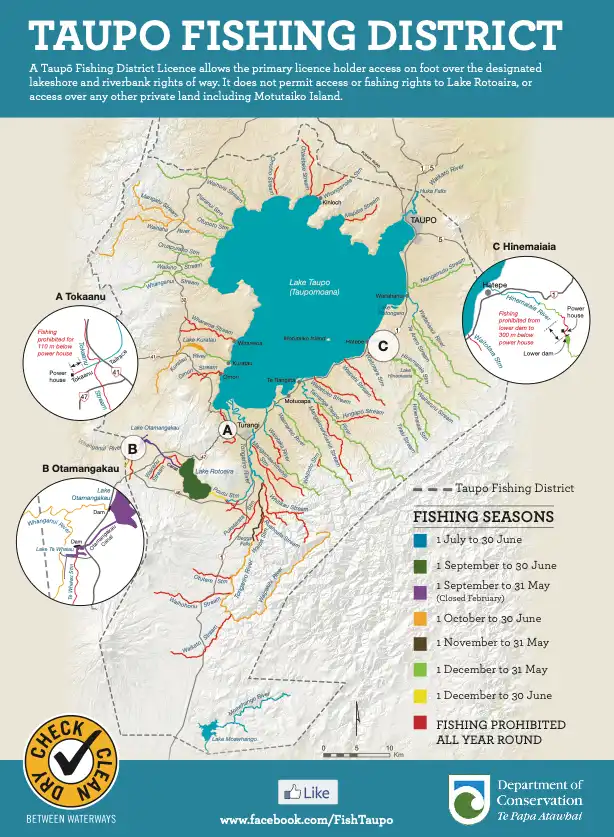
Lake Taupō is the engine of the whole system — a huge, cold caldera lake that grows strong rainbows and browns and feeds them up the dozens of tributaries that ring it. The signature fishing is the stream mouth: wading the rip where a river runs in and fishing a wet fly or smelt pattern into the current line, especially at dawn, dusk and after dark in the warmer months. Boat anglers harling and jigging take fish year-round; shore and stream-mouth fishing peaks around the runs.
A patient day, if you fancy it
Good wave on — drift country. Take your time — read the water before you cast.
Live now
Conditions on the water
Trends shown where the gauge supports them
Some readings unavailable — check directly before fishing.
How to fish · for rainbow trout
The brief
When · where · method · kit
Today's tactical plan
The plan
Plan A · Plan B · what to watch · bank or boat
Set up a broadside drift and cover the water systematically. Work a bushy searching pattern on the bob and drop a contrasting nymph on the point.
If the main plan is not working, switch to a smaller, more imitative pattern fished slower and deeper. A change of drift angle can also make a difference.
Evening tends to be the best period in summer — stay late if you can for a sedge or spinner fall.
A gentle ripple is ideal for drifting — broadside drift covering the wind lanes should be productive.
Hatches & runs
What's on, when
Twelve months at a glance
Numbers are intensity 0 (none) to 3 (peak) — a guide, not a guarantee.
Today's fly · curated pack
Top pattern + the box
5 patterns from this venue's curated pack
Evidence
Why today scores what it does
The factors driving today's verdict
- Wind conditions (ripple) closely match what this water fishes best in.
- Cloud cover (cloud) suits the fishery well.
Lake Taupō, on the water
Field guide · contributor-editedLake Taupō · about
What this water is
Background · character · contributors
Lake Taupō is the engine of the whole system — a huge, cold caldera lake that grows strong rainbows and browns and feeds them up the dozens of tributaries that ring it. The signature fishing is the stream mouth: wading the rip where a river runs in and fishing a wet fly or smelt pattern into the current line, especially at dawn, dusk and after dark in the warmer months. Boat anglers harling and jigging take fish year-round; shore and stream-mouth fishing peaks around the runs.
A vast caldera lake at the heart of the North Island, filling the crater of one of the largest eruptions of the last hundred thousand years, ringed by pumice beaches and the cone of Ruapehu away to the south. Its cold clear water grows the rainbows and browns that run its many tributaries, and the river mouths — the rip lines where stream meets lake — are the classic fishing.
Wading: Cold deep lake, sudden weather, drop offs at the rips — boat/shore
- Lake
- Volcanic
- Stillwater
- River mouth
Lake Taupō · directions
How to get to the water
Lake Taupō · zones
Where the rules change
Seasons · zones · per-species rules
- Troutyear-round (Taupō district calendar) → year-round
Lake Taupō · permits
Good to know
- Taupō Fishing District — DOC Taupō licence required (not Fish & Game)
- Stream-mouth boundary rules and night-fishing seasons apply
- Confirm current DOC Taupō regulations.
Lake Taupō · learn
Related guides
Learn-zone playbooks for this water
Lake Taupō
Lake Taupō is the engine of the whole system — a huge, cold caldera lake that grows strong rainbows and browns and feeds them up the dozens of tributaries that ring it.
A patient day, if you fancy it
Good wave on — drift country. Take your time — read the water before you cast.
Some readings unavailable — check directly before fishing.
Weather-only: no live gauge. Lake level is hydro-managed (Waikato scheme). The useful reads are wind direction, water temperature and recent freshes at the river mouths.
Conditions are ideal for Lake Taupō — wind, cloud and temperature all line up.
Set up a broadside drift and cover the water systematically. Work a bushy searching pattern on the bob and drop a contrasting nymph on the point.
If the main plan is not working, switch to a smaller, more imitative pattern fished slower and deeper. A change of drift angle can also make a difference.
Evening tends to be the best period in summer — stay late if you can for a sedge or spinner fall.
A gentle ripple is ideal for drifting — broadside drift covering the wind lanes should be productive.
- Wind conditions (ripple) closely match what this water fishes best in.
- Cloud cover (cloud) suits the fishery well.
Numbers are intensity 0 (none) to 3 (peak) — a guide, not a guarantee.
Terrain map
- Taupō Fishing District — DOC Taupō licence required (not Fish & Game)
- Stream-mouth boundary rules and night-fishing seasons apply
- Confirm current DOC Taupō regulations.
Lake Taupō is the engine of the whole system — a huge, cold caldera lake that grows strong rainbows and browns and feeds them up the dozens of tributaries that ring it. The signature fishing is the stream mouth: wading the rip where a river runs in and fishing a wet fly or smelt pattern into the current line, especially at dawn, dusk and after dark in the warmer months. Boat anglers harling and jigging take fish year-round; shore and stream-mouth fishing peaks around the runs.
A vast caldera lake at the heart of the North Island, filling the crater of one of the largest eruptions of the last hundred thousand years, ringed by pumice beaches and the cone of Ruapehu away to the south. Its cold clear water grows the rainbows and browns that run its many tributaries, and the river mouths — the rip lines where stream meets lake — are the classic fishing.
Wading: Cold deep lake, sudden weather, drop offs at the rips — boat/shore
- Lake
- Volcanic
- Stillwater
- River mouth
- Troutyear-round (Taupō district calendar) → year-round
Lake Taupō is the engine of the whole system — a huge, cold caldera lake that grows strong rainbows and browns and feeds them up the dozens of tributaries that ring it. The signature fishing is the stream mouth: wading the rip where a river runs in and fishing a wet fly or smelt pattern into the current line, especially at dawn, dusk and after dark in the warmer months. Boat anglers harling and jigging take fish year-round; shore and stream-mouth fishing peaks around the runs.