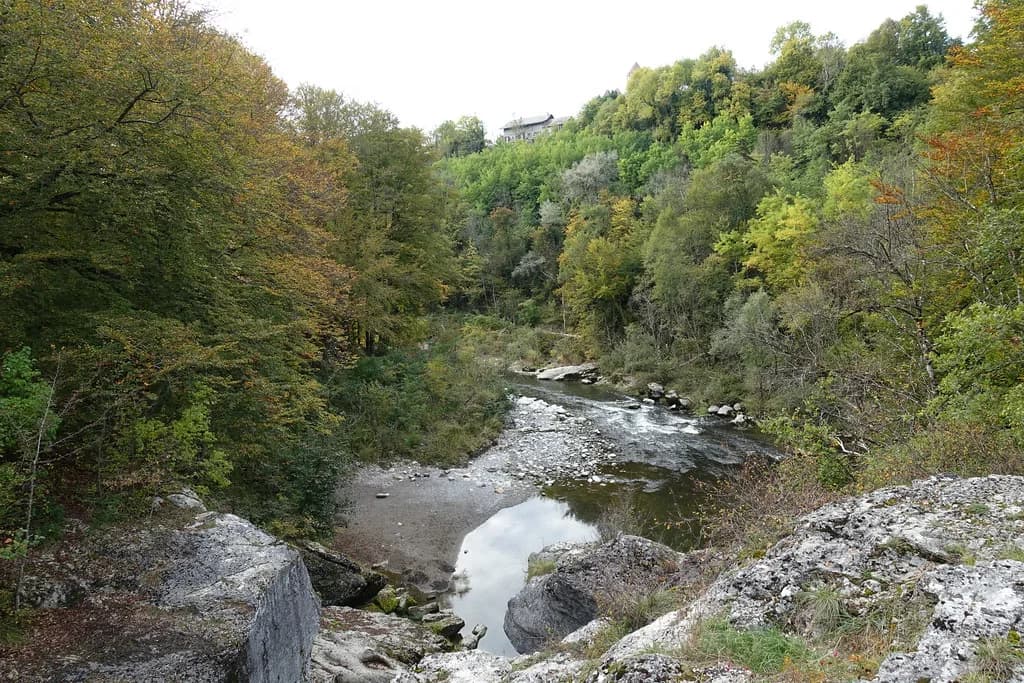
Annecy makes its case simply by existing where it does — a lake town wedged between the Bornes massif and the Bauges, with wild Mediterranean-strain fario trout in the rivers running close enough to fish before lunch.
The Fier, Usses and Fillière offer technical Alpine river fishing, while Lac d'Annecy itself — one of Europe's cleanest lakes — is the stillwater fallback when the rivers run high with snowmelt.
The Fier for the near-town wild trout session. The Usses and Fillière for the quieter tributary day. Lac d'Annecy when the rivers are running high.
Fly Fishing from Annecy: Alpine Water, Wild Trout
Annecy makes its case simply by existing where it does — a lake town wedged between the Bornes massif and the Bauges, with the Fier running close enough to the old town to fish before lunch and a fanned-out cluster of Haute-Savoie rivers within easy reach for anyone willing to drive a little further into the mountains.
What these rivers hold is worth knowing before you arrive: wild fario trout of Mediterranean lineage, not the more commonly stocked Atlantic strain found across much of the rest of France — smaller rivers, technical wading, and fish that have not been simplified by generations of hatchery stock.
The Legal Bit, Briefly
A carte de pêche, bought through an AAPPMA, a local dépositaire, or online at cartedepeche.fr, is required for all freshwater fishing in France — AAPPMA Annecy Rivières manages the Fier, Usses and Lac d'Annecy basin specifically.
France requires a carte de pêche (fishing card) for anyone fishing fresh water, issued through the local AAPPMA (Association Agréée de Pêche et de Protection du Milieu Aquatique) responsible for that stretch of water, a local tackle-shop dépositaire, or directly online at cartedepeche.fr. There is no separate rod licence system as in Britain — the carte de pêche does both jobs.
AAPPMA Annecy Rivières holds responsibility for the Fier, the Usses and the Lac d'Annecy watershed, and is the first point of contact for current rules, categories and any specific reaches with special restrictions. Most of these rivers are classified 1ère catégorie (salmonid water), where fly fishing is the dominant and often the required technique — worth confirming the exact classification for the specific stretch you plan to fish, since rules shift river by river and even season by season.
Le Fier and the Wider Basin
Wild fario trout managed by AAPPMA Annecy Rivières, with fly fishing the primary technique across the 1ère catégorie water of the Fier, Usses and Fillière.
The Fier is the natural starting point — close to town, holding wild trout, and managed specifically for fly fishing on its salmonid-classified reaches. Read water here the way you would any technical Alpine river: fast pocket water, boulder-strewn runs, and fish holding tight to structure rather than cruising open glides.
The Usses and the Fillière extend the same character further out, each a smaller tributary system with its own access points and its own local knowledge worth picking up from the AAPPMA or a local tackle shop before making the drive. None of these are big rivers by international standards — the Alpine character is technical, intimate water rather than broad, expansive fishing, and that is precisely the appeal for anglers who want to work for a wild fario rather than simply present a fly to a stocked fish.
Lac d'Annecy: The Stillwater Option
One of the cleanest lakes in Europe, a short walk from the town centre, holding trout and char alongside its better-known coarse and lake species.
For a change of pace, or a day when the mountain rivers are running high with snowmelt, Lac d'Annecy itself is worth a session — one of the cleanest large lakes in Europe, with trout and char present alongside its more commonly targeted species. This is a different discipline from the river work: covering water from a boat or the shore, watching for rises or feeding activity rather than reading a specific lie.
The Annecy Year
Spring for rivers still carrying snowmelt — expect higher, colder water than the calendar might suggest. Summer for the technical low-water game. Autumn for the last of the season before closure.
Spring in the Alps runs later than lowland France — expect the Fier and its neighbours to be running high and cold well into what would be full spring elsewhere, carrying snowmelt down from the massifs above. Fishing tends to improve through May and June as the melt eases.
Summer brings the technical low-water game these rivers are built for — careful wading, long leaders, and precise casting into pocket water rather than blind searching. Afternoon storms are a real feature of Alpine summers; watch the sky as much as the water.
Confirm the exact season dates and any closed periods directly with AAPPMA Annecy Rivières before travelling — French 1ère catégorie seasons are set annually and vary by département.
What to Carry
A 7'6" to 8'6" 3–4 weight for the technical pocket water of the Fier and its neighbours. A 9' 5-weight with floating and intermediate lines for Lac d'Annecy.
For the rivers: a short 7'6" to 8'6" rod of 3 to 4 weight suits the tight, technical wading these Alpine tributaries demand — space to cast is often at a premium, and a shorter rod handles the close-quarters work better than a longer one built for open water. Small, sparse nymph and dry patterns matched to whatever's actually hatching serve better here than anything flashy.
For Lac d'Annecy: a 9' rod of 5 weight with both floating and intermediate lines covers most lake situations. Polarised glasses help spot cruising fish in water this clear.
Buy your carte de pêche before fishing — through AAPPMA Annecy Rivières, a local dépositaire, or cartedepeche.fr — and confirm the exact classification and rules for whichever stretch you plan to fish.
The Final Verdict
The Fier for the near-town wild trout session. The Usses and Fillière for the quieter tributary day. Lac d'Annecy when the rivers are running high with snowmelt.
Annecy's case rests on genuine variety within a small radius: technical Alpine river fishing for wild Mediterranean-strain fario a few minutes from the old town, quieter tributaries a little further out, and one of Europe's cleanest lakes as a stillwater fallback. It rewards an angler who wants to work for a wild fish on demanding water rather than one looking for an easy stocked afternoon.