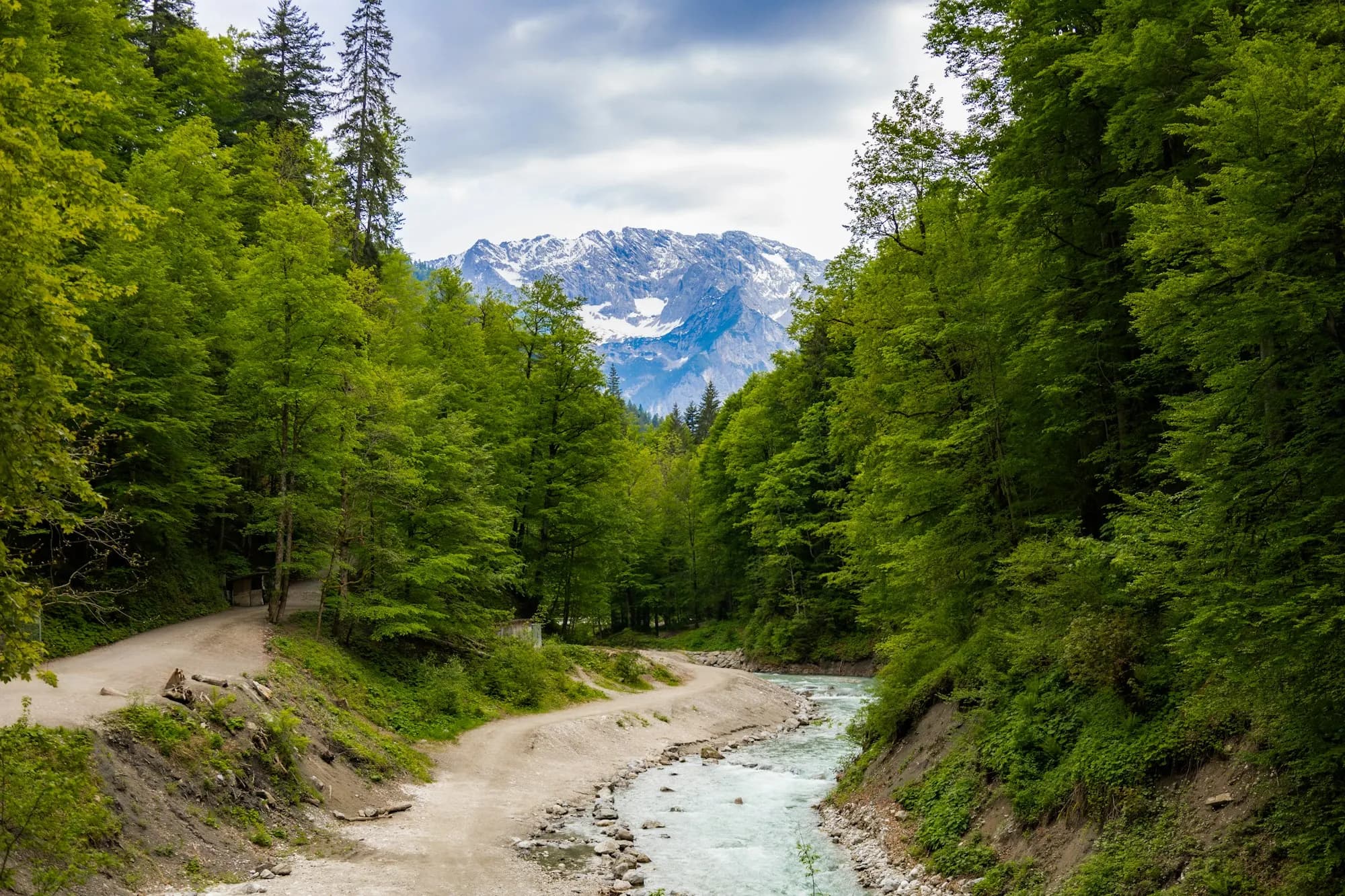
Southern Germany is better fly-fishing country than its reputation, and harder to get into than its reputation suggests. The rivers are the real thing: clear limestone water running off the Alps, grayling and brown trout in the same pools, a few Bavarian rivers where the fish still breed for themselves. Further west the Black Forest offers something quite different, small, quick, tree-lined streams with wild brown trout and a temper that changes with the rain. What ties it together is the way access works. Fishing rights are held locally, so the question is rarely whether a river is good, and almost always who you ask. This guide is a map of the water and the season; the asking is up to you.
Limestone rivers for the dry fly. Small streams for the short cast. Ask early.
Southern Germany: Good Water, Local Rules
Southern Germany does not announce itself as a fly-fishing destination, and perhaps that is part of the appeal. The rivers are properly good: clear, alkaline, often cold, with grayling and brown trout sharing the pools, and a handful in Bavaria where the fish are still breeding naturally. It is the kind of country where a guide mentions the Ammer in the same breath as the Loisach, Lech and Isar and you realise there is a whole district of fishable water you had never heard of.
This guide is about where the water is and how the year runs. Tactics belong in the other playbooks. One thing needs saying early: in Germany the fishing rights are held locally and the licensing rules are set state by state. Some of the finest water here is controlled, fly-only, or reached through a club, and the venue descriptions are frank about it. Treat access as the first job, not the last.
This is also only a slice of Germany. It covers Bavaria, with Munich as the natural base for the Alpine foothills, and the Black Forest in Baden-Württemberg. The rest of the country, the Eifel, Sauerland, Harz and the Baltic coast, is a different trip and sits outside this guide.
How Access Works: Rights, Clubs and Asking Early
Who holds the rights, who issues the permit, and why the first email matters.
The pattern across southern Germany is consistent. The fishing right belongs to a local holder, often a club or a managed fishery, and the federal state sets the licensing rules, including any fishing-exam requirement. That is the level this guide can honestly speak to. Which permit applies on which stretch is a question for the rights holder, the Land's rules and the venue page.
The venue descriptions show the range. The Loisach is tightly controlled and best arranged well in advance. The Traun has beat-style management and a named managed-waters entry. The Isar has a guest-angler entry built around published windows. Ask first, keep your paperwork with you, and respect fly-only and removal rules where they apply.
The Alpine Rivers: Isar, Loisach, Ammer, Lech and Inn
Clear limestone water, grayling and brown trout, and controlled access to the best of it.
The Isar runs from the Karwendel mountains through Munich to the Danube, which makes it the most convenient serious river in the region for a Munich-based angler. It holds grayling, brown trout and rainbows in varied water, and even the urban sections hold fish. The upper Isar above Sylvenstein is well-regarded grayling water. For visitors there is a separate guest-angler entry: guiding sources publish practical windows of roughly early May to mid-July and early September to mid-November on the better wild stretches. Treat those as a lead and confirm them with the rights holder before you plan around them. Brown trout and grayling have different closed seasons in Bavaria, and brown trout spawn on these gravels in autumn, so in the later window ask exactly which fish you may target and keep.
The Loisach, near Garmisch-Partenkirchen, is one of Bavaria's best fly-fishing spots, with high-quality trout and grayling in clear alpine limestone water. It is also the clearest example of the access problem: strict fly-only and removal rules, and access tightly controlled through local fishing rights. Enquire well in advance. The reward is a proper mountain river.
The Upper Ammer sits in the Ammergau Alps and is mentioned by guiding sources alongside the Loisach, Lech and Isar. The Bavarian Lech runs from the Austrian Alps through the Allgäu, holding grayling and brown trout in limestone water. Some of it is heavily dam-regulated, and the natural stretches between the impoundments hold the best fish.
The Inn comes in from Austria through Rosenheim and is a bigger, more glacial river. Grayling, brown trout and huchen are in the system, and summer glacial colour affects the main stem, so the tributaries often offer better fly water than the main channel. If the huchen interests you, there is a playbook for it, linked below. They are protected fish, so ask what applies before you target one.
The Traun, the Wiesent and the Upper Danube
The flagship Bavarian beat river, a Franconian limestone classic, and a young Danube in a gorge.
The Deutsche Traun, in the Chiemgau, is a flagship Bavarian trout and grayling river, one of the few in Bavaria where brown trout, rainbow trout and grayling still reproduce naturally. The Hochberg stretch is crystal-clear and beat-style management comes with strong stocks. There is a separate entry for the Rudi Heger managed waters, a named managed water. Ask the rights holder whether visitor permits are issued before you plan around it.
The Wiesent runs through the limestone of the Fränkische Schweiz in Franconia, and is regularly mentioned alongside the Deutsche Traun as a serious Bavarian fly-fishing destination. Clear water, good hatches, mixed methods productive: a good river for an angler who likes to look at the water before he decides.
The Upper Danube is the surprise. In its youth it cuts through the Swabian Jura limestone gorge, with excellent grayling and brown trout in clear, alkaline water. The gorge section between Tuttlingen and Sigmaringen is genuinely spectacular, and the dry fly and nymphing are classic European limestone. The gorge lies in Baden-Württemberg, with Bavaria's rules applying only further downstream, so check which state's rules apply on the stretch you choose.
Alpine Lakes: Förchensee, Eibsee and Walchensee
Clear water, fine leaders, and a reminder that the fish can see you.
The Förchensee, a small alpine stillwater in the Chiemgau, is a small, clear stillwater with brown trout, rainbows and some char. It can be fished from the shore or a belly boat, and it is the more practical and accessible of the three.
The Eibsee lies below the Zugspitze, trout and char in water so transparent you feel your fly is under magnification. That calls for fine leaders and careful presentation, and for checking local permits before you fish. Walchensee is one of Germany's largest and deepest alpine lakes, with trout and char, bank and boat fishing. Stocking varies, so confirm the target species locally before you plan.
The Black Forest: Small Water, Short Casts
Pocket water, wild brown trout and streams that change their minds within hours of rain.
The Black Forest streams are a different kind of fishing. The Gutach (several Black Forest streams share the name; the venue here is the Schönwalder Gutach, so confirm which one your permit covers) is classic: pocket water and broken currents, wild brown trout in intimate terrain, and quick to respond to rain. That gives you short windows for the dry fly during hatches, so timing matters as much as technique. The Große Wiese, a small mountain stream in the Wiesental Nature Park, is very short drifts and pocket water, with Euro nymphing and dry-dropper the right tools.
The Murg in the northern Black Forest has a mixed character of riffles, runs and pools, with good caddis hatches in spring and some grayling in the lower sections. The Wutach is the one to see, though parts of the gorge are protected with restricted access, so check before you go: it cuts through a dramatic gorge in the southern Black Forest, with limestone influence giving it clearer water than the granite streams to the west. It holds good brown trout and some grayling, and the fishing there is as much about the landscape as the fish.
Schluchsee is the odd one out: a large reservoir lake at about 930 metres, cold and deep, with stocked trout. Fishing is usually best in spring and autumn when fish move closer to the surface, and that the elevation and exposure create a window rather than a season. All of these are on rights held locally, so check the rules of Baden-Württemberg and the local club or rights holder.
The Bavarian and Black Forest Year
Spring and autumn carry the best of it, and the weather decides the Black Forest.
Winter: the exposed Alpine and high-altitude waters are closed or out of reach, and brown trout are spawning or protected on most rivers. Some river grayling fishing may be possible under local rules, but the Land sets different closed seasons for brown trout and grayling, so ask the rights holder what is open for which fish. Otherwise this is the time to sort out rights and permits.
Spring: caddis hatches are noted on the Murg, and Schluchsee fishes best in spring when trout move closer to the surface. The Black Forest streams respond to rain within hours, so the window between spates is the one to look for. For the Isar guest-angler stretches the guiding sources publish an early-May opening for the better wild stretches; confirm it.
Summer: low, clear summer water on the Black Forest streams demands stealth and stillness, and the glacial Inn runs coloured on its main stem, so the tributaries are the better bet. The clear Alpine lakes ask for fine leaders and careful presentation.
Autumn: Schluchsee fishes well in autumn as well as spring, and grayling rivers such as the Traun, Wiesent and Upper Danube are classic dry-fly and nymph water. Brown trout and grayling have different closed seasons in Bavaria and Baden-Württemberg, and brown trout may be closed or protected from the start of October while they spawn, so do not travel for autumn trout without checking. Ask what you may fish for.
Gear, Licences and Where to Base Yourself
A nine-foot four- or five-weight, fine tippet, and a letter written well in advance.
A nine-foot four- or five-weight handles most of the Alpine rivers and the lakes. For the Black Forest streams a shorter, lighter rod and a short-line nymphing set-up suit the tight, pocket-water fishing. Fine leaders and tippet matter on the clear limestone rivers and the very transparent lakes such as the Eibsee. The Förchensee can be fished from shore or a belly boat.
Munich is a sensible base for the Isar, Loisach, Ammer, Traun and Lech country in the Alpine foothills, and Garmisch-Partenkirchen suits the Loisach and Eibsee. For the Black Forest the Wiese, Gutach, Murg and Wutach are all in Baden-Württemberg, so plan that as its own trip.
Licensing is by federal state, and the fishing rights on the water are held locally. Check the Land's rules, the local rights holder or club and the venue page. Some waters, such as the Loisach, are tightly controlled, so enquire well in advance rather than turning up.