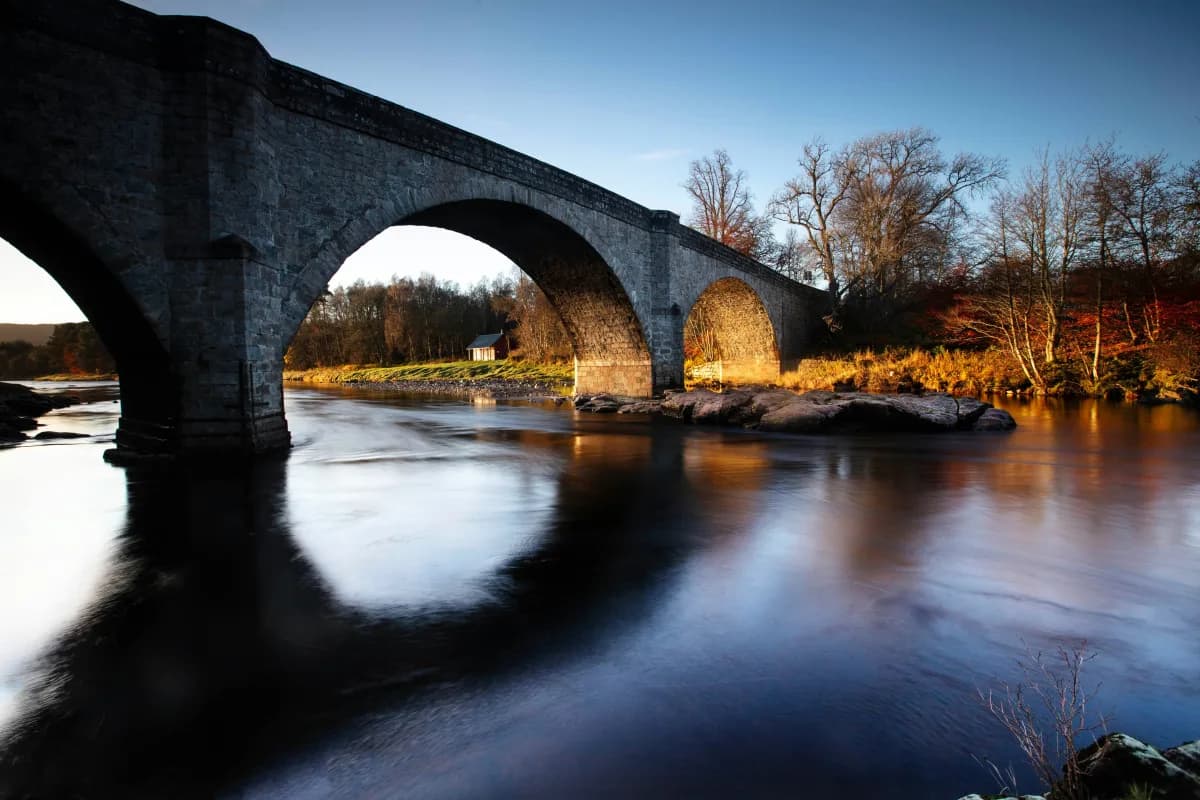
October turns the river over. In four weeks the water cools by a few degrees on most rivers, the leaves come down, the first frost arrives, and a stretch that fished well in September can look unrecognisable by Bonfire Night. Knowing what changed, and what hasn't, makes the difference between an afternoon on the bank and an afternoon on the sofa.
The temperature drop
How fast depends on the kind of river.
Spate and upland streams. Small, shallow and quick to drain, they follow the air closely and get cold first.
Large rivers. More water means more thermal mass, so they lag the air and cool more slowly. They carry that stored warmth into early winter.
Chalk and spring-fed streams. Groundwater comes out at a steady 10 or 11°C, so these fall far less than a freestone does. By November they are usually several degrees warmer than a neighbouring spate river, though they are still cold in a hard winter, and cool a little more towards the lower reaches.
Below a reservoir. The dam sets the temperature more than the weather does. It can change within hours when the release changes, and it is harder to predict from the air than any other type.
For fish, the drop matters because it slows everything. Trout and grayling are cold-blooded, and as the river drops through the single figures their metabolism slows and they feed less often. This is gradual. There is no number at which fish "switch off". Feeding narrows and shifts rather than stopping. Fish still feed in cold water. They do it less, in smaller windows, and they take food that comes to them without much effort.
The practical advice: slow your fly down, put it closer to the fish, and fish in the middle of the day. In winter the river itself warms by only a degree or two between dawn and mid-afternoon, so the gain is small, but the light is better and insects and fish are more active.
Leaf fall
In October the leaves come down in numbers.
A wooded river will carry thousands, sailing on the surface, sinking, collecting in eddies and snagging on your line.
Your line. Leaves hook your fly, particularly a dry or a nymph on the swing. Expect it and check your fly regularly.
The surface. Leaves on the surface make a good case for fishing a nymph or a wet fly. A dry has trouble competing with them.
The colour. Peaty and woodland streams run tea-brown in autumn. Most of the stain is humic acid washed out of the peat and soil by the autumn rains, with leaf litter adding to it. It is a stain, not mud: the water is dark but not thick, and a fly is still visible at close range. It does not clear like silt after a spate, and it deepens on every rise.
Underfoot. Wet leaves on rock are slick, and a mat of them hides holes in the bed. Wade as though the stones were greased.
Frost and the first cold snaps
Frost does not stop fishing.
A hard overnight frost followed by a bright, still day often gives pleasant, settled fishing, though the fish take time to wake. The sensible plan is to start late and fish the afternoon.
The thing to watch is the rapid cold snap. Big rivers and chalk streams hold their heat and rarely swing more than a degree in a day, but a small spate stream can lose two or three degrees in a couple of days, and more when snowmelt or cold rain is feeding it. Anglers commonly find a sudden fall slows the fish for a day or two while they adjust, and a steady fall is easier on them. If the river has dropped sharply, the first day after may be slow. Wait it out, or switch to deeper water and slower flies.
Ice at the margins and in slack water is another matter. Take care wading. A frozen rod ring and numb hands are a nuisance. A slip into freezing water is a danger.
After rain
What a spate does to temperature depends on the weather behind it.
In October, with soils and river still mild, the change is usually small, a degree or so. Mild rain on a southwesterly can even nudge the river up. Cold rain, snowmelt or rain after a hard frost pulls it down, sometimes by several degrees, and it recovers as the flood passes. Rain on frozen ground runs off almost as fast as it falls, so a frosty week can make a spate sharper than the rainfall suggests. In Rise Daisy the water temperature is an estimate worked from the air unless a gauge measures it, so it will not show the chill of a cold spate. The clarity category is also an estimate, built from rainfall, flow trend and geology. Treat both as a guide and look at the water.
How long it all lasts depends on the catchment. A steep spate river is up and clear again within a day or two. A big lowland river rises late and clears slowly. A peaty river stays stained for days. A chalk stream barely rises at all and clears quickly, which is why a chalk stream can fish after rain that would shut a spate river.
As a rough guide:
Rising and thick: don't bother, and take care wading.
Peaked and falling, still coloured: worth a go with a big, heavy fly, particularly for salmon.
Dropping and clearing: often the best of it. Fish feed more freely as the colour drops out and food is washed down, within what the cold allows.
Low, clear and cold: fish small, fish fine, fish at midday.
When to go
In late autumn and winter, the question is rarely "which day" but "which hours".
A cold, bright day with a gentle rise in temperature from morning to mid-afternoon can fish well. A mild, wet, windy day with a coloured river will not. A frosty dawn will fish badly until the sun reaches the water.