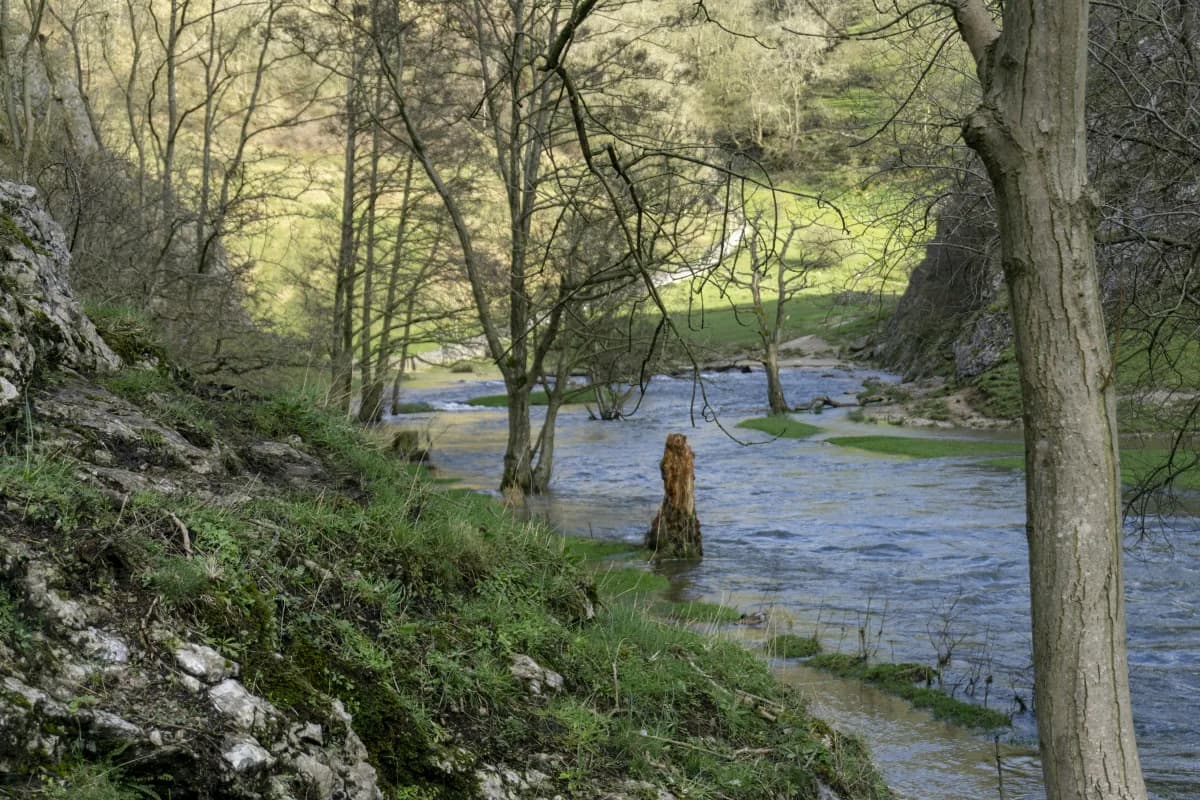
Manchester is not a chalk-stream city. It is not the Test or the Itchen, and nobody is going to confuse the Mancunian Way with the upper Wylye on a May evening. Most fly anglers, asked to name a city to be based in, would name half a dozen others first. They would, on this particular count, be wrong. Within a ninety-minute drive you can be on the Derbyshire Wye, on a tight Cheshire freestone holding unstocked browns, or on the Ribble, with grayling enough for a winter season.
The Derbyshire Wye is the headline river. The Dane is the best wild trout water close to home. The Ribble is the grayling answer. The Goyt is the local evening. Pennine Trout Fishery is the short-notice stillwater.
Fly Fishing from Manchester: A Better Base Than It Lets On
Manchester is not a chalk-stream city. It is not the Test or the Itchen, and nobody is going to confuse the Mancunian Way with the upper Wylye on a May evening. Most fly anglers, asked to name a city to be based in, would name half a dozen others first. They would, on this particular count, be wrong.
Within a ninety-minute drive you can be on the Derbyshire Wye — one of the few rivers in Britain with genuinely wild rainbow trout — or on a tight Cheshire freestone holding unstocked browns, or on the Ribble, which is a proper northern river with grayling enough for a winter season. There are Peak District classics within reach, a clutch of stocked stillwaters for the days when nothing else will fit the diary, and a small river that runs almost into the city for the evenings when you have got two hours and no patience for the M60.
The honest hierarchy, in the order most anglers will use them, is short enough to remember. The Derbyshire Wye is the headline river. The Dane is the best wild trout water close to home. The Ribble is the answer for grayling and for bigger northern fishing. The Goyt is the local water for evenings. Pennine Trout Fishery is the short-notice stillwater. The rest is detail, which is mostly what fly fishing is anyway.
The Legal Bit, Briefly
An Environment Agency rod licence covers fly fishing on rod and line throughout England. Fishery permits, club tickets and beat rules are layered on top, and access matters more than the geography suggests.
Anyone fishing with rod and line for trout, salmon, freshwater fish, smelt or eel in England and Wales needs the correct Environment Agency rod licence — on club water, day-ticket water, even private lakes. GOV.UK sells one-day, eight-day and twelve-month versions and the enforcement officers are politer about it than you might expect, but only the first time.
It also helps to keep two things separate in your head: the rod licence makes you legal nationally; the fishery permit gives you permission to fish that particular water. Access around Manchester is overwhelmingly club, estate or association controlled. There is very little free fishing of any quality, and what looks like an unattended stretch of river is almost always somebody's leased water. Read the rules of the specific fishery before you stand in it. Some are upstream dry only, some barbless mandatory, some no wading. None of this is onerous; it is the price of fishing waters that are being managed for the long term.
The River Goyt: The Closest Credible River
Twenty-five to forty-five minutes from central Manchester. Not a destination river. A short-session river, which is a different thing — and a useful one to have inside the M60.
The Goyt is the one to know about first, partly because it is the closest proper river the city has and partly because most anglers have not really fished it. Twenty-five to forty-five minutes from central Manchester, depending on which stretch you are aiming at, with the upper end pressing into the Peak edge above Whaley Bridge and the lower water running on through Stockport towards the Mersey.
Stockport & District Anglers Federation holds the lion's share of fly-relevant water — somewhere around four and a half miles of river, with fly fishing among the permitted methods and a history of stocking that has included grayling. None of which makes the Goyt a destination river. The Wye it is not. What it is, exactly, is a short-session river — somewhere to learn a beat, to fish an evening in summer, to take a winter walk in waders with a nymph rod, and to begin to understand what northern small-river fishing actually feels like before committing a Saturday to it.
The fishing wants a four-weight, a handful of olive patterns, North Country spiders, Pheasant Tails, Hare's Ears and the occasional dry-dropper. The browns are not large but they are reasonably trusting, which is mostly what you want in a club river twenty-five minutes from home. Check membership requirements before turning up; this is club water, not day-ticket water, and the difference matters.
The River Dane: Wild Browns on the Cheshire Edge
The closest river that genuinely fishes like a wild trout stream. Forty-five to seventy minutes through Macclesfield, with the Macclesfield Flyfishers water above Wincle the relevant key.
If you want the closest river that genuinely fishes like a wild trout stream, it is the Dane. Forty-five to seventy minutes down through Macclesfield and into the country above Wincle, depending on which stretch you are aiming at and what the road through the Cat & Fiddle is doing about the weather.
The relevant water is held by Macclesfield Flyfishers, and the club describes its Dane and Clough Brook fishing in language that should make any wild-trout angler look twice: wild brown trout, unstocked, catch and release, barbless or de-barbed hooks, and some of it involving the kind of walk that puts off the casual visitor. The Wild Trout Trust's habitat survey of the club's water above Hug Bridge calls it excellent wild trout habitat, with a proper pool-and-riffle character.
The river is small and tree-lined in stretches, broken and pacy in others, and the fish are exactly the size and temperament you would expect of a north-western freestone that has been left mostly alone. A nine-foot four-weight is the right rod, a little stiffer if you intend to work upstream into wind. The fly box wants nothing exotic: olives, spiders, small caddis, a few terrestrials for the summer, perdigons for the heavier pockets. The walk to Three Shires Head is a reasonable summer day in its own right if the fishing slows. So is the pub afterwards, which is not unimportant.
The Peak District Classics
Manchester's geography starts to look generous here. Three of the most storied rivers in English fly fishing sit within seventy-five to a hundred minutes of the city — and one of them holds wild rainbow trout, which is rare enough to plan a day around.
This is the section of the guide where Manchester's geography starts to look generous. Within seventy-five to a hundred minutes you can reach three of the most storied rivers in English fly fishing — the Wye, the Derwent and the Dove — and one of them, the Wye, is the only river in the country with self-sustaining wild rainbow trout. None of these are walk-on rivers. Almost all of the best water is estate, club, hotel or guided access. The visitor's route in is usually through one of those four doors rather than over the gate, which is the price of fishing somewhere that has been managed for a long time.
The Derbyshire Wye: The Prestige Day
The Wye is the prestige day, and it is not a cheap one. Wild browns, wild rainbows and grayling on seven miles of dry-fly water. Seventy-five to ninety minutes from the city.
The Wye is the prestige day, and it is not a cheap one. The Peacock Fly Fishing Club describes its waters as unstocked, with wild browns, wild rainbows and grayling, and offers what it lists as something over seven miles of prime dry-fly water. The Peacock at Rowsley sells day tickets to hotel residents and guided guests, with access to roughly seven miles of the Wye or three and a half miles of the Derwent, and grayling fishing available in winter on a guided or resident basis. The published day-ticket prices put it firmly in the special-day-out category rather than the after-work one.
What you get for the money is genuinely rare. The Wye in mayfly is the kind of fishing people drive for hours to do once a year. Outside the mayfly window it is still excellent dry-fly water, and in autumn and winter it is one of the best grayling rivers in England. A nine-foot five-weight, a careful approach, 5x or 6x tippet on the dry water, and a willingness to walk and watch before casting. The Wye does not reward hurry.
The Derbyshire Derwent: The Bigger-River Option
A bigger-river feel than the Wye and a slightly less rarefied set of access arrangements. Wild browns, grayling, and a winter grayling case worth driving for.
The Derwent gives you a bigger-river feel than the Wye and a slightly less rarefied set of access arrangements. The Peak District National Park lists the Wye, Derwent and Dove together as the area's three serious river fisheries, with rainbow trout, wild brown trout and grayling between them. In practice the Derwent's best water is in the same general ownership and access patterns as the Wye — estate, club, hotel, guided — and the visitor's route in is usually through one of those four doors rather than over the gate.
Fish it with a five-weight, a heavier nymph rig for the deeper runs and pots, dries and spiders for the rising fish, and the winter for grayling on heavy bugs and small jigs. The Trout River Playbook and the Grayling Playbook between them cover most of what you need to know about how the river fishes through the year.
The River Dove: The Literary River
Walton fished it, Cotton wrote about it, and four hundred years have not changed the limestone valley as much as they should have. Eighty to a hundred minutes from Manchester. Worth the trip.
The Dove is the southern flank of this district, and from Manchester it is the longest of the Peak drives — eighty to a hundred minutes depending on traffic and which beat. It is worth the trip. Peaks Fly Fishing publishes day tickets for several Dove beats, including the Izaak Walton Hotel water, which is described as something like three miles of fly fishing for wild brown trout and grayling.
The Dove is the literary river — Walton fished it, Cotton wrote about it, and the limestone water and the gentle valley have not changed as much as four hundred years ought to have changed them. It fishes as a small-to-medium limestone river fishes: careful approach, accurate dries, sensitive nymphing, spiders for the rising fish in the broken water. It is a river to book a beat on rather than chance the day.
North to the Ribble and the Hodder
Cross out of Greater Manchester and head north, and the country opens. Proper northern spate-river fishing without the commitment to Cumbria.
Cross out of Greater Manchester and head north, and the country opens. The Ribble and the Hodder give the Manchester angler access to proper northern spate-river fishing without the commitment to Cumbria. They are real rivers, with real seasons, real water-temperature swings, and the kind of grayling fishing that gives the winter angler somewhere to go between November and February.
The River Ribble: Grayling and Bigger Northern Fishing
The right answer when you want a bigger river. Sixty to ninety minutes to Clitheroe, with a real spread of water as the catchment runs from the Yorkshire Dales down to the Lancashire plain.
The Ribble is the right answer when you want a bigger river. Sixty to ninety minutes to Clitheroe and the Ribble Valley, with the catchment offering a real spread of water types as it runs from the Yorkshire Dales down to the Lancashire plain. Ribble Rivers Trust runs a fishing-tickets portal for the Ribble and its tributaries that is the simplest way for a visiting angler to get on the water, and Ribble Valley Borough Council also issues permits on four municipal stretches around Clitheroe.
For a fly guide aimed at trout and grayling anglers, the Ribble's strength is its grayling — large, plentiful in places, and willing through the winter — and its wild and stocked brown trout. The river also runs migratory fish, but salmon and sea trout fishing on the Ribble is its own discipline, with its own seasons, rules and method restrictions, and any angler intending to fish for them needs to read the small print of the relevant beat before casting a line. Lead with grayling and trout. Take the migratory interest as a bonus, and check what is permitted where.
A nine-foot five or six-weight, a French leader or duo rig for the heavier water, dries and spiders for the rising fish, and a heavier outfit if you intend to swing flies on the bigger pools. The Grayling Playbook and the Euro Nymphing Playbook do most of the heavy lifting on tactics; what the Ribble adds is scale and the discipline of not letting a long glide make your fly choice for you.
The Hodder and the Bowland Streams
The more rural option, with the Forest of Bowland sitting behind it. Day-ticket access through an Angling Passport-style scheme at relatively gentle prices.
The Hodder is the more rural option, with the Forest of Bowland sitting behind it. Seventy-five to a hundred minutes from the city, depending on which part of Bowland you are aiming for. The Forest of Bowland fishing pages describe the Ribble as one of England's best salmon and sea trout rivers and note that the Hodder offers wild brown trout and grayling, with day-ticket access available through an Angling Passport-style scheme at relatively gentle prices.
In practice this is the Manchester angler's go-north-for-nicer-country option. The Hodder fishes more like a Yorkshire or Cumbrian river than a Cheshire one — small to medium, freestone-and-limestone in character, with wild fish, decent grayling and a genuine sense of being somewhere other than near a city. A four or five-weight, a small fly box, sensible wading boots, and a willingness to walk the lanes when the obvious pools have already been fished.
Stillwater Fly Fishing Near Manchester
There are days when none of the river fishing is going to work. The river is up, the wind is doing the wrong thing, or you have three hours and two children. The stocked stillwaters are the practical answer.
There are days when none of this is going to work. The river is up, or you have got two children and a window of three hours, or the wind is doing the wrong thing for a wild river. The stocked stillwaters are not the romantic option, but they are the practical one, and there are at least two within range worth knowing.
Pennine Trout Fishery, on Calderbrook Road in Littleborough, is thirty to forty-five minutes from central Manchester. Two lakes, around five acres in total, stocked with rainbows and browns, with the kind of day-ticket arrangement that means you can decide on the morning of and still fish. A six-weight floating line, a midge-tip, buzzers, Diawl Bachs, damsels, small lures, and a small box of dries for the days when the fish are looking up. The right answer for a Tuesday evening in May, or a winter Saturday when the rivers are unfishable.
Danebridge Fisheries, sixty to seventy-five minutes south through Macclesfield on the Cheshire edge of the Peak District, is the other one. A trout lake stocked with rainbow, brown, blue and sparctic trout in a properly attractive setting that pairs well with a day on the Dane if you fancy a wild-then-stocked double-header. Standard stillwater tactics: depth control, retrieve speed, paying attention to where the fish are rather than what fly is on. Bring more than one line density.
The Manchester Year
March opens the rivers. May and June are the prime window. September is the most underrated month. October through February belongs to grayling, and to the stocked stillwaters when the wild water is closed or out of condition.
March and April bring the small olives, the spiders, and the earliest dry-fly chances on the wild trout rivers. Check the trout season opening date on each water; on Peak District rivers it is generally late March or 1 April. Grayling are still in good condition and continue to take into the early part of the trout season on rivers that permit it.
May and June are the prime window. The mayfly comes on the Wye and the Dove and the better Peak waters and turns the season for a couple of weeks. The Dane and the smaller freestone rivers fish well through this period on olives, caddis and the first terrestrials. Premium beats on the Wye book early. So does the road through the Cat & Fiddle on a sunny weekend.
July and August belong to earlier and later in the day. The smaller rivers — the Dane, the Goyt, the upper Hodder — get low and warm in a dry summer, and the right thing on a hot afternoon is to leave them alone and go to the stillwater. Dawn and dusk are the windows when the rivers do fish.
September is the most underrated month. The trout are back on station, the grayling are in real condition, and the rivers are usually carrying enough water to fish properly. If you only get a handful of trips in the year, weight some of them towards September. October to February then belongs increasingly to grayling — on the Wye, the Derwent, the Dove, the Ribble and the Hodder, depending on access and beat rules — and to the stocked stillwaters as the water cools. Carry a thermos.
Suggested First Trips
If the question is "I have just moved to Manchester and I want to start fishing again", the answer is roughly this: stillwater first, Goyt in spring, Dane in May, Wye or Dove in mayfly week, Ribble and Hodder in autumn.
Begin at Pennine Trout Fishery on a Saturday in March to remember what casting feels like. Move to the River Goyt in April and May for short evening sessions and the start of the dry-fly. Spend a day on the River Dane in late May or June, when the wild trout fishing is at its best and the walk into the upper river is at its most pleasant.
Book a Peacock or Peaks Fly Fishing day on the Derbyshire Wye or the Dove for the mayfly week if you can, or for September when the river is at its most generous to ordinary anglers. Save the Ribble and the Hodder for late summer and autumn, when grayling start to come into focus.
Carry the rod licence in your wallet. Read each fishery's rules before you stand in the water. The rest tends to look after itself.
The Final Verdict
The Derbyshire Wye for the headline day. The Dane for wild browns close to home. The Ribble for grayling and bigger northern fishing. The Goyt for the evening. Pennine Trout Fishery for the short notice. A better base than Manchester usually admits.
The thing that makes Manchester unusual as a fly-fishing base is the spread. Plenty of cities sit near one good river. Manchester sits near several, in three different directions, with the Peak District to the east and south, the Cheshire freestones to the south-west, and the proper northern spate rivers an hour up the M6. None of them is a chalkstream. All of them are interesting.
The Derbyshire Wye for the prestige day, and one of the very few rivers in Britain that holds wild rainbow trout. The Dane for unstocked wild browns on the Cheshire edge. The Derwent and the Dove for the bigger Peak District options. The Ribble for grayling and bigger northern fishing. The Hodder for the day when nicer country matters more than postcode efficiency. The Goyt for the short local session. Pennine Trout Fishery and Danebridge Fisheries when the rivers will not behave.
That is a strong seven waters. It is more than most people give Manchester credit for, and it is enough — for an angler who is paying attention — to build a season around.