Little Red Sedge
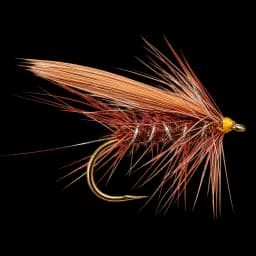
Dark hare's ear spun on hot orange silk, a red-brown hackle palmered the length of it and locked down with fine gold wire, a rolled wing of feather barbs over the back and a second hackle at the shoulder. Skues' most famous dry fly, and the ancestor of the Elk Hair Caddis — Troth admired both its flotation and the trick of securing the body hackle with wire, and took them both. The original wing was landrail, which is neither buoyant nor obtainable now; hen pheasant is the standard substitute.
Evening sedge activity, June through September, and any time an adult caddis is on the water. Dead drift first; if that is refused, the smallest skitter across the surface often provokes a take that a static fly will not.
The palmered hackle held down by wire is the engineering: it floats the fly high in broken water and survives fish after fish, where an unsecured herl or hackle body comes apart. The rolled wing gives a hard tent-shaped silhouette that reads unmistakably as a sedge from below.