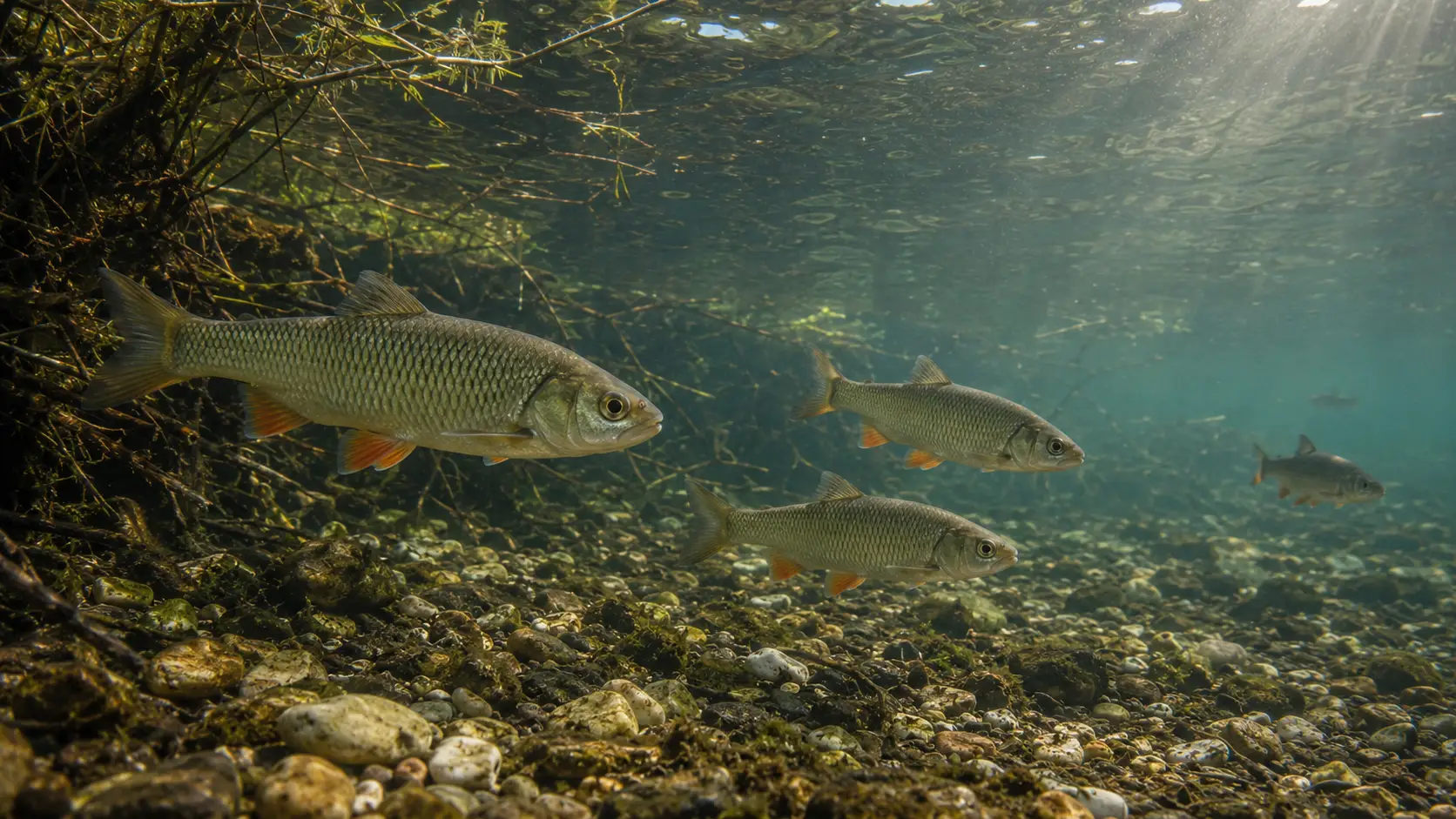
Chub are the cyprinid you walk past on the trout stream — until the summer the beetles start falling and the willows lean in over warm low water. Then they become the fish you cannot wait to fish for. A black foam beetle, cast tight to overhanging cover, landed with a small audible plop. Five seconds of motionless drift. Then a take so confident it changes how you think about coarse fish forever. The middle Severn through Bewdley, the lower Wye through Ross, the limestone Loue and Doubs in the French Jura, the slow Plaine de l'Ain — five rivers, two distinct styles, the same fish. Twenty inches average, four pounds when she comes, and a fight that bends a four-weight properly.
Cast tight. Plop. Count five. Twitch once. The take is unmistakable.
The Chub Revelation
Chub on the fly is one of European angling's quietest pleasures. They are not glamorous — they do not run for the salt, they do not leap, and they will not appear on the cover of any fly-fishing magazine. But they take a dry fly with a conviction that shames a trout, they fight with a bulldogging surge that bends a four-weight properly, and they hold in the kind of water that nobody else fishes — the middle and lower reaches of trout rivers where the water broadens and the willows lean.
The best chub fishing happens within twenty feet of cover. An overhanging tree, an undercut bank, a trailing branch of bramble. You will cast tight, land the fly with a small audible plop, then wait. Five seconds is the rule — five seconds of motionless drift before a single subtle twitch. The fish that ignored a flawlessly drifted Adams in open water will eat that fly without hesitation under the right willow. It is the most pattern-independent fly fishing I know — small black, audible delivery, tight to cover. Pattern is the third variable, behind position and presentation.
And then the take. Chub do not sip. They take a surface fly the way a Labrador takes a tennis ball — a confident, head-down, no-fuss inhalation that ends with the leader straightening and the rod loading. Most of them are eighteen inches. Some are twenty-two. The four-pounder, when she comes, will eat the fly without changing pace and pull steadily toward whatever cover she emerged from. Lose her in the willow roots, take a moment, and try the next bend. There are more.
Why Chub Eat Flies
Omnivorous, opportunistic, surface-oriented in summer, structure-bound year-round. Understand the chub and you fish chub water everywhere it occurs.
Chub (Squalius cephalus) are an omnivorous cyprinid that occupies the warmer, more cover-rich middle and lower reaches of European trout rivers. Where the brown trout thins out — where the bedrock gives way to silt, where the canopy closes over the water, where the temperature in summer pushes through twenty degrees — the chub thrives. They take what comes: aquatic invertebrates, terrestrials, small fish, fry, even fruit in autumn from overhanging trees.
Their surface-feeding habit is the angler's opportunity. Chub will rise to a fallen beetle, a dapping daddy longlegs, a stranded sedge, an elderberry in late summer. They have a wide mouth and a tolerant palate. The fly does not need to match a specific hatch — it needs to look like something edible and arrive in a place where the chub is willing to investigate. That place, ninety per cent of the time, is within an arm's length of overhanging cover.
Welfare matters in summer. Chub tolerate warm water — they feed actively at twenty to twenty-four degrees while trout retreat to thermal refuges — but above twenty-five degrees with low dissolved oxygen they become stressed. Fight quickly, handle in the water where possible, revive thoroughly before release. The chub recovers well from a clean release but is fragile when played to exhaustion in summer warmth.
Prime Waters: Severn, Wye, Loue, Doubs, Ain
The UK Welsh borders + middle Severn for cover-fishing. The French Jura limestone rivers for sight-fishing on warmer water. Five rivers, two distinct styles, the same fish.
The middle and lower Severn (Welsh Marches, Shropshire down to Worcestershire) is the heartland of English fly-fishing-for-chub. The river broadens through Stourport and Bewdley, the willows lean in, and the chub stack in the shaded glides through summer. The Severn coarse season runs 16 June to 14 March on most beats — the closed season protects spawning chub, the open season delivers the warm-water terrestrial fishing.
The Wye — the Welsh borders Wye, not the Yorkshire one — holds outstanding chub in its lower reaches around Hereford and Ross. Big fish; the Wye produces specimen chub on bait every year. On the fly, the lower beats below Whitney offer the same Severn-style cover fishing in slightly clearer, faster water. Concurrent with the trout, salmon, sea trout, and grayling seasons, the Wye is genuinely one of the most multispecies fly rivers in Europe.
The Loue and Doubs (Franche-Comté, France) are the limestone Jura equivalents. The middle reaches below the famous trout beats hold large chub in clear, weedy, slower water. The Loue chub takes a CDC olive in summer with the same selectivity the grayling shows in winter — these are fish that have seen flies and are demanding in their presentation. The Doubs (France section, distinct from the Swiss Doubs) fishes similarly, with more streamer opportunities for the larger fish in autumn.
The lower Ain — the Plaine de l'Ain section between Varambon and the Rhône confluence — is the warmer, slower, terrestrial-dominated chub water of eastern France. Less famous than the upper Ain trout beats but with excellent chub-on-the-fly opportunity from June through September. Fishing licences via cartedepeche.fr cover most of the AAPPMA water.
Where Chub Lives but We Don't Surface It
Chub inhabit the carriers of the Test and Itchen, the Hampshire Avon, and many other chalk-stream systems. Those beats remain trout/grayling waters by tradition.
A working knowledge of British chalk streams reveals chub in nearly every system — the carriers of the Test, the slack water below Itchen weirs, the lower Hampshire Avon, the Dorset Frome below the trout beats. Bait anglers know them well; specimen chub on bread or worm are caught from these rivers every autumn. But the fly-fishing tradition on those beats is brown trout and grayling, often with strict rules about target species and methods. Targeting chub on a managed chalk-stream beat is — at best — frowned upon and frequently against the beat's rules.
Rise Daisy deliberately surfaces chub as a target only on the five venues above where chub-on-the-fly is a recognised, encouraged, ethical pursuit. The fish exist elsewhere; the cultural context for fly fishing them does not. If you want to fly-fish chub on the lower Frome or in a Test carrier and you have permission, you have an excellent fishery. We simply will not encourage the wider angling public to treat chalk-stream chub as a default target.
The Beetle, the Plop, and the Five-Second Rule
A black foam beetle, cast tight to cover, landed with an audible plop, allowed to drift motionless for five seconds. The simplest and most lethal chub method.
The black foam beetle in size ten to fourteen is the iconic chub fly, and the case for it borders on monomania among chub specialists. It floats indefinitely on foam. It lands with a small audible plop that chub recognise as a fallen terrestrial. It sits in the surface film exactly as a drowning ground beetle does. And it can be twitched, skated, or left motionless according to the fish's mood. One fly, three presentations, ninety per cent of the season.
The plop is the crucial element. Chub investigate audible surface impacts — a flat presentation that lands without disturbance gets ignored more often than not. Lift the rod on the forward cast slightly to make the fly land with a deliberate small impact. Not a splash — a plop. Then count. Five full seconds of motionless drift. Most takes come during this pause. If no take, give the fly a single subtle twitch — half an inch, no more — and wait again.
Refusals are information, not failure. A chub that follows the fly and turns away has not seen what it wanted; that fish often takes the second presentation a few minutes later, after the first fly has drifted out of the lie. Rest the fish for five minutes and try again with the same fly. If it refuses a second time, change the size before the pattern. Drop from size ten to size twelve. The fly that was too big becomes the fly that the fish eats.
The Terrestrial Year: Hawthorn, Beetle, Daddy
Three terrestrial windows define the chub fly season. Each is a takeover by a single insect that anglers should know by heart.
The hawthorn fall (Bibio marci) in late May and early June is the first major chub terrestrial. Naturals blow off the hawthorn blossom into the water for two to three weeks each spring. Chub in their post-spawn recovery feed confidently on dangling-legged hawthorn imitations — black body, splayed pheasant-tail legs, size ten to twelve. Warm, breezy afternoons with the blossom in flower are the prime windows.
The black beetle fall is the universal summer trigger. Ground beetles tumble off bankside vegetation onto the water on hot bright afternoons from June through September. The foam beetle covers the imitation indefinitely; the natural delivery is what matters. On bright days, chub move into the deep shade under overhanging willow and ambush the beetles that fall from the foliage above. Cast to the shaded edge, land the fly with the plop, count five.
The daddy longlegs (crane fly) fall from late July through October is the late-summer-into-autumn killer. Naturals blow onto the water in numbers on calm warm days, and chub move into open water to take them. A daddy fished both dead-drift and skated produces some of the year's most theatrical takes. The skated daddy — lift the rod tip slowly to drag the fly two inches across the surface — provokes chub of two to four pounds to launch from holding lies they would never leave for a beetle. This is the late-summer fly to carry.
Streamers for the Four-Pounder
The biggest chub almost always come on a small streamer fished short and slow. When the surface refusals stop you cold, switch.
Chub above three pounds become increasingly piscivorous. They eat minnow, bullhead, bleak, small dace, and their own fry. A small streamer — olive marabou on size eight to ten, or a black wooly bugger weighted with a tungsten bead — fished short and slow under undercut banks and through pool tails takes chub that ignore every surface offering on the river. The take is a hard pluck; the fight is steadier and stronger than the dry-fly fish; the average size is meaningfully larger.
Strip-pause is the method. Two-inch strips with five-second pauses, the fly held just under the surface or down to a foot or two on a sink-tip line. Most takes come during the pause, not the strip. The chub follows the fly through several strips, then commits during the moment the fly hangs motionless. Fluorocarbon tippet of 4x or 5x, weighted fly, single-fly setup. No droppers — chub fishing under cover involves catching the fly on too many branches as it is.
Autumn is the streamer season. From late September through November, chub fatten before winter and become aggressive toward small fish. The Olive Minnow Streamer in the chub box is the autumn fly for the four-pound fish you have walked past all summer.
Reading Chub Water
Cover, shade, and depth — the three signals that locate chub on any unfamiliar river.
Chub water is structure water. They rarely hold more than a rod-length from cover. Overhanging trees, undercut banks, weed beds, sunken branches, bridge supports, raft fronts — these are the lies. On unfamiliar water, walk the bank slowly and identify the cover first. The fish are below or beside it, almost always within two feet of the surface, almost always within an arm's length of the shaded edge.
Shade matters in summer. Bright midday with sun on the water pushes chub deep into the shaded undercuts and trailing willow. The same fish in overcast or low light will move out into the open water beneath the cover, accessible to a careful presentation. The hours either side of dawn and dusk are the prime feeding windows on bright summer days — chub that vanished at noon return to feed in the cool, low-light bookends.
Depth is contextual. In a small river, chub take dry flies in two feet of water. In a larger river like the Severn, chub hold deeper — three to six feet — and a streamer or sunk fly is the consistent producer. Read the river's scale before choosing the method. A foam beetle in twenty feet of water is the wrong tool; a streamer through a knee-deep tributary is overkill.
Pods of chub stack in particular favoured lies. Where you catch one, there are usually three or four more in the same spot. Rest the lie for ten minutes after each fish, then return — competitive chub feeding has a rhythm, and a disturbed lie often re-fires within the same session.
Tackle: A Four-Weight, Fluorocarbon, Barbless
Light enough to enjoy the fight, heavy enough to lift a five-pound chub clear of the willow before she breaks you in the roots.
A nine-foot four or five weight rod is the chub outfit on most water. The four-weight is right for the smaller Severn carriers, the Loue middle reaches, and the Ain lower beats — accurate casting under low cover, sensitive enough to enjoy a two-pound fish. The five-weight is the standard on the main Severn and Wye, where the average size is larger and the wind through open water demands a bit more authority. A six-weight is rarely necessary unless you are streamer-fishing the lower Wye in autumn for specimen fish.
Leader: nine-foot tapered to fluorocarbon tippet — five-X for the foam beetle and dries, four-X for the streamer. Fluorocarbon matters; chub are leader-shy in clear summer water, particularly in the Loue and the lower Wye. Six-X is over-fine for chub; the willow takes a four-X tippet better than the chub does a six-X.
Barbless or micro-barb hooks throughout — chub have soft mouths and a barbed hook can damage them on the strike. Forceps for quick unhooking, a rubber-mesh landing net for the four-pounders, no kill priest required. The standard chub session is catch and release, photographed in the water where possible. The four-pound fish you remember will be released to be caught again at five.
The Chub Year
Spring terrestrial start, summer beetle peak, autumn daddy and streamer, winter rest. Each season has its method.
Late spring — May and June: post-spawn chub feed actively as water temperatures climb through fourteen to eighteen degrees. The hawthorn fall in mid-May is the first major dry-fly window. The damsel emergence on the lower Loue and Doubs in June produces excellent subsurface fishing in weed-bed margins. Open season starts 16 June on UK rivers under coarse-fish regulations.
High summer — July and August: peak terrestrial fishing. The black foam beetle is the universal fly, the daddy longlegs takes over from late July, and the evening sedge — a big brown deer-hair caddis fished into the last hour before dark — provokes savage takes from chub holding under cover. Welfare watch: in water above twenty-four degrees, fight quickly and revive thoroughly.
Autumn — September through November: the streamer season for the largest fish. Cooling water through October pushes chub into pre-winter feeding mode and the four-pound fish that ignored surface flies all summer takes a small Olive Minnow with confidence. The autumn daddy fall extends surface opportunities into mid-October on the Welsh borders and slightly later on the French Jura rivers.
Winter — December through mid-March: UK coarse close season starts 15 March. The fly fishing for chub effectively pauses through deep winter regardless — the fish hold deep, the metabolism slows, and the fly methods give way to bait. French rivers permit year-round angling on most lowland water; the heavy nymph and the small streamer keep producing through the colder months on the lower Ain and the Loue.
Your Chub Day
Walk the cover at dawn, beetle bombs through the morning, midday rest, evening sedge and daddy. The rhythm of a chub river.
Dawn: walk the bank slowly with polarised glasses. Identify the cover — overhanging willow, undercut banks, sunken branches. Note where the shade falls at different angles of the sun. Note which lies you can cast to from the bank and which require wading. Do not fish yet. The reconnaissance is the day's most important hour.
Morning: foam beetle, cast tight to cover, plop, count five, twitch once, count again. Move through the river methodically — one cast per lie, two if the fish refused. If the fish are competitive — multiple chub in a shaded glide, warm bright conditions — the takes come fast and confident. If the fish are sulky, change size before pattern.
Midday: the surface goes quiet on bright hot days. Switch to a small Heavy Hare's Ear nymph or a small streamer fished short and slow under the deepest cover. Or rest the river for an hour and walk the bank looking for new lies for the evening session.
Late afternoon: the terrestrial activity rebuilds as the light drops. The daddy longlegs window in August and September often peaks in the last two hours before dark.
Dusk: the evening sedge — a big brown deer-hair caddis — fished into the failing light through the same pools that fished slowly in the morning. The last twenty minutes can produce the day's biggest chub. Carry a head torch for the walk back.