
- Ecology: High
- Chemical: Unknown
WFD classification · FI04_117_001
A northwesterly has held for 11 hours, running colder than the water (11°C air against 17°C water). The end it blows into is taking that chilled surface water, so try the sheltered north-western end instead — off the back of the wind, where the undertow returns food along the bottom. That chill sits in the top of the water, though, and the bed is slower to feel it — on a bottom bait it is the undertow, not the temperature, that puts you at this end. Treat it as a tiebreaker between good swims rather than an override — features and angling pressure usually count for more.
Set up a broadside drift and cover the water systematically. Work a bushy searching pattern on the bob and drop a contrasting nymph on the point.
If the main plan is not working, switch to a smaller, more imitative pattern fished slower and deeper. A change of drift angle can also make a difference.
Keep an eye on changing conditions — wind shifts and cloud breaks can trigger short feeding spells.
A gentle ripple is ideal for drifting — broadside drift covering the wind lanes should be productive.
Hatch predictions
Top nymph shown — see all 4 guilds as a supporter.
Start free trial14-day free trial. Cancel anytime.
Hatch predictions
Top prey shown — see all 5 as a supporter.
Start free trial14-day free trial. Cancel anytime.
Numbers are intensity 0 (none) to 3 (peak) — a guide, not a guarantee.
A good match for Lake Saimaa — most conditions are close to what it fishes best in.
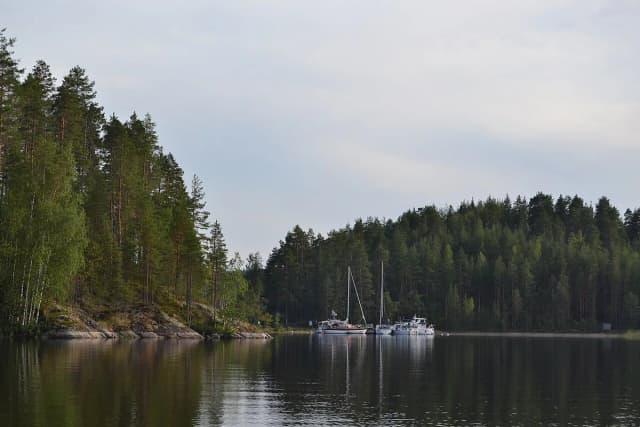
WFD classification · FI04_117_001
Finnish inland grayling (harjus) rule south of 67°N: closed 1 April – 31 May. Open 1 June – 31 March. Grayling is fully protected in sea areas. Minimum size typically 30-35 cm depending on water. Check Metsähallitus (state waters) or local fishing association permit.
Closed in spring for spawning.
Prime sport 1 August → 30 November
Lake Saimaa's Arctic char populations follow Finland's lake-specific byelaw framework. Spawning protection typically runs mid-September through November. Local fishing association or Metsähallitus permits specify exact dates per lake sub-basin — some areas may have earlier or extended closures. Check your permit.

A northwesterly has held for 11 hours, running colder than the water (11°C air against 17°C water). The end it blows into is taking that chilled surface water, so try the sheltered north-western end instead — off the back of the wind, where the undertow returns food along the bottom. That chill sits in the top of the water, though, and the bed is slower to feel it — on a bottom bait it is the undertow, not the temperature, that puts you at this end. Treat it as a tiebreaker between good swims rather than an override — features and angling pressure usually count for more.
Set up a broadside drift and cover the water systematically. Work a bushy searching pattern on the bob and drop a contrasting nymph on the point.
If the main plan is not working, switch to a smaller, more imitative pattern fished slower and deeper. A change of drift angle can also make a difference.
Keep an eye on changing conditions — wind shifts and cloud breaks can trigger short feeding spells.
A gentle ripple is ideal for drifting — broadside drift covering the wind lanes should be productive.
Hatch predictions
Top nymph shown — see all 4 guilds as a supporter.
Start free trial14-day free trial. Cancel anytime.
Hatch predictions
Top prey shown — see all 5 as a supporter.
Start free trial14-day free trial. Cancel anytime.
Numbers are intensity 0 (none) to 3 (peak) — a guide, not a guarantee.
A good match for Lake Saimaa — most conditions are close to what it fishes best in.
WFD classification · FI04_117_001
Finnish inland grayling (harjus) rule south of 67°N: closed 1 April – 31 May. Open 1 June – 31 March. Grayling is fully protected in sea areas. Minimum size typically 30-35 cm depending on water. Check Metsähallitus (state waters) or local fishing association permit.
Closed in spring for spawning.
Prime sport 1 August → 30 November
Lake Saimaa's Arctic char populations follow Finland's lake-specific byelaw framework. Spawning protection typically runs mid-September through November. Local fishing association or Metsähallitus permits specify exact dates per lake sub-basin — some areas may have earlier or extended closures. Check your permit.