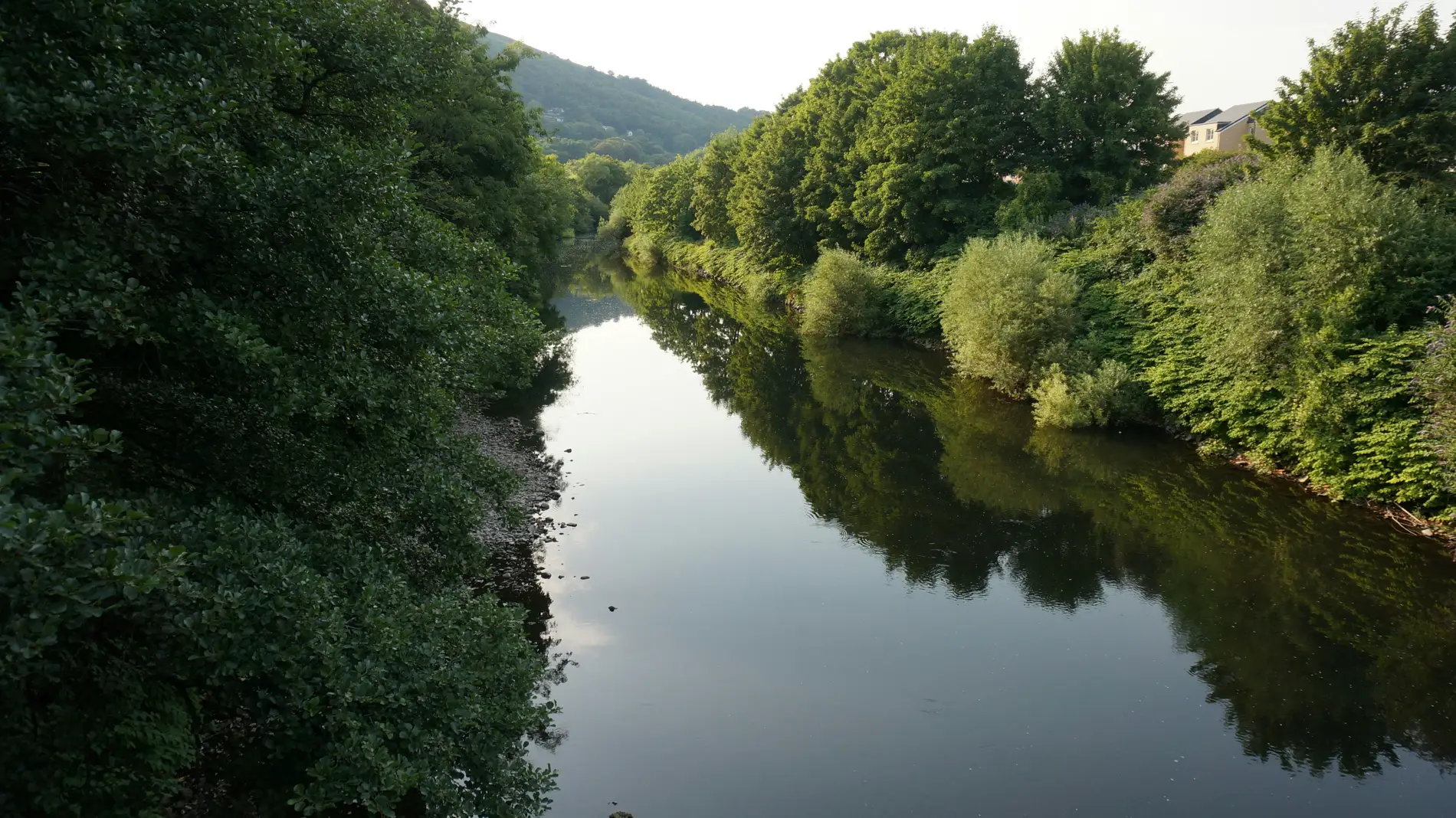
Cardiff is a better fly-fishing base than it first looks. It is not London-style reservoir-first fishing, and it is not quite the wild-trout country you reach when you drive further into Brecon or the Cambrian Mountains. Its strength is something different: you have urban grayling and wild trout on the Taff within a short drive of the city centre, the Usk system within realistic day-trip range, and a network of South Wales valley rivers that reward the kind of angler who enjoys finding fish where the guidebooks don't usually bother to look.
The Taff is the local river. Grayling in winter is the strongest Cardiff-specific angle. The upper Taff and valley tributaries are the better wild-trout option. Llandegfedd is the practical stillwater. The Usk is the river that gives the guide its quality.
The Legal Bit, Briefly
Natural Resources Wales is clear on this, and GOV.UK sells one-day, eight-day and twelve-month licences online without any particular difficulty. A rod licence is not the same as permission to fish. You still need the relevant club ticket, day ticket, beat booking or fishery permit, which is where Cardiff gets interesting.
The Local River: River Taff
The Taff is the first place a Cardiff-based fly angler needs to understand, and it is considerably better than its reputation.
It is urban in places, post-industrial in others, and on the right winter morning with a grayling at the end of a long nymph drift it is as satisfying as water anywhere.
The key practical fact for visitors: day tickets for Glamorgan Anglers' Taff water are available from Garry Evans Tackle in Cardiff. A Taff-only day ticket covers the river; a Taff-only season ticket extends to the Ely and Cardiff Bay. The Grayling Society's own guidance points visiting anglers to Garry Evans for day-ticket access downstream of Pontypridd — which means you can arrive in the city, buy a ticket locally, and be on a real river quickly. That is more unusual than it sounds.
Why the Taff matters: Cardiff-based fly fishing has a specific winter window. The grayling are there. They are not the excuse — they are the point. A Euro-nymphing setup, a few weighted point flies and a pair of waders will see you through most days on this water. In spring and early summer, wild brown trout move into the picture. By late summer on lower urban stretches, do something else.
The Taff is not a wilderness experience. The banks are what they are. But the fish are real, the ticket is easy to get, and the drive from the city centre is short enough that a morning's fishing before lunch is a practical proposition rather than an expedition.
Best tactics: Euro nymphing and duo in faster runs and pocket water. Small dries and spiders when conditions allow, particularly for grayling in the early part of the October-to-February window. A 10-foot 3-weight or 4-weight covers most of it.
Osprey Fly Fishers' Association
Osprey is the most important club name for fly anglers around Pontypridd and Abercynon, and it is worth understanding what it offers separately from the Glamorgan Anglers arrangement.
The club controls stretches of the Taff, Rhondda and Cynon and offers visitor day passes for much of this water. Brown trout fishing runs from 3 March to 30 September; grayling from 1 October to 28 February — which neatly covers the year if you are organised about it. Osprey's Taff stretches run from the Treforest and Upper Boat area upstream towards Abercynon: deep pools, long runs, good wild brown trout, and occasional reports of larger fish that have no obvious right to be there.
Why it matters: this is the most credible proper local river fly fishing ticket near Cardiff. The water has more character than the more urban Glamorgan stretches. The grayling season means a Cardiff-based angler can have local moving-water fishing through the whole winter rather than retreating to reservoirs in October.
Best for anglers who want moving water and are willing to work with the post-industrial valleys character of South Wales rivers. There is real fishing here.
Upper Taff — Merthyr Tydfil Angling Association
Drive north from Cardiff and the Taff changes. By the time you reach Merthyr the valley has narrowed, the catchment is more upland, and the character of the fishing is noticeably different from the lower river.
This is where you go when you want wild trout rather than grayling, and when the drive to the Usk feels like one step too far. Merthyr Tydfil Angling Association has day and guest tickets for its water, which includes the River Taff, River Tarrell, the Usk at Mardy, Cantref and Dolygaer/Pontsticill reservoirs, and other waters. Adult trout day tickets run to £15; reservoir day tickets at £8. Tickets are available through the club, local outlets, and the Fishing Passport online — which means you can book before you leave Cardiff.
Why it matters: this is the better version of the Taff for wild trout. The upland feel changes the experience. The fish are smaller on average, properly wild, and considerably more demanding of presentation than anything stocked.
Best tactics: dry-dropper and small nymphs on the river; spiders and small dries in suitable conditions. In higher water, weighted nymphs and streamers. A 9-foot 4-weight handles most of it. The attached reservoirs — Cantref, Pontsticill — give you a stillwater option when the rivers are running off.
Llandegfedd Lake
Llandegfedd is the obvious stocked stillwater answer east of Cardiff, and it is worth being honest about what it is and isn't.
It is a 434-acre reservoir with bank and boat fishing, regularly stocked with rainbow trout and holding some native brown trout. Boats are fly-only; bank fishing also permits ledgered worm from designated areas. Spinning is not generally permitted. Welsh Water runs the fishery and there is a visitor centre on site. The drive from Cardiff is thirty-five to fifty minutes depending on which corner of the city you start from.
The honest word on Llandegfedd: trout fishing on this water has declined in recent years, and the Fishing in Wales assessment is candid about this rather than promotional. It remains a practical day out. It is not the premium Welsh trout experience it once was, but for a beginner, a boat angler, or an angler who wants less wading and less river uncertainty, it is still the most accessible large stillwater from Cardiff.
Best for beginners, boat anglers, competition-style reservoir tactics. A good fallback when the rivers are running off after rain.
River Usk — the Day Trip that Justifies the Guide
The Usk is an hour to an hour and a half from Cardiff depending on which beat, which means it is not a local water in the same sense as the Taff. It is, however, within the range of a full day, and it is the river that gives the guide its quality.
For dry-fly and nymph fishing for wild brown trout, the Usk is the best river within day-trip range of a South Wales city. Abergavenny, Crickhowell and Brecon are the names to know for day-ticket access; the Wye & Usk Foundation's Fishing Passport is the primary booking platform, giving online access to beats across the river with current conditions, catch reports, webcams and weather information before you commit.
What the Usk offers that the Taff cannot is scale, condition and the particular atmosphere of a river that has been fished seriously for a long time and still justifies the attention. Glides, riffles, the long run where you cannot see the bottom but know something is holding in the seam — the Usk on a May morning with olives coming off is a fairly strong argument for being alive.
Best season: spring and early summer, especially when upwinged flies are active. The river holds salmon, but the case for the Usk from Cardiff is overwhelmingly a wild brown trout case. Low and hot in late summer means dawn and dusk only, or a reservoir day instead.
Best tactics: 9-foot 4 or 5-weight, small dries through the spring and early summer season — olives, iron blues, March browns, pale wateries. Nymphs and spiders for the faster water. Perdigons and heavier tungsten for the deeper pools. The river rewards patience and careful reading of water more than it rewards effort and mileage.
Caveat: the Usk is condition-sensitive. Check the Fishing Passport beat reports, the river webcams and the recent catch returns before driving. A spate or a prolonged dry spell both close windows here.
The Valleys Tributaries: Rhondda and Cynon
The Rhondda and Cynon are not destination names for most travelling fly anglers, and they are not presented here as such. They are useful because they broaden the local picture for a Cardiff-based angler who has fished the Taff through and wants more.
Osprey's river permits explicitly include grayling fly fishing on the Rhondda and Cynon between 1 October and 28 February, alongside the Taff. Wild brown trout fishing on these waters follows the standard season. They are post-industrial valleys rivers — the character is what it is — but for an angler who enjoys exploratory fishing and is not expecting chalk-stream presentation, there is genuine fishing here in the grayling months and through the trout season.
Best for local knowledge accumulation. These are the waters that make a Cardiff angler more interesting to talk to in a pub.
Worth Going Further: Wye and Irfon
For the best winter grayling fishing within the region, the Wye system is the right answer — even though it is ninety minutes from Cardiff rather than thirty.
The river below Rhayader and around Builth Wells and Erwood, plus the Irfon tributary, are the noted South Wales grayling stretches, with beats bookable through the Fishing Passport. This is a different experience from Taff grayling. More rural, more space, more river in front of you. It is the kind of day that reminds you why you fish for grayling in the first place, and it justifies the drive in a way that is hard to explain until you have made it. The Irfon in October or November, in low clear water, is a particular thing.
The Welsh Dee
The Welsh Dee is too far to be a casual Cardiff option. It belongs in the guide because a Cardiff-based angler who is serious about grayling will eventually drive there, and they should know it is worth the trip.
The Dee's brown trout season runs 3 March to 30 September; grayling from 16 June to 14 March. For an angler who has exhausted the local options and wants a day that feels like a destination rather than a commute, the Dee qualifies.
Llys-y-Frân
Llys-y-Frân is far west relative to Cardiff — it is not a sensible day trip for most residents of the city — but it belongs in the wider South Wales picture.
Welsh Water lists it as open all year, with bank and boat fishing, stocked rainbow trout, native brown trout, and fly-only boat fishing. Worth knowing about; not the first recommendation.
Choosing by Angler
The winter grayling angler does not need to leave Cardiff. Start with the Glamorgan Anglers' Taff water, pick up a ticket from Garry Evans, and fish the nymph through the colder months.
Add Osprey's Rhondda and Cynon stretches for variety. For a more rural version of the same thing, drive ninety minutes to the Wye and Irfon.
The wild trout angler goes to the upper Taff and Merthyr Tydfil AA water first and the Usk when the season and conditions justify the drive. The two are complementary — the Taff for a weekday afternoon, the Usk for a full day with an early start and a proper plan.
The beginner or the angler who wants reliability goes to Llandegfedd. The reservoirs at Merthyr AA provide a useful backup option when the rivers are off colour.
The angler who enjoys exploratory water — post-industrial valleys, access homework, water that isn't in any marketing material — finds the Rhondda, Cynon and the smaller upper Taff tributaries more interesting than the obvious places. This is not beginner territory. It is the kind of fishing that makes you quietly pleased with yourself.
The day-trip-obsessed angler drives straight past everything and goes to the Usk, because that is the right decision on any day when the conditions support it.
The Cardiff Year
The grayling season from 1 October to 28 February is the period when Cardiff has the strongest specific identity as a fly-fishing base.
The Taff and the Osprey waters are the local answer through autumn and winter — nymphing, spiders, dry-dropper when the air temperature is workable. December and January are not the most comfortable months on urban river water, but the grayling are genuinely there, and a midday hour between spate events can be surprisingly productive. For the more ambitious winter trip, the Wye and Irfon are worth scheduling.
March opens the trout season. The upper Taff water becomes the right call — upland character, wild fish, smaller than the stocked reservoir trout and more interesting for it. Llandegfedd is open through winter and into the early season; bank fishing is the practical option before any complex boat planning.
April and May are the prime Usk months. The olive hatches on the middle river through spring are the fly-fishing reason to be in South Wales, and if you only make one journey from Cardiff in the year, make it a day on the Usk in late April or early May when the fish are active and the river is in form.
June and early July are the high point of the rivers. Late July and August require honesty — low water means early mornings and evenings on the trout rivers, and reservoir fallbacks for the middle of the day. Llandegfedd and the Merthyr reservoirs handle the hot-summer problem without requiring compromise on quality.
September through the Usk again, briefly, before the river winds down into the coarser-fishing close season. Then October returns you to the Taff and the grayling, which is where the Cardiff year begins.
The Final Verdict
Cardiff is a strong winter grayling base, a reasonable wild-trout base, and a practical stocked-reservoir base. It is not a first-choice salmon base and it does not claim to be.
What makes it interesting is the combination of urban accessible winter fishing — genuinely good grayling within minutes of the city centre — and the Usk as a day-trip option that most UK cities would be glad to have within two hours.
Cardiff is one of the best UK cities for accessible winter grayling, with proper Welsh trout fishing on the Usk within reach for a full day. Most visiting anglers do not know this. Most of them are thinking about Bristol reservoirs or North Wales rivers and have not looked south. That is their problem.
For the Cardiff-based angler, the year makes sense: local grayling in winter, upper Taff wild trout in spring, Usk as the day-trip prize, Llandegfedd as the reliable fallback. The Wye and Irfon add a serious long-day grayling option. The Dee is there for the dedicated.
That is a year's fishing. It is enough.