

Stillwater · Granite · Castilla y León / Salamanca (Arribes del Duero)

Embalse de Aldeadávila

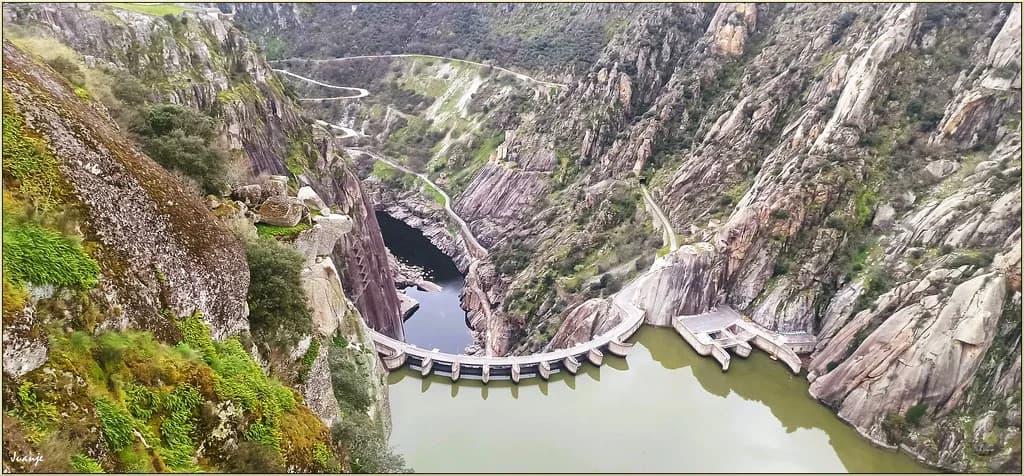
A reservoir on the Duero itself, deep in the Arribes del Duero natural park where the river forms the Spain–Portugal border in a sheer granite gorge.

Species

Summer pike — dawn and dusk topwater

Good wave on — drift country. Drift fishing weather — three flies on a long leader.

Pike are ambush-feeding from weed cover. Fry and small perch concentrate in the warm shallows, drawing pike in during low-light periods. Mid-day pike retreat to deeper weed channels.

67% confidence in this read
Conditions
Wind
W 14 km/h
Gentle breeze
Wave
20 cm ripple
Water temp
No reading
Air temp
15°C
Cloud
Clear
Pressure
1018 hPa
Rain · 24h
0.0 mm
No rain

Some readings unavailable — check directly before fishing.

Condition match
65%
Cloud70%
Wind65%
Temp60%

A reasonable day here, though temperature isn't quite in the sweet spot.

Reservoir levelas of 1 Jun
92% 10-yr norm
Filling
97% full
High & filling
+5 ptsvs seasonal norm
-1 ptsvs last year
+4 ptsthis week
High and still filling — new water inundating margins, surface fishing improves dramatically.
How to fish it · for pike
When
Pike are ambush-feeding from weed cover. Fry and small perch concentrate in the warm shallows, drawing pike in during low-light periods. Mid-day pike retreat to deeper weed channels.
Where
Summer pike on the fly. Fish early (first light) and late (last hour) when pike push shallow to feed. Topwater is king — poppers and gurglers over weed beds. Mid-day fish hold deep in weed channels. Take a break during the heat of the day. Use a 9-10wt rod with a stiff butt for turning big fish away from weed.
The plan
Plan A

Summer pike on the fly. Fish early (first light) and late (last hour) when pike push shallow to feed. Topwater is king — poppers and gurglers over weed beds. Mid-day fish hold deep in weed channels. Take a break during the heat of the day. Use a 9-10wt rod with a stiff butt for turning big fish away from weed.

Plan B

If the main plan is not working, switch to a smaller, more imitative pattern fished slower and deeper. A change of drift angle can also make a difference.

Watch for

Evening tends to be the best period in summer — stay late if you can for a sedge or spinner fall.

Boat — drift

A gentle ripple is ideal for drifting — broadside drift covering the wind lanes should be productive.

Why this score
  • summer conditions with clear skies and breezy wind.
  • High and still filling — new water inundating margins, surface fishing improves dramatically.
Through the year
0–3 scale · June highlighted
J
F
M
A
M
J
J
A
S
O
N
D
Black MidgeHatch
2
3
3
3
3
3
3
3
3
3
3
2
Reservoir BuzzerHatch
2
3
3
3
3
3
2
Gray DrakeHatch
2
2
Silverhorns & LonghornsHatch
1
2
2
2
1

Numbers are intensity 0 (none) to 3 (peak) — a guide, not a guarantee.

Permits & access
Permit required — see local rules.
  • Castilla y León licence required (Confederación Hidrográfica del Duero); note the Portuguese border — fish the Spanish side under Spanish rules
  • Barbel protected during spawning
  • Wels catfish and zander are invasive in the Duero — retention and handling rules apply; check current regulations.
Directions
About this water

A reservoir on the Duero itself, deep in the Arribes del Duero natural park where the river forms the Spain–Portugal border in a sheer granite gorge. It feeds one of the most powerful hydroelectric stations in Spain, and the setting is dramatic — cliffs of bare rock dropping straight into cold, deep, clear water with griffon vultures overhead. This is not a sight-fishing flats venue: it is a deep canyon water dominated by predators, with zander and very large wels catfish (siluro) in the depths and pike and barbel where the side-streams and shallower necks let fish hold. Bank access is genuinely difficult on the gorge sections; the upper necks and tributary mouths are the realistic fly water.

  • Reservoir
  • Granite
About this water · Lough note · 4 min read

A reservoir on the Duero itself, deep in the Arribes del Duero natural park where the river forms the Spain–Portugal border in a sheer granite gorge. It feeds one of the most powerful hydroelectric stations in Spain, and the setting is dramatic — cliffs of bare rock dropping straight into cold, deep, clear water with griffon vultures overhead. This is not a sight-fishing flats venue: it is a deep canyon water dominated by predators, with zander and very large wels catfish (siluro) in the depths and pike and barbel where the side-streams and shallower necks let fish hold. Bank access is genuinely difficult on the gorge sections; the upper necks and tributary mouths are the realistic fly water.

Other water nearby · 2