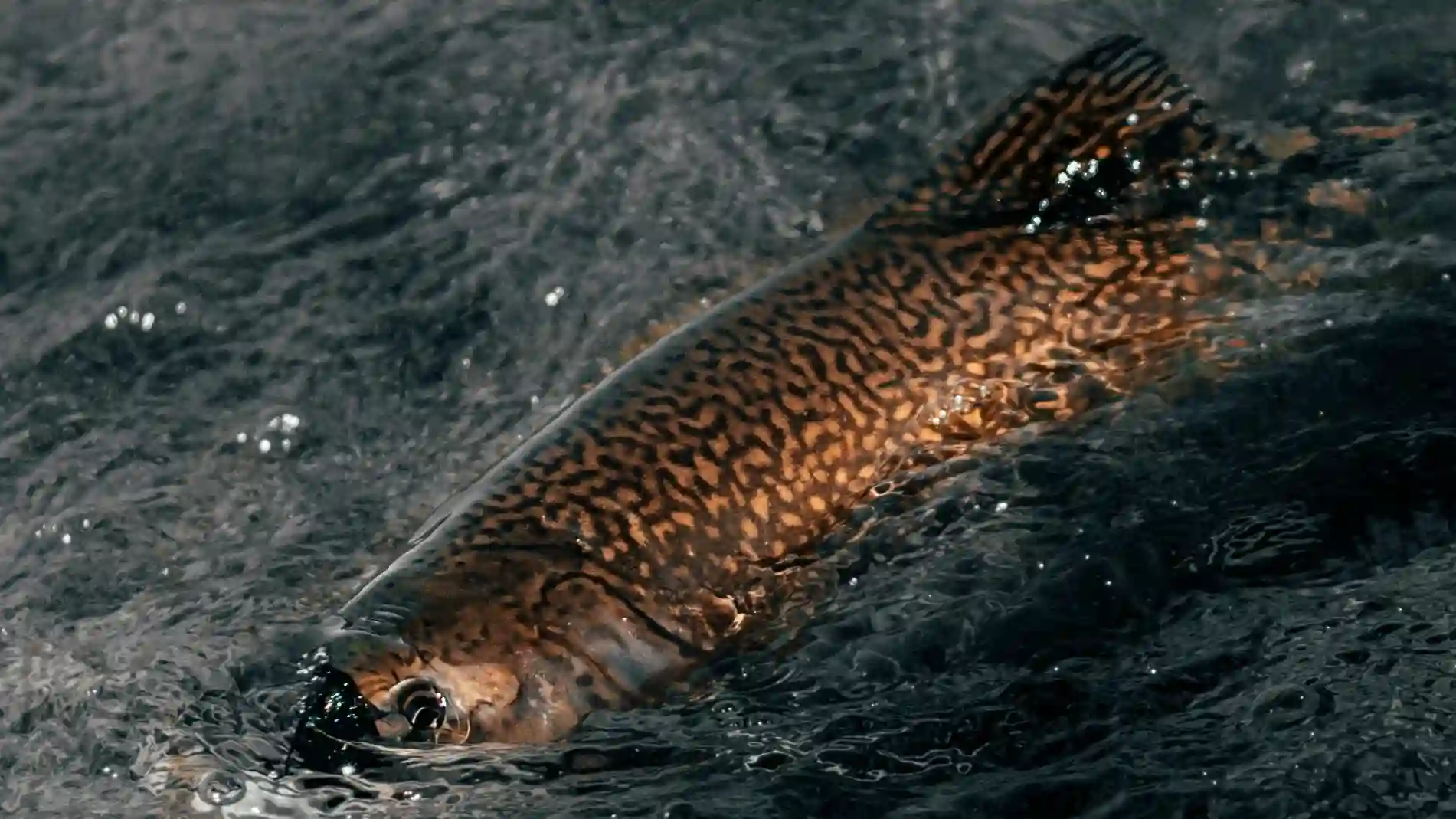
There's a peculiar pleasure in arriving at a small commercial stillwater on a quiet Tuesday and discovering that the most recent stocking has been imaginative. Blue trout, the colour of cold steel. Golden trout the colour of a wedding ring. Tiger trout, brook trout, the occasional spartic — all of them, save the brook, are essentially rainbow trout with the dial turned in some peculiar direction, and the angler who treats them as identical is missing the small adjustments that catch them more reliably. None of this is wild fishing. None of it pretends to be. But on the right Tuesday, it's enjoyable in a way the trout snob has decided not to allow.
Blue and golden: rainbow tactics. Tiger, brook, spartic, triploid: pulled flies, structure, patience.
Beyond Rainbows: The Stillwater Menagerie
The standard stocked stillwater in Britain runs on rainbow trout. That is the deal — hatchery rainbows, freshly stocked, swimming in circuits around a lake that was probably a gravel pit or a farm pond in a previous life. The rainbows are the bread and butter. They are also, after the first few days in the water, predictable enough that fishery managers like to spice things up.
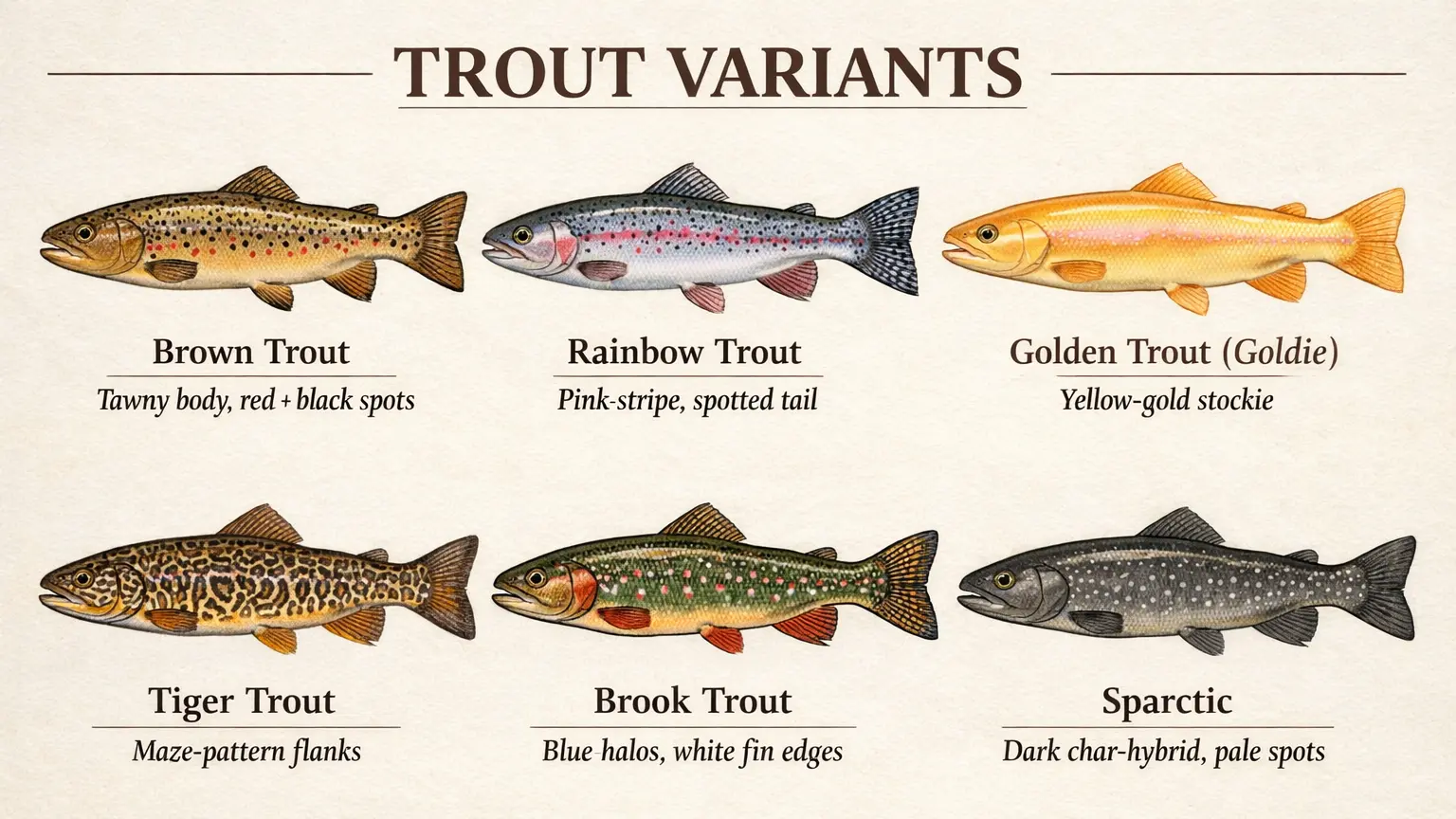
So they stock oddities. Blue trout that look like they have been dipped in steel. Golden trout the colour of butter. Tiger trout with flanks like marbled endpapers. Brook trout with their white-edged fins and jewelled spots. And occasionally something called a spartic, which looks like a char that cannot quite decide what it is, because that is more or less what it is.
These are not wild fish. They are not conservation stories. They are hatchery products, bred for sport and variety, stocked into enclosed waters where they will be caught and (usually) killed. That is worth saying plainly, because it puts them in the right category. But they are still trout — or trout-adjacent — and they are still interesting. Some of them fight differently. Some of them behave differently. And all of them, when you hold one in the net and see something you were not expecting, remind you that even a put-and-take lake can surprise you.
Rainbow trout overwhelmingly dominate European trout farming — roughly ninety-seven to ninety-eight per cent of EU trout production is rainbow. Everything else on this page is a niche addition, a novelty stocking, a way of making Tuesday at a commercial fishery slightly more interesting than the Tuesday before.
Blue Trout
A colour variant of rainbow trout. Not a separate species — a man-made strain selected for a cold, metallic blue-silver appearance.
The blue trout is the most common variant you will encounter on UK commercial stillwaters. It is, biologically, a rainbow trout. Same species — Oncorhynchus mykiss — but selected over generations for a steel-blue or cobalt-silver colouration that lacks the warm pinkish blush of a standard rainbow. In the water, they look like someone turned the colour temperature down.
They fight like rainbows. They feed like rainbows. They cruise the same patrol routes as rainbows. The tactical adjustment required is essentially zero — fish them on your normal rainbow programme: washing line, buzzers, blobs, boobies, whatever the day demands. The main practical difference is visibility. A bright blue fish in clear water can become more wary than a standard silver rainbow once it has been in residence for a few weeks and seen some pressure.
Most commercial trout fisheries in Wales, England, and Scotland stock blues alongside their regular rainbows. Venues like Tavistock, Hawkridge, Avon Trout Fishery, Chirk, Garnffrwd, Ledcrieff, and Swanswater all list blue trout in their stocking programmes. If you are fishing a well-run commercial stillwater in Britain, you will probably catch one sooner or later without trying.
Golden Trout / Goldies
Banana-yellow, butter-gold, unmistakable. Another hatchery rainbow variant, stocked for variety and the small thrill of catching something unusual.
In the context of European stocked fisheries, a golden trout — often called a goldie — is almost always a hatchery golden form of rainbow trout. It is not the wild Californian golden trout (Oncorhynchus aguabonita) of the High Sierra, though the name borrows some of that romance. What you are looking at is a selectively bred rainbow with reduced dark pigmentation and a bright yellow-gold body colour.
They are the easiest variant to identify. If it looks like someone painted a trout with a banana, it is a goldie. The colouration can range from pale creamy gold to vivid orange-gold, usually with faint or absent spotting compared to a standard rainbow.
Tactically, treat them as rainbows. They are rainbows. The standard stillwater playbook applies without modification. Tavistock, Hawkridge, Hobby Lake at Sportfish, Avon Trout Fishery, Chirk, Swanswater, and Wardend all stock golden trout as part of their regular rotation.
Tiger Trout
Brown trout crossed with brook trout. The most visually dramatic of the stocked hybrids — maze-patterned flanks, aggressive feeding, and a reputation for hitting pulled flies harder than anything else in the lake.
The tiger trout is the one that gets people excited, and with reason. It is a genuine intergeneric hybrid — Salmo trutta (brown trout) crossed with Salvelinus fontinalis (brook trout). The cross is typically produced artificially in the hatchery, and the resulting fish are usually sterile, which is one of the reasons fishery managers like them: all the aggression of a predatory salmonid with none of the breeding complications.
What you notice first is the pattern. Tigers have bold, dark vermiculations — worm-like maze markings — over the entire flank. No other stocked trout looks like that. The base colour is usually brownish or grey-brown, and the overall effect is more brown trout than rainbow, which makes sense given the parentage.
The behaviour is where it gets interesting for anglers. Tigers are widely reported as more aggressive than standard stock rainbows. They hit harder, they chase further, and they seem more willing to take a pulled fly or a small streamer. This makes sense if you think about the parentage — brown trout crossed with brook trout, both of which become increasingly piscivorous as they grow. A tiger trout stocked at a pound or two is already more predatory in temperament than a rainbow of the same size.
The practical adjustment is modest but real: if a venue stocks tigers and you want to target them specifically, give more time to streamers, mini lures, fry patterns, and pulled teams. Fish the margins, drop-offs, points, and anywhere near structure. Tigers are the variant most likely to reward a more assertive retrieve and a position-focused approach.
Tiger trout are the most widely stocked hybrid in UK stillwaters. You will find them at Tavistock, Hawkridge, Avon, Duncton Mill, Millan Waters, Salford, Maran Lakes, Chirk, Garnffrwd, Tan-y-Mynydd, Ledcrieff, Wormit, Swanswater, Ae Fishery, and many others.
Spartic / Spartic Char
Brook trout crossed with Arctic char. The rarest of the common oddities — a char hybrid that inherits the aggressive feeding of its brook trout parent and the deep-water instincts of its Arctic char parent.
A spartic is a hybrid of brook trout (Salvelinus fontinalis) and Arctic char (Salvelinus alpinus). Both parents are chars rather than true trout, so the spartic is properly a char hybrid, not a trout hybrid. It does not reproduce naturally, which is one of its attractions for fishery managers who want variety without breeding risk.
Identifying a spartic bankside is the hardest call on this page. It looks like a char — dark body, pale spots, often some white edging on the lower fins — but it is neither a clean brook trout nor a clean Arctic char. It has a halfway quality, a blurred look, as though two char species had been overlaid at slightly different transparency. If a venue stocks spartics and you catch something that looks char-like but does not quite match either parent species, you are probably holding one.
Spartics are much less commonly stocked than tigers or blues. The venues that do stock them tend to be the ones that take pride in offering the broadest possible species mix. Tavistock, Hawkridge, Hobby Lake, Millan Waters, Salford, Duncton Mill, Maran Lakes, Dare Valley, and Foxhill Fishery all list spartics in their stocking programmes.
Tactically, treat them as trout with a slight predatory bias — somewhere between a rainbow and a tiger in terms of aggression. Smaller mobile lures, nymphs, and brisk retrieves in cooler water. They are not common enough to build a separate method around, but they are common enough that you should know what you are looking at when one turns up in the net.
Brook Trout
Not a hybrid — a species in its own right, and arguably the most beautiful freshwater fish in Europe, despite being an American import.
The brook trout is Salvelinus fontinalis — a char, not a true trout, native to eastern North America and widely introduced to European waters. In the UK, it is mainly encountered in enclosed stillwaters that stock it directly, and it also serves as one of the parent species for tiger trout and spartics.
Brook trout are, even the hatchery ones, absurdly beautiful fish. Olive to brown dorsal surface with pale, worm-like vermiculations on the back (similar to tiger trout, but concentrated dorsally rather than across the whole flank). The flanks carry red spots with blue halos — the signature brook trout marking. The lower fins are orange with a distinctive white leading edge, sometimes followed by a black stripe. No other fish in a UK stillwater looks like that.
They are commonly described as aggressive feeders — willing to chase, willing to hit something moving, and less cautious than brown trout of equivalent size. In a stocked stillwater context, treat them as lively, mobile fish that will respond to nymphs, small lures, and active retrieves.
Brook trout are rarer than tigers or blues in UK stocking lists. Chirk, Ledcrieff, and Ae Fishery are the clearest current venue signals for deliberately stocked brook trout.
Triploid Brown Trout
Not a different species. Not even a different fish to look at. A management tool — brown trout made infertile by chromosome manipulation, stocked where breeding with wild populations must be prevented.
Triploidy is a chromosome treatment applied to brown trout eggs in the hatchery, producing fish with three sets of chromosomes instead of the normal two. The result is a functionally sterile brown trout — identical in appearance and behaviour to a normal brown, but unable to breed successfully. This matters in management terms because it allows fisheries to stock brown trout into waters with wild populations without risking genetic contamination of native stocks.
From an angling perspective, triploid browns are simply brown trout. They look like brown trout, they feed like brown trout, and they fight like brown trout. The triploidy is invisible to the angler. You would only know you had caught one because the fishery told you it stocks triploids rather than fertile browns.
UK and Irish fisheries guidance discusses triploid stocking explicitly in the context of supported and regulated fisheries. Welsh fishery material mentions triploid brown trout being stocked in managed waters. The Environment Agency in England uses the approach in its wild trout conservation strategy.
For Rise Daisy, triploid browns are classified as brown trout for prediction purposes. The scoring engine does not need a separate model — the fish behaves identically to a diploid brown trout in every way that matters for feeding, temperature preference, and condition prediction.
Bankside Identification: Quick Field Guide
Take one side-on photo in decent light before release. Flank pattern, fin edges, and overall colour will tell you what you have.
Normal silver fish with a pinkish lateral band and dark spots on the tail: standard rainbow trout. Cold metallic blue-silver without the warm blush: blue trout. Bright banana-yellow or butter-gold: golden trout. These three are all the same species at different colour settings.
Brown-grey body with bold, dark maze-like markings across the entire flank: tiger trout. This is the easiest hybrid to identify — no other stocked fish has that dramatic all-over vermiculation pattern.
White leading edge on the lower fins is the char diagnostic. If the fish has olive-brown colouring, worm-like back markings, red spots with blue halos, and orange fins with white edges: brook trout. If it looks broadly char-like but does not match either brook trout or Arctic char cleanly — dark body, pale spots, a halfway quality: probably a spartic.
The main identification traps: blue trout can look like unusually pale rainbows in poor light. Tiger trout and brook trout both show vermiculations, but the tiger pattern is bolder and covers the whole flank, while brook trout show it mainly on the dorsal surface with the red-blue-haloed spots on the sides. Golden trout are hard to mistake for anything except possibly an albino stockie. Spartics are the genuinely difficult call — unless the venue stocks them, most anglers would not identify one from a quick bankside glance.
How to Fish Them: The Honest Answer
Start with normal rainbow methods. Then make small adjustments based on what the fish are actually doing, not what the species label says they should do.
Here is the honest angling answer. If the fish were stocked recently, fish for them as stocked trout, full stop. If the venue is heavily pressured, fish location, depth, and mood first — the species label matters less than whether they are cruising high, sitting deep, or tucked into structure. If you specifically want the oddities, your best edge is usually where and how you fish, not some magic fly pattern.
Blue and golden trout: fish them as rainbows. Washing line, nymphs, boobies on the right line, blobs and attractors early in the day if it is that sort of fishery, and buzzers when they are feeding on naturals. That is the percentage play, and the colour variant does not change the equation.
Tiger trout, brook trout, and spartics: still largely rainbow methods, but with a slightly stronger case for pulled flies, mobile lures, and structure-focused fishing. Tigers are the variant most likely to reward an assertive retrieve. Give more attention to margins, drop-offs, points, wind lanes, reeds, sunken features, and any fry-rich water.
The clean practical adjustments are these. Start with your normal rainbow programme. Then bias toward structure for the hybrids — they tend to hold near features rather than open-water cruising. Pull a bit more often. And do not overthink colour strains: blue and golden fish are better understood as special rainbows than as fish demanding a new tactical doctrine.
For mixed fisheries where you do not know what you will hook next, depth, recent stocking, light, pressure, and available food matter more than the name on the fish. The venue guide summary works like this: most stocked variants can be targeted with standard stillwater rainbow tactics. Tiger trout, brook trout, and spartic-type fish may show a stronger response to mobile lures and structure-focused fishing, but in mixed fisheries, capture is still largely opportunistic.
Where to Find Them: UK Venue Guide
The strongest variant venues in Britain stock four or more types. Wales, the West Country, and a handful of Scottish fisheries lead the way.
The broadest mix of variants in England sits at Tavistock Trout Fishery in Devon, which stocks rainbow, brown, blue, golden, tiger, and spartic trout — possibly the most comprehensive stocking list of any single UK venue. Hawkridge Reservoir in Somerset matches it closely with spartic, rainbow, brown, tiger, golden, and blue. Hobby Lake at the Sportfish Game Fishing Centre near the Hampshire-Berkshire border stocks rainbow, blue, brown, golden, spartic, and tiger. Avon Trout Fishery in Hampshire runs daily stockings of rainbow and blue trout with regular additions of brown, golden, and tiger.
In Wales, the official Fishing in Wales listings make the picture clear. Chirk Trout Fishery in north-east Wales stocks rainbow, brown, brook, golden, blue, and tiger — one of the few UK venues where brook trout appear explicitly. Garnffrwd Fishery in Carmarthenshire has brown, rainbow, tiger, and blue. Tan-y-Mynydd in Denbighshire lists blue, brown, rainbow, and tiger. Dare Valley Country Park has been reported with blues, golden, tigers, spartic, and brown.
Scotland has strong options too. Ledcrieff Lochs in Perthshire lists rainbow, blue, brown, tiger, and brook trout. Swanswater Fishery near Stirling stocks rainbow, golden, brown, blue, and tiger daily. Ae Fishery in Dumfries and Galloway has rainbow, blue, brown, brook, and tiger. Wormit in Fife and Wardend in Aberdeenshire both list tigers and blues.
In the English Midlands and North, Salford Trout Lakes in the Cotswolds has brown, rainbow, spartic, blue, and tiger. Maran Lakes in North Yorkshire advertises rainbow, brown, blue, spartic, and tiger. Millan Waters in Kent and Duncton Mill in West Sussex both stock spartics alongside tigers, browns, and rainbows.
One practical caution: venues advertise their stocking mix honestly, but not every variant is topped up every week. For a special trip to chase a specific oddity — spartics especially — ring ahead on the morning of the trip. That is how commercial stillwater stocking works: the list is real, but the timing is variable.
How Rise Daisy Classifies Them
Core species get their own prediction models. Variants and hybrids inherit from their parent species — because the biology says they should.
Rise Daisy treats brown trout and rainbow trout as core species with full, independent scoring models. Each has its own thermal preferences, flow responses, clarity sensitivities, and seasonal patterns. These are the species that drive prediction accuracy on wild rivers and serious fisheries.
Stocked variants — blue trout, golden trout, tiger trout, spartic, brook trout, and triploid brown trout — inherit their parent species' prediction model. Blue and golden trout use the rainbow scoring engine. Tiger trout and brook trout use the brown trout engine as a base, with a slight bias toward structure and predatory feeding. Spartics use a char-influenced model. Triploid browns use the standard brown trout model without modification.
This is not laziness — it is biological accuracy. A blue trout is a rainbow trout. Its thermal envelope, its oxygen requirements, its feeding rhythm, and its response to barometric pressure are identical to any other Oncorhynchus mykiss. Giving it a separate scoring model would be false precision. The same logic applies to golden trout, and to triploid browns relative to fertile browns.
Where it matters — tiger trout, brook trout, spartics — the differences are real but small. More aggressive feeding, slightly stronger structure-orientation, possibly a wider thermal tolerance from the char parentage. These are modifiers on the base model, not separate engines. The prediction card for a venue that stocks tigers will note the variant mix and suggest the slight tactical adjustments that matter, but the core conditions score comes from the parent species model.