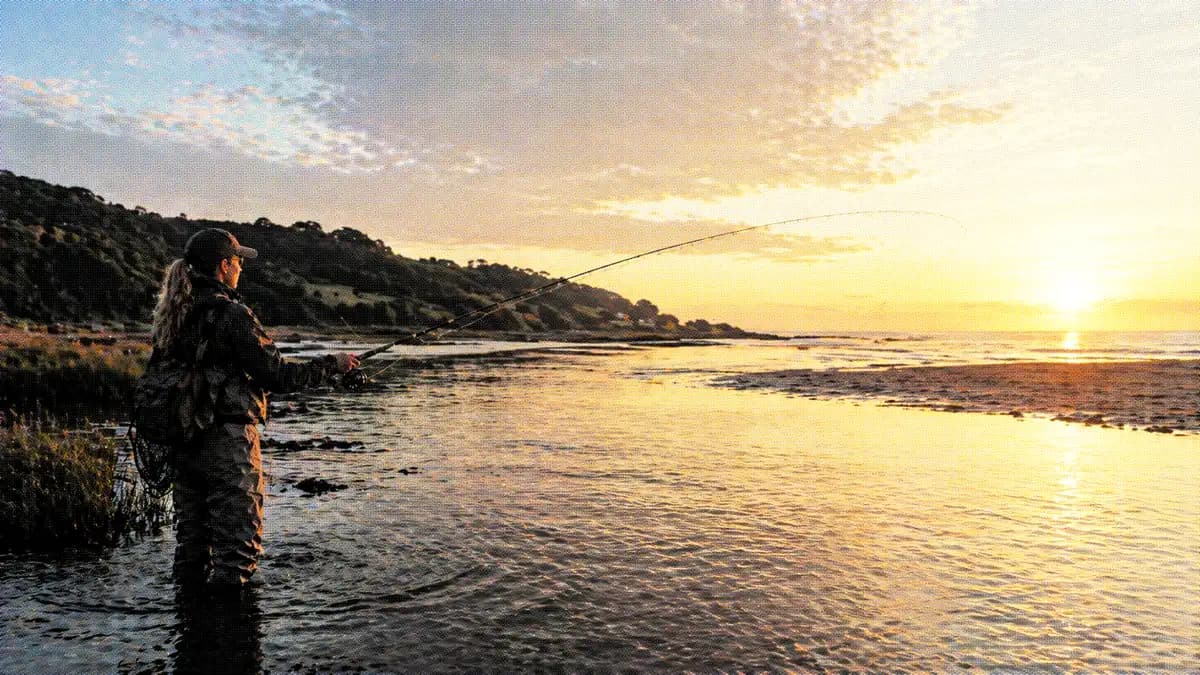
Bass is what trout fishers do when the trout season closes and the conscience starts to itch. The instincts transfer almost entirely — read the water, watch the tide, fish the seam — and the gear is one weight up and a bit more abrasion-resistant. Slack water is for sandwiches. The half-hour either side of high or low produces less than the rising ebb, and any time the tide is moving and the bait is being pushed somewhere predictable, you have a fair chance of intersecting a fish that wasn't expecting you and runs harder than you're ready for.
Eight-weight. Intermediate line. Weighted Clouser. The tide does the rest.
The Sideways Step
Sea bass fly fishing is what happens when a trout angler walks down to the estuary mouth one morning, watches a school of small fish crashed by something silver and angry, and decides that the eight-weight in the cupboard might earn its keep after all. The fly rod still works. The casting still works. Most of what you learned on the chalk stream still works, applied sideways. The difference is mostly that the river runs both ways, and the fly is nine inches long.
Bass are mobile coastal predators. They use tide and structure to make food easy: sandeels lifted from sand, prawns washed from weed, fry pinned against harbour walls, baitfish confused in surf, crabs dislodged from rock. They are not always chasing. Sometimes they ambush, sometimes they grub, sometimes they cruise the edges, and sometimes they smash bait on top. The pleasure of fishing for them is that none of this is academic. You can usually see what the bass are doing before you cast, if you watch long enough.
They are not bonefish. The comparison is not so much unflattering as misleading — bass are slower, heavier, and far less concerned with stealth. But they are also not pollack. They feed in measured bursts and then disappear. They are entirely capable of inspecting a fly and deciding against it for reasons known only to themselves. There's a useful sliding scale: if a trout would have refused the fly, a bass might still take it; if a bonefish would have refused the fly, a bass certainly will.
The Tide Question
"High tide is best" is the kind of advice that sounds true and often isn't. The right question is which tide stage makes this particular mark feed.
The single most useful thing to know about bass fly fishing is that the tide does the heavy lifting. Moving water concentrates food. Slack water — the half hour either side of high or low — is often the deadest part of the day. The bass are still there. They are simply not feeding in any way you can intercept with a fly.
Flooding tides push fish onto new ground. A creek floods inches of water across a mudflat that was bare an hour earlier, and the prawns and crabs and sand shrimps that were hiding underneath are suddenly available. Bass move up the creek with the rising water and feed as they go. This is the moment for shrimp flies, small Clousers, and a careful approach — you are wading in the same shallows the fish are working.
Ebb tides do the opposite. They flush food back into predictable lanes. A creek mouth on the dropping tide is a feeding lane. Everything that was up on the flat is now coming back down, in a current narrow enough to read with your eyes. Bass sit in the slack edge of the current and pick prey out of the flow. Cast across, mend the line, and let the fly swing into the seam.
Slack water is a chance to walk and look. Sometimes a bass will still take in dead water, especially around structure where bait is concentrated by lights or shadow. More often it's a chance to spot the structure for the next moving tide, eat a sandwich, and not work too hard. The advantage of fishing for a tide-led species is that the timing is honest — when the tide isn't moving, the fish aren't feeding, and there's nothing to be gained by working harder.
Estuaries and Tidal Rivers
Probably the most fly-friendly bass water you'll find — controlled casting, lighter tackle, and tide that runs to a schedule.
If you are coming to bass fly fishing from a freshwater background, the estuary is where the transition is most forgiving. The currents are readable. The wind is usually blocked by some bank or building. The fish are accessible without a long wade through breaking surf, and the wading itself is mostly safe if you respect the tide. Most of the great Welsh, Cornish, Irish, French Atlantic and Iberian bass beats are estuary-based, and not by accident.
Look for the same features you would on a small spate river, just translated to brackish water. Creek mouths, where small drains feed into bigger channels. Current seams, where the main flow meets slack water. Mud-to-sand transitions, where the substrate changes and the prey changes with it. Bridge shadows on bright days. Boat moorings, where small fish hide and bass come to find them. The flooding edge of a saltmarsh on a spring tide, where the prawns are. The same eye that reads a trout pool reads an estuary mouth — the variables are different but the question is the same: where would I sit if I were a fish that wanted food without working too hard?
The fly box for the estuary is small. A weighted Clouser for the channels, a small Deceiver or Surf Candy for clean water, a Shrimp/Prawn Fly for the weed edges, and a Gurgler for low light. A Mullet Fry Fly for autumn fry concentrations is a useful tenth pattern, but you can fish a productive estuary for a week with the first four. The discipline that pays is presentation, not pattern. Mend the line so the fly swings naturally through the seam. Don't always strip like mad. A fly drifting, pulsing, and then twitching often looks more edible than one fleeing at full panic.
The cardinal estuary mistake is fishing for casting comfort rather than feeding fish. The wide open run from the car park is easy to fish; it is also rarely where the bass are. The bass are at the awkward corner around the back, where the creek joins the main channel and the wading is slightly nervous and the casting angle is wrong. That's where they are. That's where you should be.
Surf Beaches
The "beach within the beach" — gutters, bars, and channels do the work; featureless surf rarely fishes for long.
A productive bass beach is almost never the bit that looks photogenic. The flat sand with the regular waves is the magazine shot, and the magazine shot rarely holds fish. What you want is structure: a gutter running parallel to the shore, a bar that breaks the wave so it forms again behind, a rip channel cutting outward through the breakers, a corner where rock meets sand. These are the places where bait gets disorientated and bass set ambushes.
The most useful skill on a surf beach is reading the water before you wade. Stand on the dunes for ten minutes with your back to the wind and watch where the waves break. The bar is where the wave first peaks. The gutter is the deeper water in front of it. The channel is the flat, calmer slot between bars, where most of the wave energy bypasses. Bass run gutters and channels. They lie in the slot just behind a bar. They almost never sit in featureless flat water.
Conditions for the surf beach are simpler than the textbook makes them. A slight to moderate fizz, enough to disorientate sandeels but not so much that casting becomes an act of violence. Lightly coloured water rather than gin clear or chocolate. A clean wind that doesn't blow your line into your face. Dawn or dusk for a confidence boost. Anything more than that is detail.
Don't wade past the first gutter without fishing it. This is the rule of bass beaches. Bass run within ten yards of the dry sand more often than you'd believe, especially on the flood, and the angler who wades straight out to the second bar to "reach the deep water" has just walked through the fish. The first cast goes parallel to the shore, in the wash. The second cast goes a little further out. Only when you've covered the close ground do you step in.
Rocky Marks and Kelp Edges
Bigger fish water, less forgiving. The rod is half the equation; the other half is whether you should be there at all.
Rocky marks hold bigger bass on average than estuaries. They also drown anglers, occasionally, and the difference between a productive mark and a coffin in waiting is often a single big swell. Take this seriously. The mark that fishes brilliantly in a northwesterly with a small spring may be impassable in a southwesterly with a big spring; the headland that's safe at low water is cut off at high; the kelp that gives bass somewhere to hunt is also the kelp that wraps around your ankles when the wave knocks you down.
That out of the way: the fishing on a good rock mark is some of the most exciting bass fly fishing there is. Look for current wrapping around a point, white water over shallow reef, the deep gully running parallel to the rock face, the kelp edge where weed gives way to sand. Bass hold in the slack behind boulders and ambush bait coming through. The fly fishes across or down the current, swings into the gully, and rises up the rock face on a tight line. A take in this kind of water arrives like a door slamming.
A heavier Clouser, a Half and Half for bigger profile, a sparse Flatwing for clear water — these earn their keep on the rocks more than anywhere else. The Crab Fly is the specialist call: bass rooting through pools and boulder fields will take a small crab pattern hopped slowly along the bottom, especially on Iberian rocky shores in summer. Don't dredge. A fly hopping too low snags every cast. A fly swimming a foot above the structure draws fish up.
The rule for rock fishing is to leave when you said you would, not when the fishing slows down. The decision to walk back is easier in daylight, on a falling tide, with a bass in the bag. It gets harder as the swell builds, the light fades, and the next gully looks a bit fishy. Make the decision when the sums still add up.
Harbours and Marinas
Urban, unromantic, productive. The bass in the harbour are the same fish that would earn rapturous prose if they lived on a tropical flat.
Harbours are bass headquarters. The tidal flow concentrates bait against walls and pontoons. The boat hulls and moorings provide structure. The lights at night attract fry. The fishing is accessible — there's usually somewhere to park, somewhere to get coffee, and somewhere flat to stand. The water quality is sometimes questionable. The fish do not seem to mind.
The technique in a harbour is patience as much as casting. Sit at the wall for ten minutes before you string up the rod. Watch where the small fish are getting hit. Watch the shadow lines around moored boats — bass sit in shadow looking out at the lit water. Watch the outflows, where the storm drains and harbour sluices empty into the dock; food is concentrated there and bass know the address. Then cast smaller flies than you'd expect: an EP Baitfish, a small Surf Candy, a Mullet Fry Fly matched to the local fry size, fished slowly along the wall face. Oversized patterns rarely work in close.
Night fishing in harbours is the most productive bass fly fishing many anglers ever do. A Black Night Baitfish or a sparse Flatwing fished slow under the lights, on a floating or intermediate line, to fish that are hunting visible bait. The Gurgler at first dark, before the lights come on, on calm water inside the harbour. A small surface fly fished with confidence in known water, on a known tide, with a known bait pattern. None of this is glamorous. All of it works. The harbour at midnight, with a 4lb bass nodding against the rod tip, is a place where the romance of the chalk stream looks slightly silly for a moment. Then it comes back.
The Fly Box
Match the prey, then the depth, then the colour. Most of the disagreement about bass flies is really an argument about prey.
A bass fly box is organised by what the fish are eating, not by aesthetics. The two questions before any cast are: what is the dominant prey here, and where in the water column are the bass taking it. Sandeels and small baitfish in the open are subsurface. Shrimp and crab on weed and rock are subsurface but lower. Surface activity from chasing baitfish is, obviously, on top. Get those two right and the precise pattern matters less than you'd think.
Sandeels: slim, pale, mobile. Surf Candy, Sandeel Streamer, DNA Sandeel, slim Clouser. Long bodies, sparse dressing, fast strips with hard pauses. The mistake is going too bulky. A real sandeel is a pencil with eyes.
Small baitfish and fry: profile matters more than length. Surf Candy, Lefty's Deceiver, EP Baitfish, Mullet Fry Fly, Crease Fly. Match the size of the local fry first. Most bass fail to take harbour fry imitations because the angler tied on a fly twice the size of the actual prey.
Shrimp and prawns: short pulls, twitches, slow drift. Shrimp/Prawn Fly, Sand Shrimp, sparse Gotcha-style patterns. Natural and not over-dressed. The presentation does the work: the fly arrives in the bass's world looking like a small thing trying not to be noticed, and the bass intercepts it.
Crabs: slow crawl, little hops, long pauses. Crab Fly, weighted, fished bottom-hugging without snagging. This is specialist water — Iberian rocky shores, kelp edges in early summer, rock pools at high water. It will not be your default fly. When it's the right fly, nothing else works as well.
Surface flies: noise and silhouette over imitation. Gurgler, Crease Fly, Bob's Banger, Floating Sandeel. Pop or skate, then leave it. The take comes on the pause, every time. The Gurgler at first dark on a calm estuary is one of the great pleasures of the bass year, and not because it catches the most fish — it doesn't — but because watching a bass commit to a surface fly in shallow water is a thing you remember.
Every pattern named here lives in the Rise Daisy fly box under the Sea Bass species filter, with hook sizes, retrieves, and the conditions each fly fishes best in. Use it as a checklist before a session, or as a way to find the gaps in your existing box.
The Five Retrieves
Stripping is not retrieving. The fly does most of its work between strips, and the take usually comes when nothing is happening.
Bass anglers who come from a trout background almost always retrieve too uniformly at first. The trout pull is steady and rhythmic; the bass pull is varied, pause-heavy, and often barely moving. There are roughly five retrieves you actually need, and once you know them you can stop fiddling with the fly.
Fleeing baitfish: fast strips with abrupt pauses. The fly looks like prey trying to get away and failing to keep its nerve. Surf Candy, Sandeel Streamer, slim Clouser. The take is usually on the first stop after a burst. If the line goes heavy mid-pause, that's a bass.
Wounded baitfish: strip-strip-pause, with the fly hanging or dropping in the column. Lefty's Deceiver and EP Baitfish were designed for this — they have profile and movement that comes alive on the pause. The drop is the trigger. Keep contact with the line on the drop or you'll miss takes.
Shrimp twitch: very short pulls of an inch or two, then drift, then another twitch. This is how a real shrimp moves on a flooding flat. The Sand Shrimp and small Shrimp/Prawn Fly need this retrieve specifically. Anything faster and bass refuse.
Swing: cast across the current and let the fly swim through the lane on a tight line, occasionally tweaking the line hand to give the fly life. This is the classic estuary retrieve and it kills on bass holding behind structure in moving water. Don't strip; let the current do it. The wet-fly trout angler already knows this retrieve.
Surface pause: pop, spit or skate the fly once or twice, then let it sit dead on the surface. Bass watch the disturbance, follow the fly, and take it during the moment of stillness. Stripping a surface fly continuously is the most common reason it gets refused.
The default sequence for a search cast is straightforward. Cast across or slightly uptide. Let the fly settle into the lane. Strip twice, pause, strip three times, pause longer, speed up near structure. Near your feet, keep fishing — bass follow into ankle-deep water more often than they should, and the angler who lifts off at fifteen feet has just declined the take.
Tackle: An Eight-Weight Outfit
A 9ft 8wt does almost everything. The rest is detail and personal preference.
The all-rounder is a 9-foot 8-weight rod, a saltwater-safe reel with a decent drag, and three lines: a floater, a slow intermediate, and a sink-tip. Add 12–20lb fluorocarbon leader in straight 6-to-8-foot lengths — no need for tapered leaders, the flies are heavy enough to turn over a level fluoro. With this, you can fish estuaries, surf beaches, harbours, rocky marks, and most boat work. A 7-weight is more pleasant on calm flats and warm summer days, but only if you commit to small flies.
The reel needs to handle salt and the occasional run. A bass at four or five pounds in a tide rip will pull harder than the same fish in still water; a bigger one — and they go to twelve pounds and beyond, though most fly anglers will spend a career hoping — will take backing. Buy something that can be rinsed and lubricated rather than something that promises a sealed lifetime warranty. Salt finds a way into everything eventually.
Lines do most of the depth work. The intermediate is the default — it sinks slowly, fishes the top three or four feet of water, and casts cleanly through wind. The floater handles surface flies, shallow flats, harbour lights and night fishing on calm water. The sink-tip or fast intermediate covers deeper channels, surf gutters, and rougher ground where the fly needs to get down quickly. Most bass anglers carry these three on spare spools and switch as the venue dictates. There are clear-tip integrated lines that simulate floater-with-intermediate-tip, and they cast beautifully, but the spare-spool approach is cheaper and easier to think about.
Hooks matter more than people admit. Bass mouths are not soft, but they are bony in places and rubbery in others, and a hook bent open by a hard fish is a hook lost. Use saltwater-grade hooks throughout, in the size range your fly chart tells you, and pinch the barbs. Pinched barbs make for cleaner releases and faster hookups when the fish takes deep. A barbed hook in a bass jaw, in poor light, on a flooding tide, with a wave coming in, is not a problem you want to be solving manually.
Rinse everything. Reel, rod, line, fly box. Once a session, with fresh water, before it dries. Salt does its damage in the days after the trip, not during it.
Reading Conditions
Wind, water clarity, surf, temperature. Get any one of them wrong and the fishing is hard work; get them all roughly right and the bass become almost cooperative.
A light offshore wind is the most pleasant condition to bass fish in: clean water, manageable casting, often a sight-fishing chance. A moderate onshore wind makes the surf and stirs food, which is good for bass fishing and difficult for casting. A strong onshore wind closes a lot of marks down. A crosswind is fine if your backcast is on the safe side. The wind is also the variable you can't change, so plan around it rather than fighting it.
Clarity matters more than most freshwater anglers expect. Gin-clear water on a bright day asks for sparse, natural, smaller flies and dawn or dusk timing — bass have excellent eyesight and the time to inspect. Lightly coloured water is often the best fishing of the year: visible flies, slightly larger profiles, Clousers. Truly dirty water needs contrast, vibration, and surface noise — Bob's Banger and a Black Night Baitfish — or a venue change. Heavily weeded water is mostly unfishable on the fly; you spend more time clearing the hook than presenting it.
Surf is the variable that gets people in trouble. A flat sea is fine; a slight fizz is excellent; moderate surf with readable gutters is the classic; heavy surf is dangerous and not productive enough to justify the risk. The lazy advice is "bass like big surf" and it is wrong. Bass like bait disturbed by surf, in conditions that allow them to feed safely. So do you.
Temperature is a band, not a threshold. Below about 9°C, in northern waters, many adult bass have moved offshore and the fishing is patchy. Between 9 and 12°C — typical of British and Irish springs and late autumns — fishing is possible but inconsistent. From 12 to 18°C, which covers most of the British and Irish summer and most of the Iberian year, bass feed reliably. Above 18°C and into the low twenties, dawn, dusk, night and oxygen become more important than they were earlier in the season. In shallow enclosed water above 22°C the fish are mostly elsewhere — looking for cooler tide pushes, deeper lies, or simply away from the heat. So, often, are you.
The Rules Question
Bass conservation rules change. Read the current ones before you fish, especially in spring.
Bass are not in trouble in the way some salmon stocks are, but they are pressured. Recreational rules in the UK and EU have shifted regularly through the last decade and the trend is towards conservation: catch-and-release windows in early spring, daily bag limits the rest of the year, minimum size for retained fish, and various local restrictions on netting, gear, and protected nursery areas. As of 2026, recreational rules in the relevant ICES divisions include a catch-and-release-only period from 1 February to 31 March and a 42cm minimum conservation reference size for retained fish, with daily limits outside the closed period. Devolved and national details vary, and the rules can change inside a season — so check before you fish, not after.
The honest position is that most fly anglers should treat bass as catch-and-release regardless of legal allowances. Voluntary release is widespread in the bass fly community, and it makes sense: bass grow slowly, mature late, and don't recover quickly from heavy harvest. Pinch the barbs, keep the fish in the water for unhooking and photography, support the body when lifting, and release into clean current. The fish you put back today is the four-pounder you find again next October.
Before any session, check the current rule for the country and water you're fishing. The MMO website covers UK rules; local angling federations and tackle shops will know about regional restrictions and protected areas. In Spain, autonomous communities set their own marine recreational rules and the licences vary by region. Five minutes of homework saves a fine, and saves a fish.
A First Bass Session
Estuary mouth, dawn, intermediate line, Clouser on the front. Most of bass fly fishing is showing up in the right place at the right tide.
For a first serious session, pick an estuary mouth with a defined creek or channel, a small or moderate spring tide, and an early-morning high. Arrive an hour before the tide turns and walk the water. Note where the creek narrows, where the current edge will form on the flood, where the wading is safe. Watch for bait — sand smelt, juvenile mullet, sandeels nervous in the shallows, gulls working the surface. Tie on an intermediate line and a small weighted Clouser. Pinch the barb.
First hour of flood: cast across the channel, mend the line so the fly settles, and let it swing through the seam. Strip in short pulls, then pause; strip again; long pause. Cover the seam from upstream to down before stepping. Twenty feet of line in the water, not eighty. The fish are closer than you think.
If a Gurgler will fish — calm water, low light, fish showing on top — change to it. If the channel is dead, walk to the next feature: a corner, a drain mouth, a structure edge. Bass move with the tide, and an unfished mark on the right tide is more useful than a familiar mark on the wrong one. Towards the top of the flood, ease back, find a wall or pontoon to lean against, and watch slack water for ten minutes before the ebb starts. Bass often resume feeding twenty minutes after slack, when the new current re-establishes the lanes.
Fish until the tide is past its useful working stage, or until the wind makes the casting unpleasant, or until you've caught one. One bass on a fly rod, in moving tide, fought from a cold morning estuary, is enough to recalibrate the whole project. The freshwater rod still works. The casting still works. The trick was always going to the right water on the right tide and casting where the bait was. Trout fishing taught you most of it. The estuary teaches you the rest.