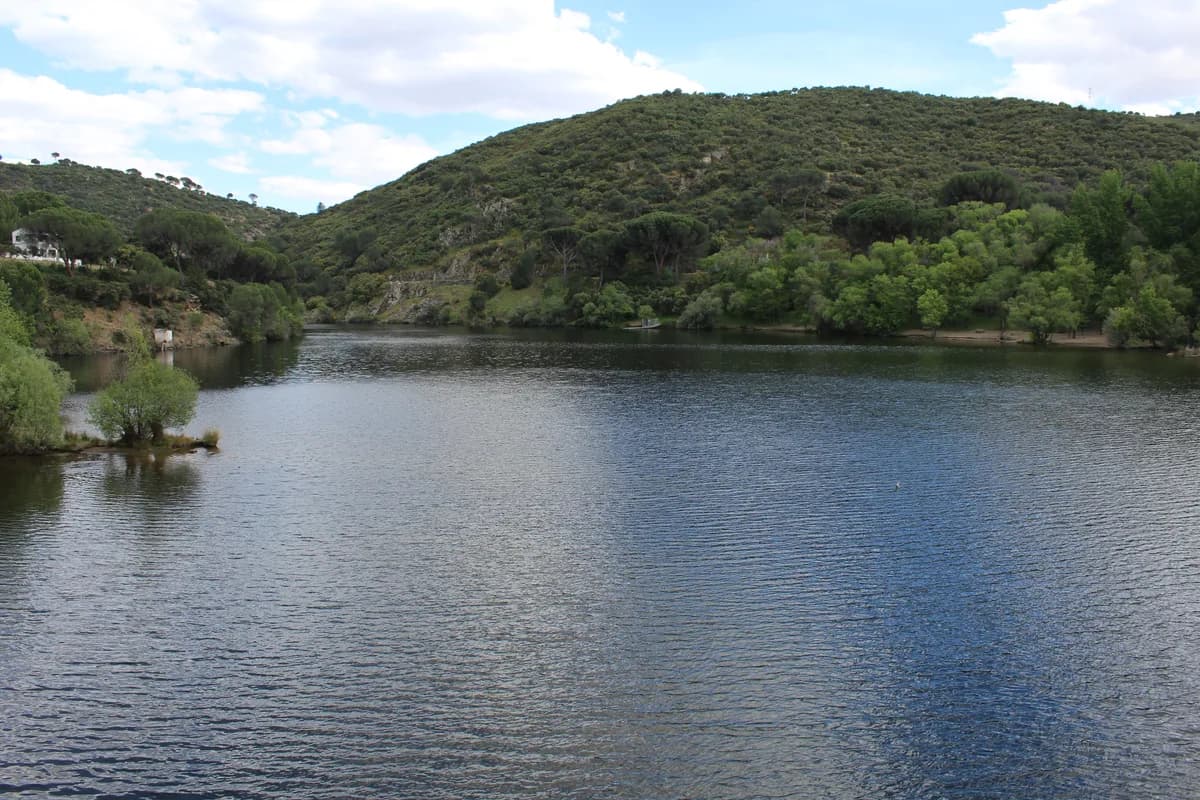


Reservoir on the lower Río Alberche, downstream of San Juan, 65–90 minutes west of Madrid. A genuine multi-species water listed with barbel, boga, carp, pike, black bass, and zander. For the fly angler the headline is black bass: the pre-spawn window (roughly April to early June) is when the bass push aggressive and visible in the warming margins. Through summer, dawn and dusk poppers and gurglers over rocky shorelines are the most reliable approach. Carp and barbel reward sight-fishing in the upper arms; pike take big streamers along the deeper edges in the cooler months.
Surface temperature is high enough to cause stress even with thermal stratification. The oxythermal squeeze narrows the comfort band — the thermocline may have warmer water than ideal and the deep water may be low in oxygen. Fish only during the coolest windows (first light to mid-morning, late evening). When you do catch, keep the fish in the water, use barbless hooks, and release without lifting. Playing time must be minimal. If fish are struggling to recover after release, stop fishing.
- DepthDo not target trout — the comfort band has effectively collapsed. Even deep-holding fish are thermally stressed.
- TimingDo not fish for trout until temperatures drop. Welfare risk is unacceptably high.
Not the day for it
Good wave on — drift country. Take your time — read the water before you cast.
Conditions on the water
Some readings unavailable — check directly before fishing.
The brief
The plan
Water temperature 31.3°C exceeds the Pike welfare threshold (21°C). Do not fish — post-release mortality is unacceptably high.
If the main plan is not working, switch to a smaller, more imitative pattern fished slower and deeper. A change of drift angle can also make a difference.
Keep an eye on changing conditions — wind shifts and cloud breaks can trigger short feeding spells.
Good ripple suits both bank and boat. Bank: work inflows, dam walls, and points. Boat: broadside drift covering wind lanes.
What's on, when
Numbers are intensity 0 (none) to 3 (peak) — a guide, not a guarantee.
Top pattern + the box
Why today scores what it does
- Wind conditions (ripple) closely match what this water fishes best in.
- High temperatures may push fish deeper and reduce surface activity.
Who this water suits
Embalse de Picadas, on the water
Field guide · contributor-editedWhat this water is
Reservoir on the lower Río Alberche, downstream of San Juan, 65–90 minutes west of Madrid. A genuine multi-species water listed with barbel, boga, carp, pike, black bass, and zander. For the fly angler the headline is black bass: the pre-spawn window (roughly April to early June) is when the bass push aggressive and visible in the warming margins. Through summer, dawn and dusk poppers and gurglers over rocky shorelines are the most reliable approach. Carp and barbel reward sight-fishing in the upper arms; pike take big streamers along the deeper edges in the cooler months.
- Reservoir
- Granite
How to get to the water
Good to know
- Comunidad de Madrid licence required
- Check current bank access points, no-fishing buffer zones, and any seasonal closures for the spawning period.
Embalse de Picadas
No photos yet for this water.
Reservoir on the lower Río Alberche, downstream of San Juan, 65–90 minutes west of Madrid.
Surface temperature is high enough to cause stress even with thermal stratification. The oxythermal squeeze narrows the comfort band — the thermocline may have warmer water than ideal and the deep water may be low in oxygen. Fish only during the coolest windows (first light to mid-morning, late evening). When you do catch, keep the fish in the water, use barbless hooks, and release without lifting. Playing time must be minimal. If fish are struggling to recover after release, stop fishing.
- DepthDo not target trout — the comfort band has effectively collapsed. Even deep-holding fish are thermally stressed.
- TimingDo not fish for trout until temperatures drop. Welfare risk is unacceptably high.
Not the day for it
Good wave on — drift country. Take your time — read the water before you cast.
Some readings unavailable — check directly before fishing.
A reasonable day here, though temperature isn't quite in the sweet spot.
Water temperature 31.3°C exceeds the Pike welfare threshold (21°C). Do not fish — post-release mortality is unacceptably high.
If the main plan is not working, switch to a smaller, more imitative pattern fished slower and deeper. A change of drift angle can also make a difference.
Keep an eye on changing conditions — wind shifts and cloud breaks can trigger short feeding spells.
Good ripple suits both bank and boat. Bank: work inflows, dam walls, and points. Boat: broadside drift covering wind lanes.
- Wind conditions (ripple) closely match what this water fishes best in.
- High temperatures may push fish deeper and reduce surface activity.
Numbers are intensity 0 (none) to 3 (peak) — a guide, not a guarantee.
- Comunidad de Madrid licence required
- Check current bank access points, no-fishing buffer zones, and any seasonal closures for the spawning period.
Reservoir on the lower Río Alberche, downstream of San Juan, 65–90 minutes west of Madrid. A genuine multi-species water listed with barbel, boga, carp, pike, black bass, and zander. For the fly angler the headline is black bass: the pre-spawn window (roughly April to early June) is when the bass push aggressive and visible in the warming margins. Through summer, dawn and dusk poppers and gurglers over rocky shorelines are the most reliable approach. Carp and barbel reward sight-fishing in the upper arms; pike take big streamers along the deeper edges in the cooler months.
- Reservoir
- Granite
Reservoir on the lower Río Alberche, downstream of San Juan, 65–90 minutes west of Madrid. A genuine multi-species water listed with barbel, boga, carp, pike, black bass, and zander. For the fly angler the headline is black bass: the pre-spawn window (roughly April to early June) is when the bass push aggressive and visible in the warming margins. Through summer, dawn and dusk poppers and gurglers over rocky shorelines are the most reliable approach. Carp and barbel reward sight-fishing in the upper arms; pike take big streamers along the deeper edges in the cooler months.