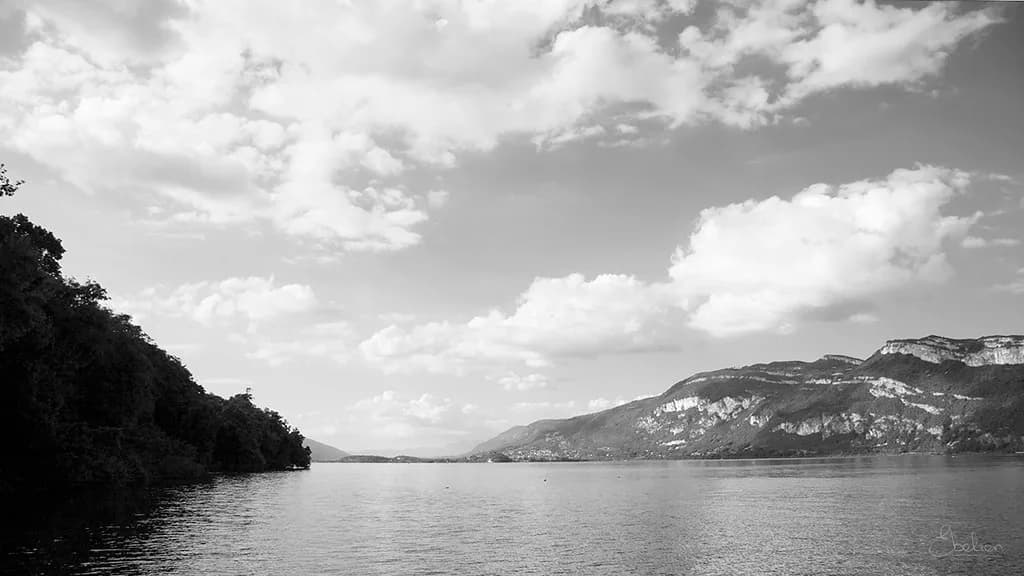

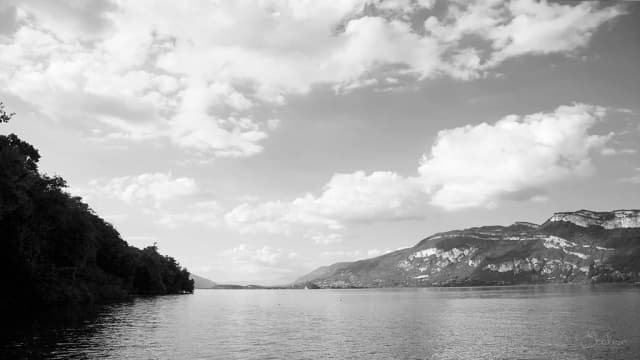
The Bourget is the largest natural lake in France and quite possibly the coldest at depth, which is why the Arctic char have held on here through every warming summer the Alps have thrown at them. It is a long, deep limestone trench — the sort of water that looks indifferent to you from the shore because it more or less is. Most of the char fishing happens vertically from a boat at thirty to fifty metres with weighted nymphs, which is how the locals have always done it and how the fish have always been caught. There are trout along the quieter edges in April and May if you can find them, and the féra run through the mid-depths in numbers that would surprise anyone who only knows the lake from the motorway. It is not quick water, and it is not water that rewards impatience, but it is good water and it deserves the time.
- Public aappma day ticket
Good drifting conditions on Lac du Bourget
Glassy and bright — hard work without a breeze. Hard work without breeze. Look for the dimples.
No strong hatch signals at the moment — general searching tactics should work best. Calm conditions may limit drift fishing — consider buzzers or dry fly if fish are rising.
Conditions on the water
Some readings unavailable — check directly before fishing.
The brief
The plan
With limited drift, anchor or fish static from sheltered positions. Work a bushy searching pattern on the bob and drop a contrasting nymph on the point. In the calm, a single dry fly or a slowly-fished nymph tends to out-fish an active retrieve.
If the main plan is not working, switch to a smaller, more imitative pattern fished slower and deeper. A change of drift angle can also make a difference.
Keep an eye on changing conditions — wind shifts and cloud breaks can trigger short feeding spells.
Flat calm suits bank fishing near features — points, weed beds, and inflows where fish patrol.
What's on, when
Numbers are intensity 0 (none) to 3 (peak) — a guide, not a guarantee.
Top pattern + the box
Why today scores what it does
- late spring conditions with mixed skies and calm wind.
Precipitation
Who this water suits
Lac du Bourget, on the water
Field guide · contributor-editedWhat this water is
The Bourget is the largest natural lake in France and quite possibly the coldest at depth, which is why the Arctic char have held on here through every warming summer the Alps have thrown at them. It is a long, deep limestone trench — the sort of water that looks indifferent to you from the shore because it more or less is. Most of the char fishing happens vertically from a boat at thirty to fifty metres with weighted nymphs, which is how the locals have always done it and how the fish have always been caught. There are trout along the quieter edges in April and May if you can find them, and the féra run through the mid-depths in numbers that would surprise anyone who only knows the lake from the motorway. It is not quick water, and it is not water that rewards impatience, but it is good water and it deserves the time.
- Lake
- Limestone
How to get to the water
Where the rules change
- TroutLast Saturday of January → End of December
- Charvaries_by_lake → varies_by_lake
Licences, sorteo, the rules
- AAPPMA Lac du Bourget + boat fishing supplement
- Depth restrictions apply to certain char techniques
- Check Savoie prefectoral order for current rules.
Lac du Bourget
The Bourget is the largest natural lake in France and quite possibly the coldest at depth, which is why the Arctic char have held on here through every warming summer the Alps have thrown at them.
Good drifting conditions on Lac du Bourget
Glassy and bright — hard work without a breeze. Hard work without breeze. Look for the dimples.
No strong hatch signals at the moment — general searching tactics should work best. Calm conditions may limit drift fishing — consider buzzers or dry fly if fish are rising.
Some readings unavailable — check directly before fishing.
A reasonable day here, though temperature isn't quite in the sweet spot.
With limited drift, anchor or fish static from sheltered positions. Work a bushy searching pattern on the bob and drop a contrasting nymph on the point. In the calm, a single dry fly or a slowly-fished nymph tends to out-fish an active retrieve.
If the main plan is not working, switch to a smaller, more imitative pattern fished slower and deeper. A change of drift angle can also make a difference.
Keep an eye on changing conditions — wind shifts and cloud breaks can trigger short feeding spells.
Flat calm suits bank fishing near features — points, weed beds, and inflows where fish patrol.
- late spring conditions with mixed skies and calm wind.
Numbers are intensity 0 (none) to 3 (peak) — a guide, not a guarantee.
Terrain map
- AAPPMA Lac du Bourget + boat fishing supplement
- Depth restrictions apply to certain char techniques
- Check Savoie prefectoral order for current rules.
The Bourget is the largest natural lake in France and quite possibly the coldest at depth, which is why the Arctic char have held on here through every warming summer the Alps have thrown at them. It is a long, deep limestone trench — the sort of water that looks indifferent to you from the shore because it more or less is. Most of the char fishing happens vertically from a boat at thirty to fifty metres with weighted nymphs, which is how the locals have always done it and how the fish have always been caught. There are trout along the quieter edges in April and May if you can find them, and the féra run through the mid-depths in numbers that would surprise anyone who only knows the lake from the motorway. It is not quick water, and it is not water that rewards impatience, but it is good water and it deserves the time.
- Lake
- Limestone
- TroutLast Saturday of January → End of December
- Charvaries_by_lake → varies_by_lake
The Bourget is the largest natural lake in France and quite possibly the coldest at depth, which is why the Arctic char have held on here through every warming summer the Alps have thrown at them. It is a long, deep limestone trench — the sort of water that looks indifferent to you from the shore because it more or less is. Most of the char fishing happens vertically from a boat at thirty to fifty metres with weighted nymphs, which is how the locals have always done it and how the fish have always been caught. There are trout along the quieter edges in April and May if you can find them, and the féra run through the mid-depths in numbers that would surprise anyone who only knows the lake from the motorway. It is not quick water, and it is not water that rewards impatience, but it is good water and it deserves the time.